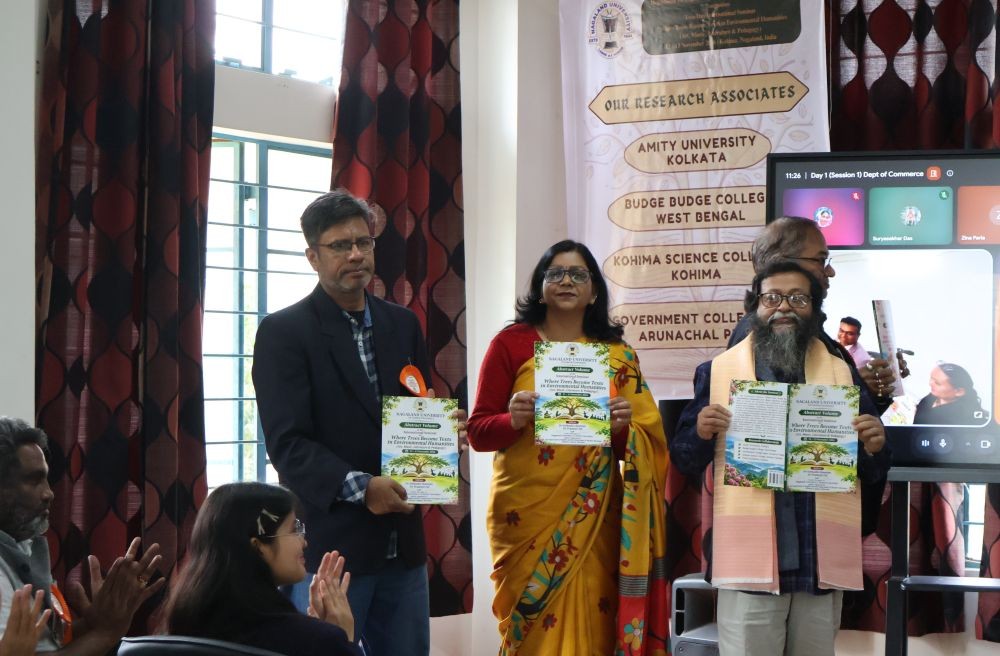
Organisers and speakers unveil the abstract volume at the inaugural session of Nagaland University’s international seminar on environmental humanities at the Kohima Campus.
KOHIMA, NOVEMBER 13 (MExN): Nagaland University’s Kohima Campus hosted a two-day international seminar on environmental humanities, bringing together 20 scholars from India and abroad to examine the relationship between literature, art, music, education, indigenous knowledge and the natural environment.
The seminar, titled “Where Trees Become Texts in Environmental Humanities: Art, Music, Literature & Pedagogy,” is being held on November 12 and 13 in hybrid mode at the Conference Hall of the Department of Commerce, Meriema. It was jointly organised by the university’s Department of English and Department of Teacher Education.
Nagaland University Vice-Chancellor Prof Jagadish Kumar Patnaik, who attended virtually, delivered the inaugural address, highlighting the role of universities in addressing environmental concerns through interdisciplinary research. He said environmental challenges needed to be examined beyond scientific and technological perspectives, as they also raised ethical, cultural and educational questions. He also pointed to the relevance of Northeast India, with its rich biodiversity and indigenous ecological traditions, as a setting for discussions on environmental humanities.
Prof Lungsang Zeliang, Dean of the School of Humanities and Education, spoke on the role of humanities and education in developing environmental consciousness. He highlighted the connections between the natural world, cultural memory, indigenous identity and literary imagination, while calling for educational approaches that promote ecological awareness and sustainable living.
Dr Subhashis Banerjee, Assistant Professor in the Department of English and seminar convener, delivered the welcome address and concept note, introducing themes including plant agency, phytohumanities, ecological aesthetics and more-than-human perspectives. He drew attention to indigenous ecological knowledge systems in Northeast India, where forests, rivers, mountains and plant life are closely linked to oral traditions and community identities.
The inaugural programme also featured a felicitation ceremony and the release of the seminar's abstract volume, edited by Dr Banerjee and Dr Prasenjit Pal, Assistant Professor in the Department of Teacher Education and co-convener.
The first day's plenary sessions featured scholars from India, Europe, North America and Asia. Prof Syamal Chakrabarti of the University of Calcutta delivered the principal plenary lecture.
Other speakers included Prof Nigamananda Das of Nagaland University; Prof Angshuman Kar of the University of Burdwan; Dr Teresa Botelho of NOVA University of Lisbon, Portugal; Prof Himadri Lahiri of Netaji Subhas Open University; Dr Aniket De of the University of California, San Diego; Dr Nikoleta Zampaki of Poland; Dr Mai Thi Khanh Van of Hue University, Vietnam; and Prof Niladri Sekhar Dash of the Indian Statistical Institute, Kolkata, among others.
The seminar also features Prof Pawel Piszczatowski of the University of Warsaw, Poland; Dr Francis Joy of the University of Lapland Arctic Centre, Finland; Dr Keitaro Morita of Rikkyo University, Japan; and Prof Somdev Banik of Tripura University.
The event is being organised in collaboration with Amity University, Kolkata; Budge Budge College, West Bengal; Government College Seppa, Arunachal Pradesh; Kohima Science College, Nagaland; and PURE Foundation, Kolkata.
The first day's deliberations explored ecological perspectives in literature, art, music and pedagogy, including the relevance of indigenous knowledge and contemporary environmental philosophy.