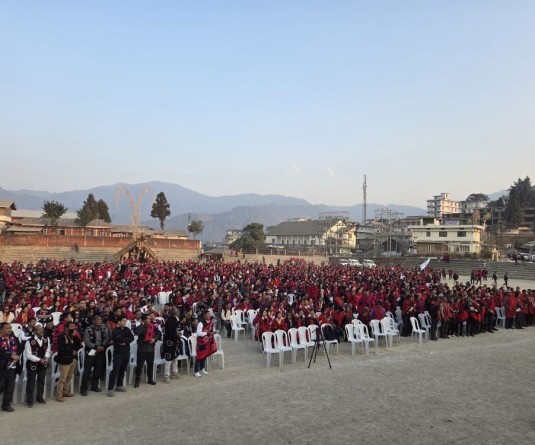
Dr. G. Bupesh (Seated), Assistant Professor, Department of Forestry, Nagaland University, with his research team. (Photo Courtesy: NU)
.jpg)
DIMAPUR, APRIL 13 (MExN): A multi-institute research team led by Nagaland University has identified anti-cancer potential in a traditional five-plant herbal formulation used by the Konyak tribe, in what researchers describe as the first scientific analysis of the specific remedy using advanced computational methods.
A press release from NU informed that the study was published in the peer-reviewed Microchemical Journal, a journal specialising in analytical methods for detecting and measuring chemical substances at micro and trace levels. The study was conducted by researchers from Nagaland University, Berhampur University in Odisha, and Saveetha Medical College in Tamil Nadu. The cross-state collaboration used gas chromatography-mass spectrometry (GC-MS) analysis alongside molecular simulation techniques to examine the formulation's bioactive compounds.
The central finding concerns VEGFR2, a protein that regulates the formation of blood vessels that supply tumours. Without this blood supply, tumours cannot sustain growth, a process known as angiogenesis. The team found that compounds in the Konyak formulation can effectively target and inhibit VEGFR2, making them potential anti-angiogenic agents. The compounds also demonstrated selective targeting of VEGFR2 over structurally similar proteins, which researchers said could help reduce side effects in future therapeutic applications — a limitation associated with several existing cancer drugs.
.webp)
"This is the first time a specific five-plant formulation used by the Konyak tribal healers has been scientifically analysed and validated using advanced computational methods," said Dr. G. Bupesh, Assistant Professor (Natural Products and Tribal Health Research), Department of Forestry, Nagaland University. "Using advanced techniques such as GC-MS analysis and molecular simulations, we identified compounds with strong anti-cancer potential, showing performance comparable to existing drugs while indicating lower toxicity."
The researchers noted that while traditional herbal systems are widely practised across indigenous communities in the region, there has been limited scientific effort to understand the mechanisms through which such remedies produce their therapeutic effects. The study was framed as an attempt to address that gap — combining indigenous knowledge with modern analytical and computational tools to validate what Konyak healers have long practised.
The identified compounds demonstrated stable molecular interactions and favourable safety profiles in the simulations. Most also showed low toxicity and acceptable pharmacokinetic properties, that is, how the compounds are absorbed, distributed, and eliminated in the body, making them candidates for further drug development. The researchers specifically pointed to colon cancer as a treatment context warranting follow-up clinical investigation.
Nagaland University Vice Chancellor Prof. Jagadish K. Patnaik said the findings reflected the institution's research orientation toward local knowledge systems. "By integrating indigenous knowledge with advanced molecular simulations, the study identifies promising compounds that match the efficacy of existing drugs while indicating lower toxicity. This achievement reflects the university's dedication to innovative, impactful research rooted in local wisdom and global scientific advancement," he said.
The paper was co-authored by Longnyu M. Konyak, Giridharan Bupesh, Parthasarathy Sudharsan, Nokenketla Jamir, and Sidhartha Saikia from the Department of Forestry, Nagaland University, along with collaborators from Berhampur University and Saveetha Medical College. The findings, researchers noted, also carry implications for cultural preservation — offering scientific documentation of a medicinal tradition that has until now existed largely outside the formal record.
The researchers cautioned that the current results are based on computational analysis and that laboratory and clinical studies remain necessary before any therapeutic application can be considered.