NSLSA officials pose for a photo during the state-level community mediation training for community mediators held at the DPDB Conference Hall in Kohima on August 13.
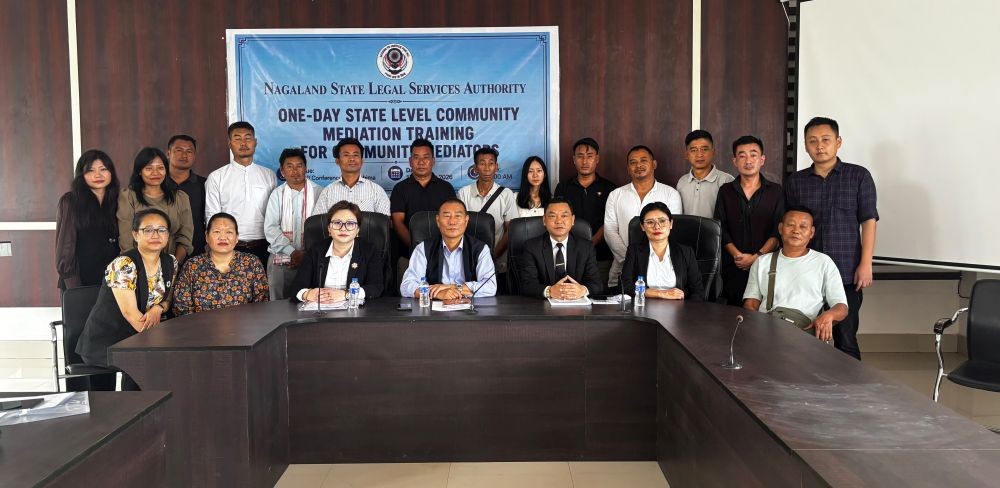
Kohima, August 13 (MExN): The Nagaland State Legal Services Authority (NSLSA) on Thursday organized a one-day State-Level Community Mediation Training for community mediators at the DPDB Conference Hall here to strengthen alternative dispute resolution mechanisms at the grassroots level.
Delivering the keynote address, NSLSA Member Secretary Neiko Akami (NJS) emphasized the vital role of Legal Services Authorities in ensuring equality and universal access to justice. He noted that socio-economic disparities frequently drive disputes, making legal literacy and accessible legal assistance essential for vulnerable communities.
Akami informed that front offices manned by panel lawyers and Para-Legal Volunteers (PLVs) are currently operational across all 11 districts to extend free legal aid, assist with document preparation, and help eligible citizens exercise their constitutional rights.
Highlighting the growing threat of drug-related offenses in the state, Akami revealed that over 700 cases under the Narcotic Drugs and Psychotropic Substances (NDPS) Act have been registered in Nagaland over the last three years. He cited official data as of July 31, noting that 488 individuals—comprising 474 men and 14 women—currently stand accused in these cases.
Detailing the burden on the state's formal justice delivery system, Akami stated that 543 new cases were instituted this year while 525 were disposed of, leaving 4,635 cases pending before judicial courts.
He pointed to Lok Adalats as a proven alternative dispute resolution route, noting that more than 600 pending cases have been amicably settled through Lok Adalats in the current year alone.
Emphasizing the value of trained community mediators, Akami observed that petty disputes are routinely brought before village and community elders first. While serious matters requiring formal trial must proceed through the courts, community mediation offers a faster, cost-effective, and less adversarial route to resolution.
He also drew attention to victim compensation schemes and NALSA’s framework providing legal assistance and financial relief to victims of human-wildlife conflicts, urging local leaders to report eligible cases to appropriate authorities.
The training included two technical sessions: Trained Mediator and Advocate Medohonu Kharutso led a module on "Understanding Community Mediation," detailing conflict taxonomy, community-level dispute dynamics, and standard mediation procedures.
Trained Mediator and Kohima DLSA Panel Lawyer Sunjib Rana conducted a session titled "Effective Community Mediation: Skills, Ethics, Documentation and Referrals," focusing on active communication, cultural sensitivity, ethical boundaries, referral protocol, and drafting legally sound settlement agreements.
Fifteen community leaders representing Kohima, Dimapur, Phek, Wokha, and Mokokchung districts completed the program and were awarded certificates of completion.