Moa Jamir
Dimapur | January 10
Prolonged unemployment, limited work experience, and largely individualised job-search efforts emerge as some of the key features of Nagaland’s labour market, according to recent official survey data.
Data from the ‘Survey Report on Employment, Unemployment, Skill and Migration in Nagaland 2025’ by the State’s Directorate of Economics and Statistics (DES) also reveal a labour market where job seekers rely heavily on personal effort and often lack both prior experience and formal skills.
Job search largely an individual effort
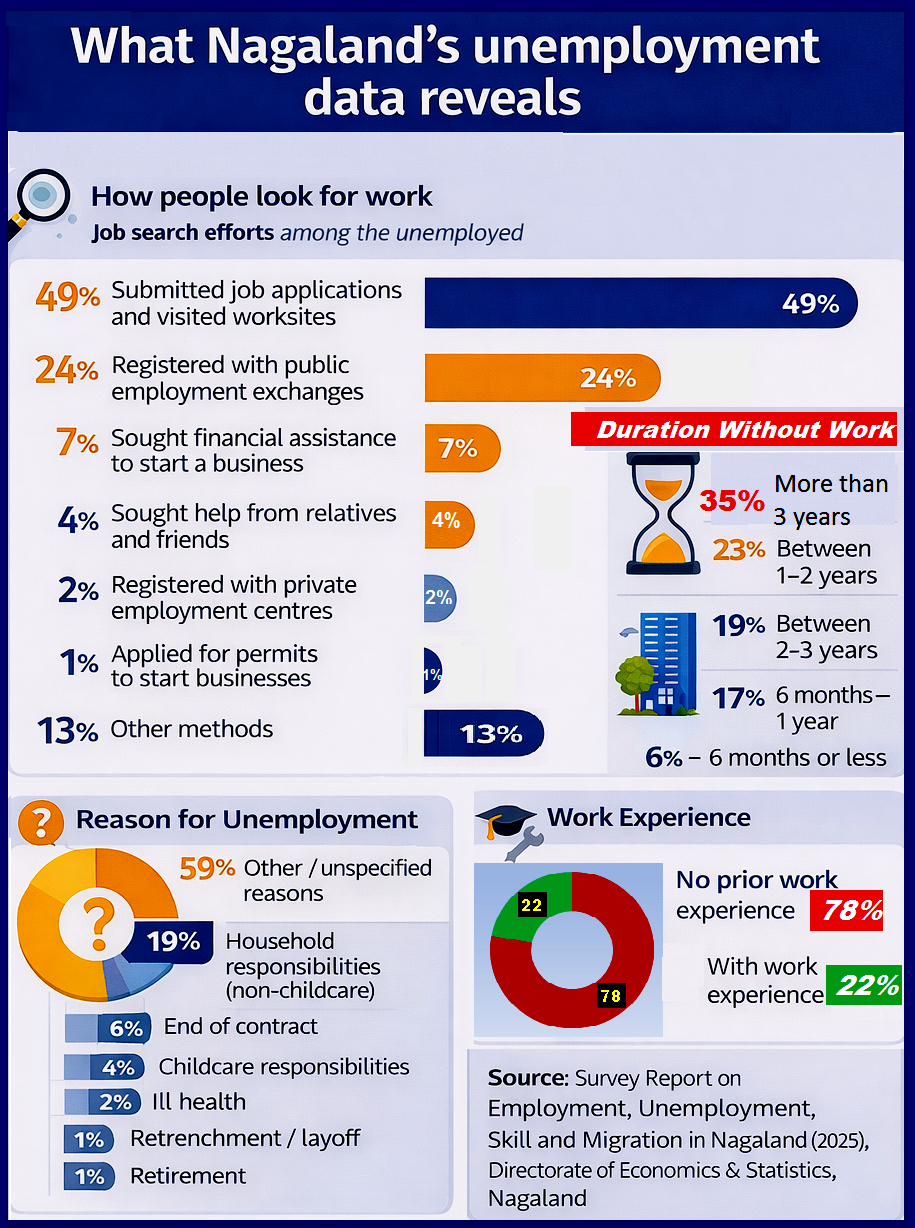
According to the survey, nearly half (49%) of unemployed respondents in Nagaland relied on direct job applications and worksite visits as their primary job-search strategy.
This was followed by registration with public employment exchanges (24%), while only 2% reported registering with private employment centres.
A smaller share pursued alternative routes into employment: 7% reported seeking financial assistance to start a business, 4% relied on relatives and friends, and 1% applied for permits to start a business.
The remaining 13% were classified under ‘other’ methods.
Overall, the distribution indicated that job-search efforts are largely individualised, with limited reliance on institutional or intermediary mechanisms. Limited entrepreneurial activity is also evident.
Dominant long-term unemployment
The survey also pointed to extended durations of unemployment for a substantial share of job seekers. As per the data, 35% of respondents without jobs had been unemployed for more than three years, making it the single largest category.
This was followed by those unemployed for one to two years (23%), two to three years (19%), and six months to one year (17%). Only 6% reported being unemployed for six months or less.
Taken together, nearly four in five unemployed respondents have been without work for more than a year, indicating chronic unemployment rather than short-term job transitions.
78% without work experience
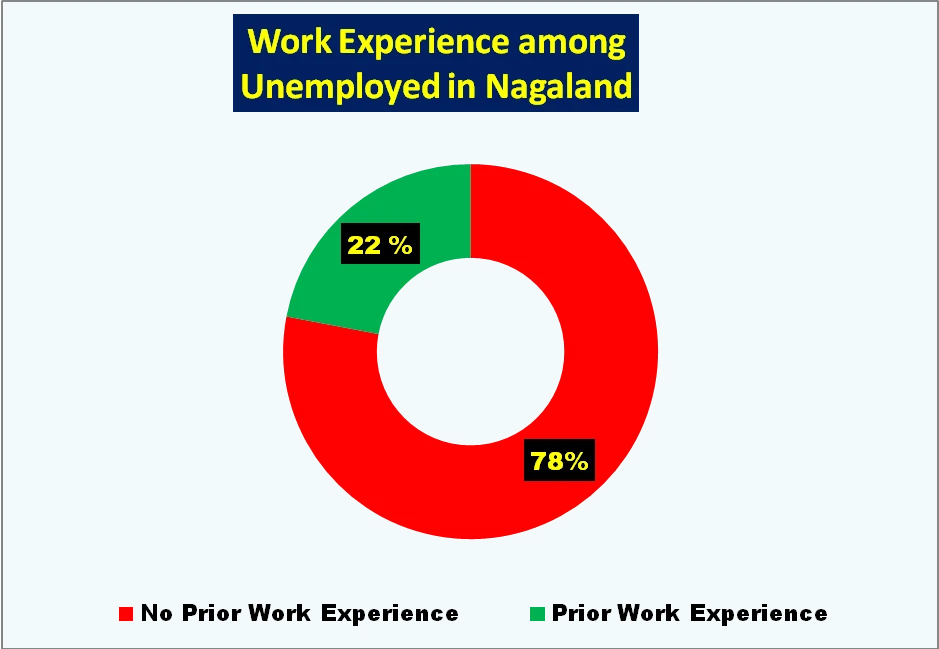
The survey showed that 78% of unemployed respondents reported having no prior work experience, while only 22% indicated that they had worked earlier.
When viewed alongside skills-related findings, particularly that 92% of respondents lack technical or vocational training, the limited exposure to the labour market among job seekers is apparent.
Further, the survey recorded zero instances of learning on the job. Where vocational or technical training was undertaken, it was largely self-funded (61%), with government funding accounting for 33% and concentrated within a narrow range of sectors (See Part II).
Taken together, the absence of prior work experience and limited access to structured skills and training pathways appear to be significant barrier for first-time job seekers entering the labour market.
Reasons for unemployment
When asked about reasons for unemployment, the largest share of respondents (59%) cited ‘others’, a broad category that does not specify structural or personal causes.
Among identifiable reasons, household responsibilities other than childcare (19%) and the absence of employment opportunities in the area (8%) were the most frequently reported.
Smaller proportions cited childcare responsibilities (4%), ill health (2%), retrenchment or lay-off (1%), and retirement (1%).
Notably, no respondents cited the shutdown of production units or a lack of financial need to work as reasons for unemployment.
The limited reporting of retrenchment or industrial shutdown is consistent with earlier findings pointing to a labour market dominated by informal and insecure employment, rather than large-scale exits from the formal sector.
Joblessness in Nagaland is further compounded by the limited engagement in subsidiary activities, with 88% of unemployed respondents reporting none, compared to 12% who had one.
Collectively, the findings from the DES report signified to a labour market defined by chronic unemployment and a lack of professional experience. These factors, alongside documented skill gaps, establish the structural basis for the state’s current employment challenges.
About the survey
As per the DES, the field survey for the “Survey Report on Employment, Unemployment, Skill and Migration in Nagaland 2025” was carried out between February and March 2025 across 11 districts, using a multi-stage stratified rural–urban sampling design. Accordingly, the reported data pertain to 2025.
A total of 1,315 households were surveyed from 60 urban wards, while 3,080 households were surveyed from 140 rural villages. Altogether, the statewide sample comprised 4,395 households.
Employment status was assessed using the usual principal activity approach over the preceding 365 days.
This is Part IV of a series on the findings of the ‘Survey Report on Employment, Unemployment, Skill and Migration in Nagaland 2025.’
Other aspects of findings from
Job Search Efforts in Nagaland | Percentage |
Job application and worksite visits | 49 |
Registration in public employment exchange | 24 |
Others | 13 |
Sought financial assistance to start business | 7 |
Sought assistance from relatives and friends | 4 |
Registration in private employment centre | 2 |
Permit application to start business | 1 |
Source: ‘Survey Report On Employment, Unemployment, Skill And Migration In Nagaland 2025’ published/conducted by Directorate of Economics & Statistics Nagaland.
Duration of Unemployment in Nagaland | Percentage |
Less than or equal to 6 months | 6 |
Between 6 months and 1 year | 17 |
Between 1 year and 2 years | 23 |
Between 2 years and 3 years | 19 |
More than 3 years 35 | 35 |
Source: ‘Survey Report On Employment, Unemployment, Skill And Migration In Nagaland 2025’ published/conducted by Directorate of Economics & Statistics Nagaland.
Work Experience
Source: ‘Survey Report On Employment, Unemployment, Skill And Migration In Nagaland 2025’ published/conducted by Directorate of Economics & Statistics Nagaland.
Reason for Unemployment in Nagaland | Percentage |
Others | 59 |
Household responsibilities other than childcare | 19 |
Absence of employment opportunities in the area | 8 |
End of contract/quit | 6 |
Childcare | 4 |
Ill health | 2 |
Retrenchment/ lay off | 1 |
Retirement | 1 |
Shutdown of production unit | 0 |
No financial need to work | 0 |
Source: ‘Survey Report On Employment, Unemployment, Skill And Migration In Nagaland 2025’ published/conducted by Directorate of Economics & Statistics Nagaland.