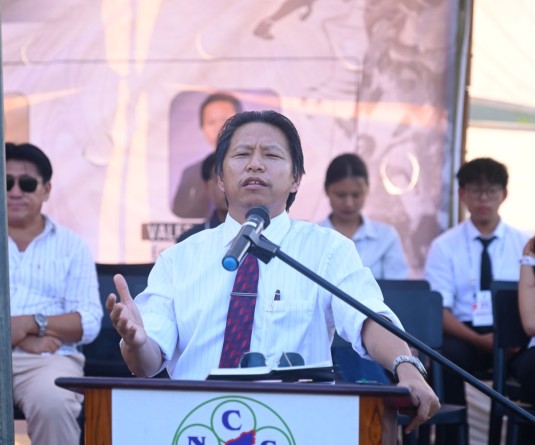
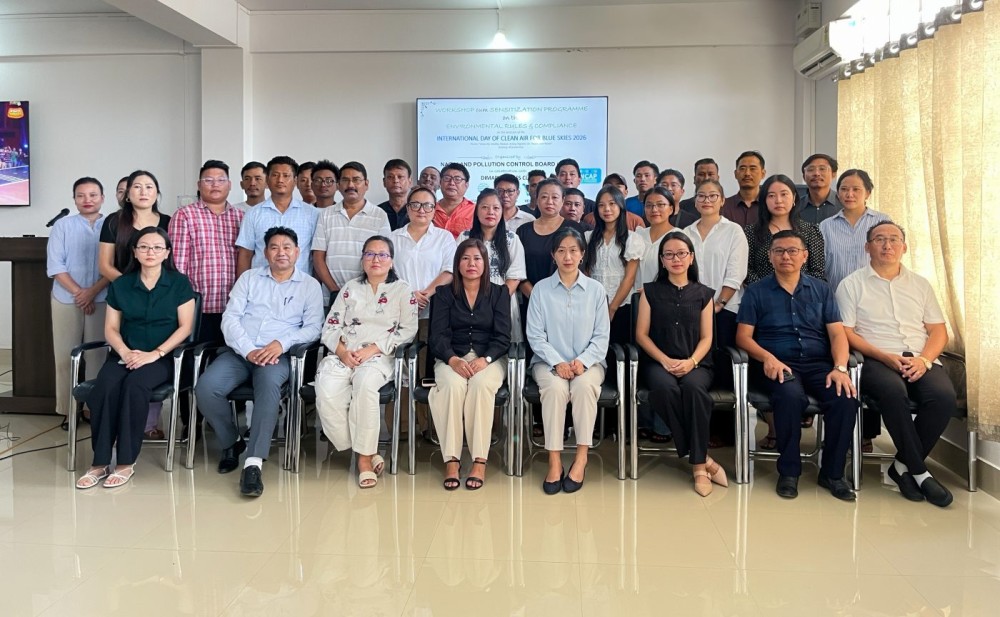
Members of the Nagaland Pollution Control Board and Dimapur Press Club during the workshop-cum-sensitisation programme on environmental rules and compliance in observance of the International Day of Clean Air for Blue Skies 2026 in Dimapur on September 7. (Morung Photo)
• Drying springwells
• Depleting groundwater
• Warmer air in the hills
Media a vital link to bridging awareness gap
Morung Express News
Dimapur | September 7
With Dimapur and Kohima classified as “non-attainment” cities for failing to meet national air quality standards, environmental scientists in Nagaland warned that climate change is shifting faster than anticipated, requiring collective action. Nagaland Pollution Control Board (NPCB) Senior Environmental Engineer Aghali A Swu pointed to a visible decade-long shift in the state’s climate and called for shared responsibility to protect water resources and air quality.
Swu made the comment at a Workshop-cum-sensitisation programme on “the environmental rules and compliance” organised by the NPCB for journalists in collaboration with the Dimapur Press Club (DPC) in Dimapur on September 7 coinciding with the International Day of Clean Air and Blue Skies 2026. ‘Clean air, healthy choices: Acting together for people and planet’ is the theme this year.
Sharing her personal observations over a 17-year career with the NPCB, she noted marked changes in weather patterns. According to her, places in the hills are getting warmer, while waterfalls and spring wells are drying up in districts like Zunheboto. In Dimapur, she said that groundwater is depleting stating reports that deep borewells in certain locations did not hit water even after drilling to 600 feet deep.
Swu linked these local challenges to global climate trends, citing the recent flash floods in Nepal and a University of Michigan study warning that rising temperatures could triple India's groundwater depletion rate by 2080.
She said that these environmental and climate issues should not be viewed in isolation, explaining that waste disposal practices directly affect air, water and soil quality. She added that the media plays a vital role in taking awareness to the masses— awareness of the environment and the regulatory guidelines enacted by the government.
The workshop saw resource persons from the NPCB scheduling sessions on waste management rules, including battery, e-waste, and hazardous waste guidelines, besides topics related air and water quality, noise pollution.
DPC Vice President Bendangchuba Kichu termed the environment as a shared responsibility. “As journalists, we have a responsibility to ensure that environmental issues do not become news only when disaster strikes,” he said.
Little awareness
While there are rules, applying them has remained a challenge. While the NPCB, as a statutory and regulatory body, engages with grassroots stakeholders, Swu acknowledged a gap in public understanding of environmental issues and the existing regulatory mechanisms.
“Many people are still not aware about the existence of these various waste management rules,” the NPCB’s Senior Environmental Engineer said, adding that the lack of awareness was the primary reason it organised the sensitisation programme.