Dr SC Jamir flanked by Concerned Naga Forum of Nagaland (CNFN) Core Committee Convenor HK Khulu (Left) and CNFN Media Convenor, Theja Therieh (Right) at the press conference in Dimapur on September 12. (Morung Photo)
.jpg)
Morung Express News
Dimapur | September 12
Former Nagaland Chief Minister Dr SC Jamir said he approached Rashtriya Swayamsevak Sangh (RSS) chief Mohan Bhagwat on the Naga political issue because the ruling BJP is influenced by the organisation. Speculations were rife in Nagaland after Jamir’s supposedly hush-hush September 10 meeting with Bhagwat, a polarising figure, heading a right-wing Hindu religious organisation regarded by minorities as antithetical to a pluralistic India.
Jamir, who also served as Governor of Gujarat, Maharashtra, Goa and Odisha, addressed a press conference in Dimapur on September 12. He was asked why he approached the head of a socio-religious body on a strictly political matter. He replied, “Today, the BJP government moves because of RSS. Even though we are shouting they (BJP-led NDA government) are not listening. So I said, why not you (Bhagwat) also shout so that they can also listen? We have to explore all possible means to ensure that settlement comes as soon as possible. That is our objective.”
Turning to the political deadlock, Jamir stated that decades of negotiations have seen the movement splinter from the Naga National Council into 36 or 37 groups, reducing governance to a “tamasha” (mockery), and running parallel governments thriving on extortion. He held that the 2015 Framework Agreement contains neither sovereignty nor territorial integration, and urged New Delhi to finalise a solution.
According to him, he submitted a written statement to Bhagwat, who agreed to study it. In the statement, Jamir called for an overhaul of the governance system in Nagaland and questioned the constitutional allegiance of MLAs since Neiphiu Rio took office in 2003. Queried on this, he responded that the state administrative machinery has collapsed. He said that the state police have been helpless against members of Naga Political Groups, involved in extortion, enjoying the patronage of Kohima and New Delhi.
He recalled resisting the NSCN (IM)’s call to boycott the state Assembly elections of 1998 honouring his constitutional allegiance and oath to his God. Jamir appealed to legislators not to betray their constitutional oaths by yielding to extra-constitutional pressures.
Asked whether Bhagwat provided suggestions to resolve the issue, Jamir said the RSS chief “only listened” due to a reportedly limited familiarity with the subject, but promised to raise the matter with authorities in New Delhi.
Regarding the demand from the Naga Youth Movement (NYM), formerly Fed-Up Nagas, seeking a solution within three months, Jamir said the public is exhausted by delays and has every right to express its frustration. The NYM had issued a three-month ultimatum to New Delhi on June 27, 2026.
On violence against religious minorities across the country, Jamir maintained that Christians and Muslims must not be persecuted. When questioned whether RSS ideology shaped by Savarkar and Golwalkar conflicts with Naga aspirations, Jamir cited Bhagwat’s recent public statements abroad supporting secularism. He said that any attempt to establish a theocratic state would mark “the beginning of ending the Indian Union.”
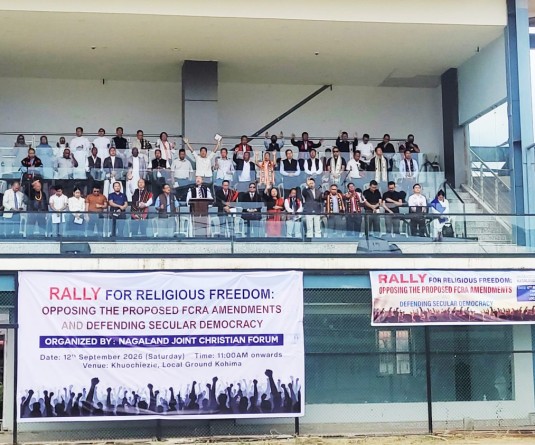
On the FCRA Amendment Bill, Jamir stated he is totally against it, urging Nagaland and Meghalaya to pass assembly resolutions against restrictions that choke funding for schools and hospitals. He had no comments on the Vande Mataram controversy. He dismissed speculation about leaning towards the BJP and the presence of his son, Working President of the Nagaland Pradesh Congress Committee Apok Jamir, during his meeting with the RSS chief. While claiming that he acted solely in the interest of the Naga people, he said, “I remain a Naga, I am a Congressman, and a Christian.”
Jamir also detailed the concerns he presented to Bhagwat, beginning with the question, “What do you mean by Indian?” He argued that genuine “Indianness” cannot rest on conformism — imposing one language, dress, or religion — insisting that “there is no one stick to beat everybody.”
Pointing out that India historically has had an assimilative culture, Jamir urged the RSS to adapt its philosophy to modern times, just as Nagas must progress into a scientific world. He described secularism as the epitome of unity in diversity, noting how Nagaland participates in Durga Puja and Muslim festivals alongside Christmas.
He described the Northeast and Nagaland as relative “newcomers” initially excluded under British rule and subjected to racial stereotyping in mainland cities.
He asserted that Nagaland is a Christian-majority state and that Article 371A explicitly protects Christian practices, noting that religious conversion does not diminish equal citizenship.