IANS Photo
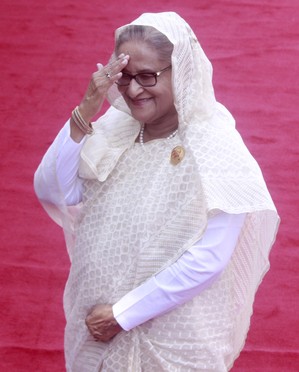
New Delhi, November 13 (IANS) Former Bangladesh Prime Minister Sheikh Hasina expressed hope that her personal circumstances would not come in the way of bilateral relations between India and Bangladesh, highlighting the longstanding historical ties and shared strategic interests between the two countries.
Speaking exclusively to IANS, Hasina said that ties between the two countries should not be held hostage to political differences surrounding any individual.
“I do not think it would be appropriate for me to comment on the decisions of the Indian government. India is a sovereign country. It has its own laws and procedures, and its government will decide accordingly. But I certainly hope my personal situation will not become an obstacle to relations between Bangladesh and India. Our relations go back to the Liberation War of 1971. We share a long border, a common history, and important interests in trade, energy, connectivity and security. These relations are far too important to be held hostage to political disagreements involving any individual,” the former PM stated.
Hasina said that both the former Muhammad Yunus-led interim government and the ruling BNP administration had repeatedly called for her return to Bangladesh.
She further questioned why her decision to return voluntarily should now invite objections.
“Both the Yunus administration and the present government have repeatedly demanded my return to Bangladesh. Now, I have decided to return myself. So, why should there be any objection?" the former PM told IANS in a rare audio interview.
When asked about preserving India-Bangladesh ties amid Dhaka's attempts to link bilateral relations to her extradition, Hasina said she did not think it would be appropriate for her to comment on India's diplomatic policy or suggest what Prime Minister Narendra Modi should do.
"I do not think it would be appropriate for me to comment on India's diplomatic policy or suggest what Prime Minister Modi should do. The Awami League has always believed in maintaining good relations with our neighbours while protecting Bangladesh's sovereignty and national interests. During our time, we strengthened relations with India while also working closely with China, Japan, the United States and other countries,” she mentioned.
Hasina emphasised that lasting bilateral cooperation between New Delhi and Dhaka required a representative government in Bangladesh with democratic legitimacy and broad public support, rather than one that excluded significant sections of the population from the political process.
“I also believe that lasting relations between Bangladesh and India require democratic legitimacy and public confidence. A genuinely representative government provides a stronger foundation for cooperation than one that excludes a large section of its own people from political life,” she noted.
Emphasising that a peaceful, democratic and stable Bangladesh was in India's interest, just as a friendly and cooperative India benefited Bangladesh, Hasina said that the two countries should preserve the relationship built during her tenure.
“That is the relationship we worked to build, and I believe it should be preserved. Neighbouring countries may have disagreements, and Bangladesh may have differences with India. But those differences should be resolved through dialogue and mutual respect, not through hostility for political advantage,” she told IANS.
Referring to issues such as the land boundary, Ganges water-sharing and maritime boundaries, Hasina said that her government had demonstrated during its tenure that differences could be resolved through dialogue.
“Our foreign policy has always been based on friendship towards all and malice towards none. This was the principle articulated by the Father of the Nation, Bangabandhu Sheikh Mujibur Rahman, and we have followed it,” the former PM stated.