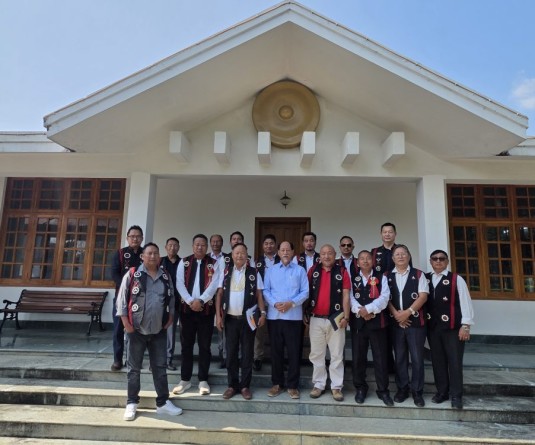
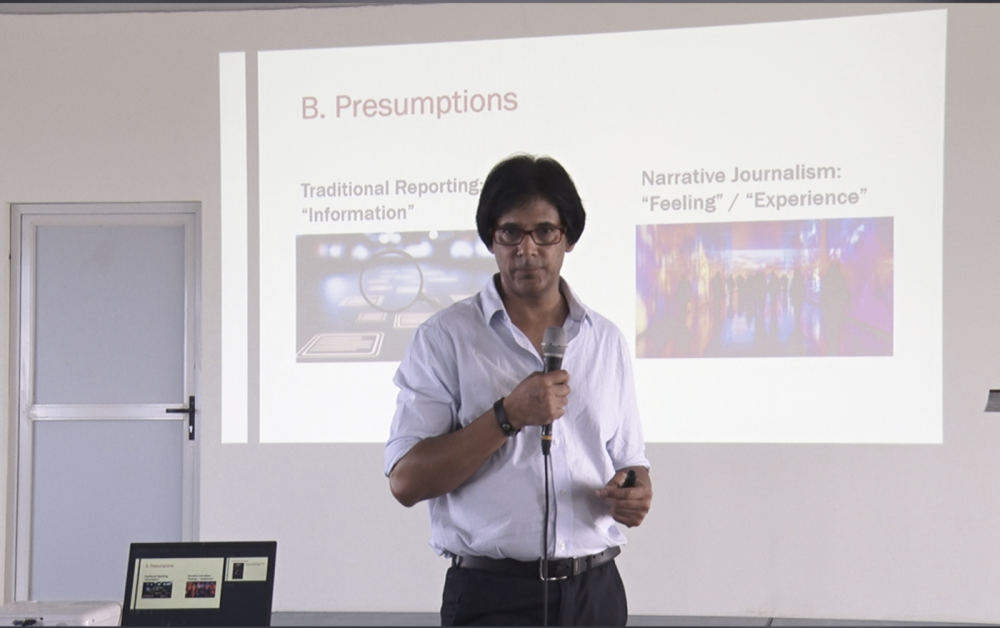
Director and Founder of Storytelling at Newsreel Asia, Vishal Arora during the lecture, titled ‘The Power of Narrative Journalism’ at the NECU, Dimapur, on March 7.
Beyond the Who, What, Where, When, Why, and How
Morung Express News
Dimapur | March 7
Journalism, by convention, is required to be objective. Journalists are to glean the ‘Who, What, Where, When, Why, and How.’ They are expected to keep aside their emotion, remain neutral, and convey cold, hard information in a matter-of-fact way. It is up to the readers to frame their own opinion.
This mechanical approach to news is apparently no longer sufficient in a polarised world, according to journalist Vishal Arora.
With 25 years of experience covering politics, human rights, and international relations in South and Southeast Asia, Arora is currently the Director and Founder of Storytelling at Newsreel Asia, an India-based online narrative platform.
During a lecture at the North East Christian University (NECU), Dimapur, on March 7, Arora said that the news industry’s obsession with objectivity and statistics often strips stories of their humanity, leaving audiences desensitised to the real world agony of the subject being written about.
In his lecture, titled ‘The Power of Narrative Journalism,’ Arora contrasted the immersive techniques of storytelling with the traditional, no-strings-attached approach to news. According to him, ‘narrative journalism’ draws from novel-writing techniques.
To demonstrate his argument, he compared a standard, objective news report of a train derailment with a narrative account of the same event. While the standard report listed casualties, the narrative version was told through the perspective of a passenger — a father packing biscuits for his daughter minutes before the crash occurred — setting a scene that readers could empathise with.
“This one (narrative account) seeks to show you what has happened through the eyes of a sufferer. So your ability to understand the pain that was caused by this accident is clearer here,” he said.
According to Arora, narrative journalism allows the journalist to be sympathetic, while remaining factually accurate. It humanises statistics.
He said that traditional journalism functions on the premise that the reporter must remain “absent” from the story to maintain neutrality. This often leads to a “he said, she said” format that balances opposing political viewpoints but fails to uncover the ground reality. By contrast, narrative journalism requires the reporter to engage with “humanitarian concerns.”
Recalling his coverage of the recent violence in Manipur, Arora said that focusing on the human element was central to his reportage. His goal was to convey the emotional reality of the conflict to the viewer/reader, instead of merely documenting the clashes or the political rhetoric.
For him, it was about letting his audience feel the same fear that he felt. “How can I make them feel grief? That they... we will feel sad about what has happened.”
Journalists, he said, should begin with objectivity but eventually side with the facts once verified.
He said that stripping a story down to its emotional core makes it universally understood, regardless of where it takes place. According to him, this approach validates local stories as national news, challenging the ‘national’ media's tendency to focus on the Hindi-speaking belt. “Whatever is happening anywhere is as important as what's happening in the Hindu heartland,” Arora said, while stating that if an issue is important to Nagaland, it is inherently a national issue.
He further cited data from a study conducted by Newsreel Asia, which found that 70 percent of news coverage in India was skewed toward electoral politics, business, and entertainment elites. Only 1 percent of coverage addressed governance issues. According to Arora, the imbalance exists because journalists view themselves as bridges to the elite, rather than advocates for the public.
.jpg)