Dr Prashanna Gogoi, Dr Hewasa L Khing along with others during the National seminar held at Tetso College, Chümoukedima on January 30.
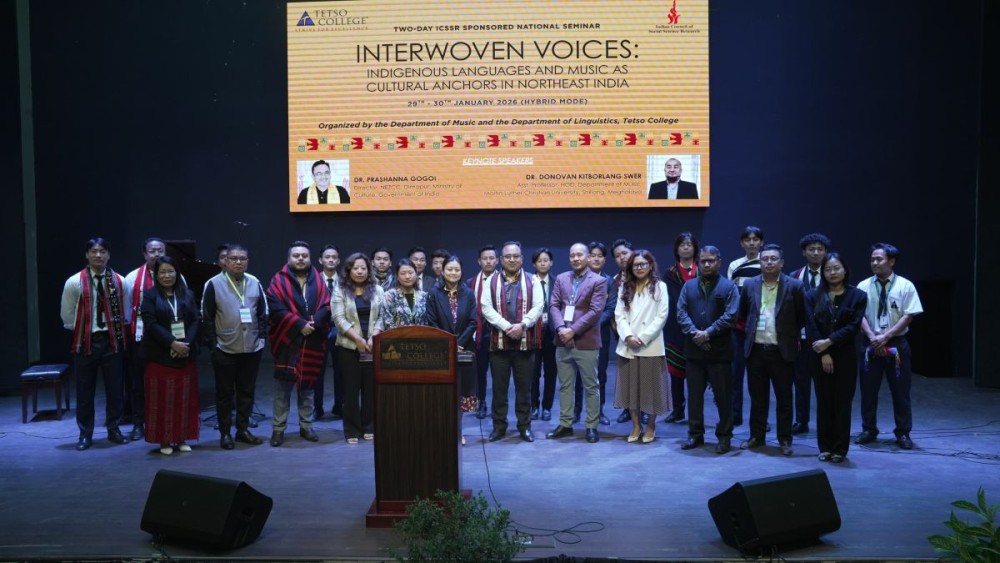
DIMAPUR, JANUARY 30 (MExN): A two-day Indian Council of Social Science Research (ICSSR)- sponsored National Seminar on the theme “Interwoven Voices: Indigenous Languages and Music as Cultural Anchors in Northeast India” was held at Tetso College from January 29 to 30.
The seminar was jointly organised by the Department of Music and the Department of Linguistics, Tetso College, and consisted of seven technical sessions conducted both on campus and online.
The inaugural programme was held on January 29 at Lorin Hall with Dr Prashanna Gogoi, Director, North East Zone Cultural Centre (NEZCC), Dimapur, Ministry of Culture, Government of India, delivering the keynote address.
In his address, Dr Gogoi highlighted the richness and diversity of indigenous cultures across the Northeastern states and stressed that language and music function as living cultural archives that preserve community memory, worldview and values.
Likewise, he said indigenous musical and linguistic traditions should be understood as knowledge systems rather than mere performance forms, and emphasised the need for systematic documentation and academic engagement to safeguard them for future generations.
Noting the pressures of modernisation and cultural homogenisation, he called for collaborative efforts between institutions, researchers and communities to strengthen preservation initiatives.
At the same time, Dr Gogoi underscored the importance of cultural awareness and rootedness, stating that identity and belonging are grounded in one’s cultural heritage.
The inaugural session began with a welcome note by Tetso College Principal, Dr Hewasa L Khing, and included the watering of the Tree of Wisdom, college anthem and invocation by Thujoi Rhakho, Assistant Professor, Department of Music.
A musical presentation titled “Cultural Cadence of Nagaland” by the Department of Music showcased indigenous musical expressions of the region. The session was chaired by Dr Wapanginla Aier, Assistant Professor, Department of Linguistics, who also presented the seminar briefing.
Technical sessions for Day One were held at Hall 1994. Session I on “Indigenous Music,” moderated by Dr Wichamdinbo Matiana with Limajungla as rapporteur, featured papers on Chokri Li as an indigenous knowledge system, digital music curation and indigenous voices, tea garden musical resistance in Assam, Naga indigenous songs in social media playlists, and contemporary folk fusion music in Nagaland.
Session II on “Indigenous Language and Music,” moderated by Dr Wapangienla Aier with Lenity B Aventh as rapporteur, included presentations on language preservation through Angami folk songs, Sümi Naga folksongs as oral ethnography, legal dimensions of protecting traditional knowledge, myth and supernatural themes in Lotha folk songs, and ecological memory in literary mytho-musical narratives.
Day Two featured parallel online sessions on indigenous music and knowledge, oral tradition and indigenous language documentation. Moderated by Dr Achuth A, Dr Thejasanuo Khezhie and Dr Kailadbou Daimai, the sessions covered ecological imagery in Khasi song texts, music and landscape in literature, symbolism and worldview in folk songs, oral narrative traditions, ritual and gender in festival contexts, and indigenous language documentation studies.
On-campus sessions held at Conference Room Saturn included a session on “Indigenous Musical Instrument and Folk Song as Cultural Continuity,” moderated by Thujoi Rhakho. Student researchers presented papers on fading traditional instruments, music–land relationships, folk song traditions in Waromung village, the role of folksongs among the Rengma Naga tribe, and Zeliang Naga musical instruments and craftsmanship.
A second on-campus session on “Memory, Identity and Transformation in Naga Indigenous Music,” moderated by Dr Wapangsenla Imchen featured presentations on folk fusion and modernity, storytelling through traditional songs, heritage and nostalgia in literature, lullabies and early language transmission, and Ao Naga lullabies.
The seminar concluded with a valedictory programme chaired by N Shelao, Assistant Professor, Department of Music. Participants shared feedback highlighting the seminar’s academic and cultural relevance.
The valedictory keynote address was delivered by Dr Donovan Kitborlang Swer, Assistant Professor and Head, Department of Music, Martin Luther Christian University, Shillong, who stressed the need to document and promote indigenous musical and linguistic traditions, particularly among younger generations.