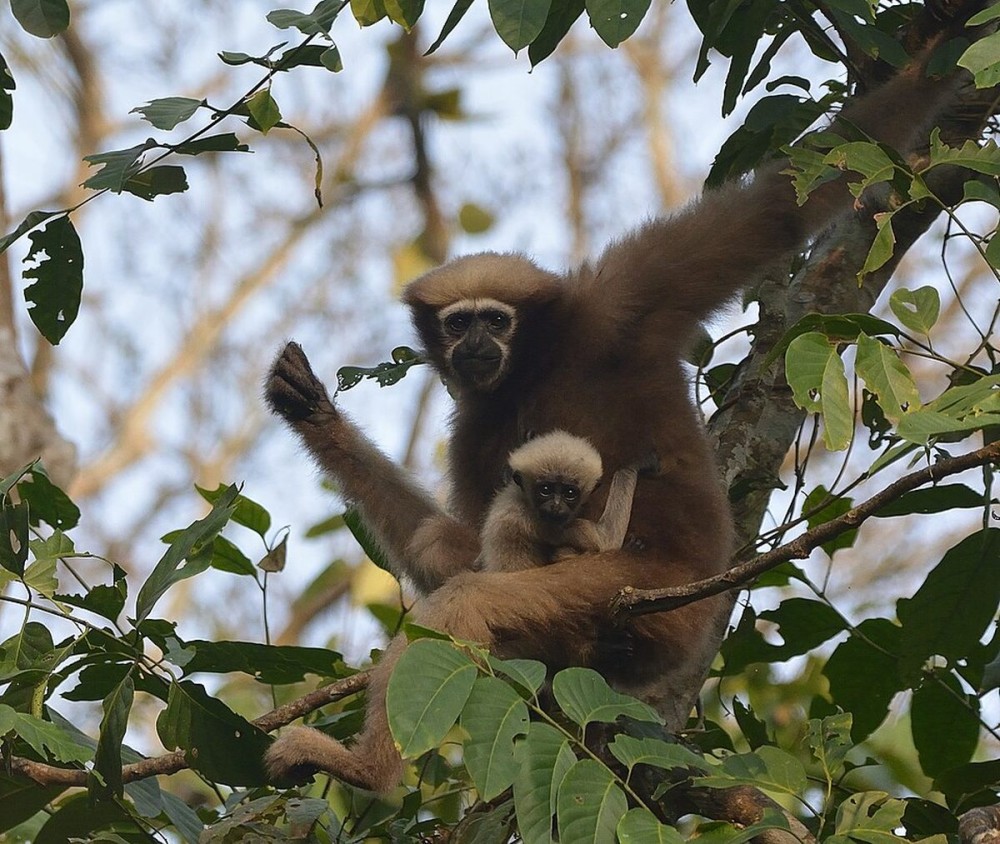
Western Hoolock Gibbon. (Photo Courtesy: Smitha Surya)
Ankita Rajasekharan
Humans first know other species from the senses- what we see, what they smell like, what they are like to touch, even what they might taste like, what feelings they evoke in us and more. And then, we come to name them. Sadly, once we name them, that’s often the only thing we learn about them. We spot them, we identify them, we put them in a checklist and move on the next. Wouldn’t it be lovely to learn to see creatures again, from our senses first, nomenclature next? Read on, to know who might be peeking at us, the next time we look up in the canopy of trees!
Amidst the tall trees of the tropical and sub-tropical forests in the north-eastern states of India, moves a creature that requires us to really stop in our tracks. A quick walk through with our gaze straight ahead, and we’d have missed the species! We have to walk slowly, intentionally, with our necks craned up far into the high canopy. We may hear them, before we see them. “Holou, holou”, they call to each other, one responding to the other, the whole forest erupting with their conversation. Their song carrying far through the forests and neighbouring villages. Named after the sound they make, the Western Hoolock Gibbons (Hoolock hoolock) are spread across the seven states of north-east India, with a significant population in Assam and Arunachal Pradesh. They are primates like the monkeys and langurs, and the only species of ape that is found in India. Like all apes, they too have no tail. They have long forelimbs, often longer their bodies. If you ever see one up amidst the trees, you’ll instantly know why! They move through the canopy using a method of locomotion called brachiation, meaning they use their long and stretched out arms to move from branch to branch. They may even be seen walking on long bamboo shoots, upright on their hindlimbs, gracefully balanced and swift. Every once in a while, with a controlled swish and a leap, they are able to cover gaps of upto 6m between trees! Their bodies have evolved to support their arboreal lifestyle. They live almost their entire lives in the canopy- feeding, breeding, playing, sleeping!
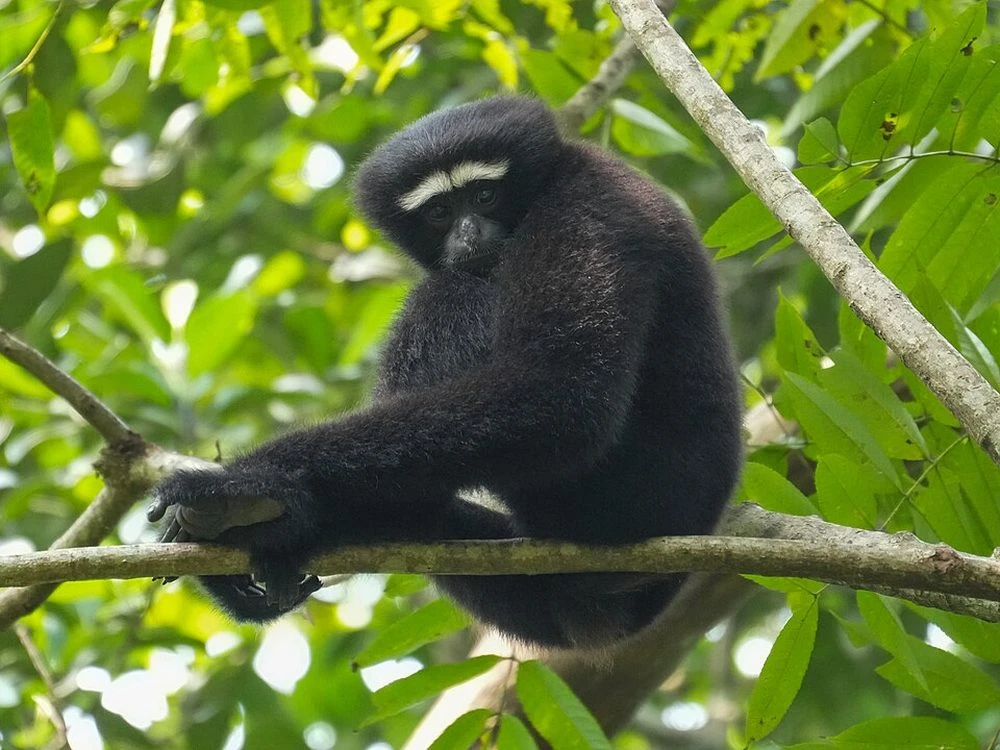
Amidst the deep hues of mixed-forest trees like the hoolong, sal, silk-cotton and bamboo thickets in these evergreen, semi-green or moist deciduous forests, the gibbons stand out with their shiny coats. The males sport glistening black fur with contrasting thick white brows, and the females are covered in brown-beige all over the body with a white lining of hair around their black eyes and mouth. Hoolock gibbons have been observed to be monogamous, and move about in small family groups of one adult male and female, with one to four young ones. They are diurnal and spend most part of their day feeding, grooming and napping. Their diet consists primarily of fruits, leaves, flowers and buds, animal protein like insects and spiders. They are integral to the health of the forests as they play the role of being seed-dispersers, dropping undigested seeds across the forest floor.
These acrobatic species, living a life so distinct from our land-based dwelling, face major threats to their survival. Continued habitat fragmentation from deforestation, mining and poaching have resulted in their classification as an endangered species by the IUCN red list. Rarely coming down to the land, the felling of even a single or handful of trees could mean that the gibbons are isolated, unable to cover the distance between fragmented patches of the forest.
What might life be like, where tree-tops are homes, roadways, source of food, and playground? Beyond nomenclature, truly pausing and spending time in the company of other species offers us the opportunity to consider, hold curiosity and care for a way of living on this planet that is beyond our experience, and having a rightful place of its own.
References:
1. Single species of Hoolock gibbons in India – A Relief for Zoos - CSIR
2. Western Hoolock Gibbon - New England Primate Conservancy
3. How Fast Can Gibbons Swing Through the Forest? - The Smithsonian
Ankita cherishes leisure and enjoys spending time observing and documenting the goings-on in the natural world. She grew up in the University of Hyderabad campus where much time was spent by the lakes, climbing trees, building clay dams, spotting birds and reptiles. She now works on facilitating and designing experiences for children and adults to nurture their unique connection with the natural world. She also writes from time to time at: https://earthlingideas.substack.com