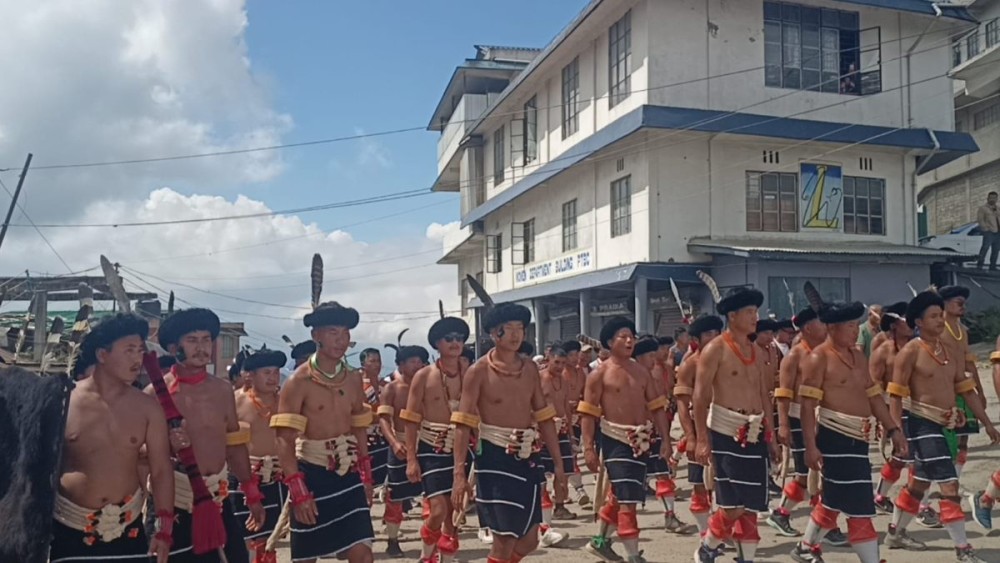
CCYO stages traditional procession at Pfutsero on September 28. (Morung Photo)
Our Correspondent
Kohima | September 28
The Centre Chakhesang Youth Organisation (CCYO) today staged a traditional procession (Kühu-Kürüle) from Rükizu Junction to the ADC Office, Pfutsero, in Phek district and later submitted a memorandum to the Chief Minister of Nagaland through the Additional Deputy Commissioner, Pfutsero, regarding the “violation of Chakhesang Naga customary and traditional rights” by the Nagaland Forest Department and the arrest of Vezhoto Hesuh.
The rally was addressed by Centre Chakhesang Public Organisation (CCPO) president Pupohu Lohe, Porba Village Council chairman Cekrohu Ciero and Vevoyi WD Vadeo, former president of the Chakhesang Students’ Union.
In an ultimatum addressed to the Chief Minister regarding the alleged arbitrary action against Vezhoto Hesuh and the seizure of the Great Barbet, the CCYO demanded an impartial inquiry and protection of the rights and customary interests of the people of Nagaland.
The CCYO expressed its strongest concern and unequivocal objection to “what it considers to be the arbitrary, high-handed and disproportionate action taken against Vezhoto Hesuh, a bona fide and law-abiding citizen of the Centre Chakhesang area, by the Forest, Environment & Climate Change Department.”
The organisation stated that Hesuh was telephonically summoned to appear before the Wildlife Crime Control Unit (WCCU), Wildlife Division, Dimapur, on September 11, 2026, reportedly in connection with photographs and videos uploaded on his Facebook page. He was subsequently detained on the same day.
The posts in question reportedly included: (i) a video in which he offered a sweet to a monkey in Assam; (ii) another video showing a bird kept in a cage and reportedly traditionally reared by a person at Porba Village; and (iii) a photograph of himself with a bird perched on his shoulder at Porba Village.
The monkey and the two birds were neither owned by nor under the custody of Hesuh, the CCYO stated.
It stated that the material in question did not depict any act of cruelty, killing, capture or deliberate harm to the animals.
The circumstances surrounding his detention are therefore deeply concerning. It is alleged that Rs 1,00,000 was demanded for his release and that, after he reportedly refused to pay the said amount, a case was subsequently initiated against him. Such conduct raises extremely serious questions concerning the exercise of official authority, accountability and the treatment of citizens by government agencies, the CCYO stated.
Stating that Hesuh is known as a responsible youth who has consistently demonstrated appreciation for nature and wildlife, the organisation stated that the mere posting of photographs or videos concerning wildlife cannot, by itself, establish criminal culpability without demonstrating the precise conduct alleged to constitute an offence and the factual circumstances supporting that allegation.
A social media post cannot be transformed into a criminal offence merely through assertion. The facts and circumstances must establish the offence, it stated, and strongly objected to any attempt to portray Hesuh as a wildlife offender merely on the basis of social media material without first establishing his actual role, possession, custody, control, intention and conduct in relation to the animals concerned.
It also expressed deep concern over the seizure of a Great Barbet from Porba Village on September 14, 2026, by the Forest Department.
The bird was reportedly reared and cared for by a young boy from the village for approximately six to seven years. Its sudden removal has caused considerable emotional distress to the child and concern among the villagers, the CCYO stated.
For generations, birds such as the Great Barbet have been traditionally reared in our communities with affection and care. They have been kept for companionship, their presence and distinctive calls, and as part of the familiar natural environment of village life. Its call and presence have historically formed part of the everyday rhythm of village life and have even been regarded as a natural indicator of time, it stated.
The CCYO urged the authorities to recognise the human, cultural and community dimensions of the matter rather than approaching the issue solely as an enforcement exercise.
The CCYO further placed on record its serious concern regarding the constitutional dimension of the matter.
“Article 371A is not an ordinary statutory provision. It forms an integral part of the Constitution of India and provides special constitutional protection in respect of specified matters concerning Nagaland. The provision was specifically incorporated into the Constitution to safeguard the distinctive social and customary institutions, customary laws and procedures, and the ownership and transfer of land and its resources of the Naga people in the constitutionally protected fields. Accordingly, the applicability and enforcement of Parliamentary legislation in Nagaland cannot be approached as though Nagaland were constitutionally identical to every other state,” the CCYO stated.
Therefore, wherever the subject matter or effect of a Parliamentary enactment touches upon matters protected under Article 371A, the constitutional requirements of Article 371A must necessarily be taken into consideration, it stated.
CCYO demands
The CCYO called upon the Government of Nagaland and the Forest, Environment & Climate Change Department to fulfil the following demands within seven days of receipt of the memorandum:
1. Immediate withdrawal of the case against Mr Vezhoto Hesuh, together with appropriate corrective action.
2. Immediate return of the Great Barbet seized from Porba Village, with due consideration to the circumstances in which it had been traditionally reared and the profound sentiments of the child, family and village community concerned.
3. An independent, impartial inquiry into the allegation of the Rs 1,00,000 demand, including identification of the officials involved and appropriate action in accordance with law.
The memorandum, signed by CCYO president Dode Nakro and general secretary Shevoto Vezuh, stated: “If satisfactory action is not taken within the stipulated period of 7 days, the Centre Chakhesang Youth Organisation shall be compelled to pursue courses of action as may be deemed necessary to seek accountability, protect the dignity of citizens, and safeguard the rights and interests of the community.”