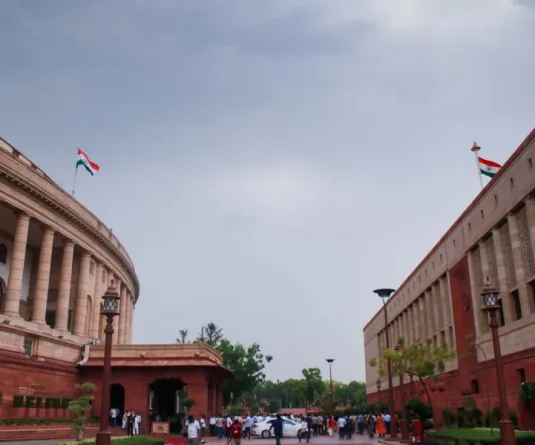
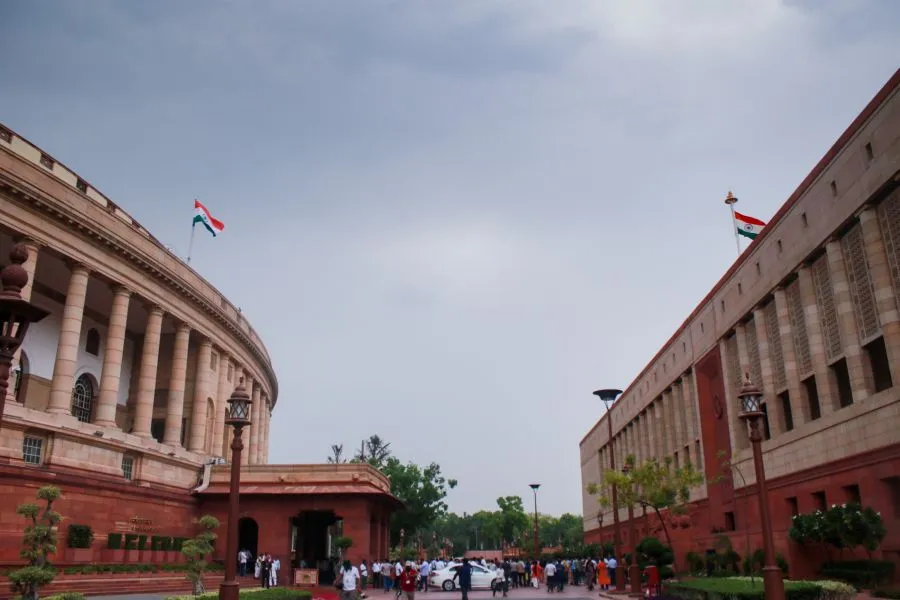
A view of the new and old Parliament buildings under dark clouds during the three-day special session in New Delhi on April 17, 2026. (Photo: IANS/Qamar Sibtain)
New Delhi, November 27 (IANS): The Union Cabinet’s decision to clear amendments to the Constitution Amendment Bill linked to delimitation and the implementation of women’s reservation has sought to address the fear, largely among southern states, of losing their relative influence in Lok Sabha, and at the same time, improve the chances of securing the requisite support in the Parliament to pass the legislation.
State leaders in Tamil Nadu, Kerala, Karnataka, Andhra Pradesh, and Telangana have been raising concerns that a population-based delimitation exercise would punish them for successful population-control policies while rewarding states with higher population growth.
The government’s earlier attempt to push through the Constitution (131st Amendment) Bill failed in the Lok Sabha in April after it fell short of the special two-thirds majority required for a constitutional amendment.
Incidentally, the government has repeatedly assured that no state will be disadvantaged in the delimitation exercise, with Union Home Minister Amit Shah earlier offering to amend the Bill introduced earlier with a uniform 50 per cent rise in seats.
Now, with an assurance reportedly in place, Tamil Nadu’s Dravida Munnetra Kazhagam (DMK), Andhra Pradesh's Yuvajana Sramika Rythu Congress Party (YSRCP), Telangana’s Bharat Rashtra Samithi (BRS), among others, are expected to support the measure.
Meanwhile, the Nationalist Congress Party – Sharadchandra Pawar (NCP-SCP), the Biju Janata Dal (BJD), the Jharkhand Mukti Morcha (JMM), the breakaway Trinamool Congress group, among others, may also stand in support considering the empowerment of women that the bill is linked to.
The Lok Sabha has a sanctioned strength of 543 members, where there are currently three vacancies.
The Bharatiya Janata Party (BJP) itself has 241 members, while its partners in the National Democratic Alliance (NDA) together are estimated to add around an additional 79 MPs.
If all 540 members vote, the government would need 360 votes to pass the constitutional amendment.
In case of absence or abstention, the number will reduce accordingly.
Rebel Trinamool members, numbering 20, have already announced their alliance with the ruling coalition. However, the Nationalist Citizens Party of India (NCPI) that they currently claim to represent is subject to the Speaker’s nod.
DMK leader M. K. Stalin on Friday posted on social media their demand as “the number of parliamentary constituencies is increased, under no circumstances should Tamil Nadu’s share fall below its current 7.18%!"
"A uniform increase across states meets that demand. The existing proportion of parliamentary representation among States, as determined on the basis of the 1971 Census and frozen earlier, must remain unchanged for another 25 years!” he added.
Considering the government delinking delimitation from an immediate census-based redistribution, and ensuring a gap in the population count exercise, no state’s proportional share in the Lower House is reduced for that period.
Additionally, DMK has already distanced itself from the Congress and the Opposition INDIA bloc. Stalin’s party accounts for 22 MPs in the Lok Sabha.
Meanwhile, NCP-SCP leader Supriya Sule has been noncommittal, saying that her party will decide after going through the content of the bill. With the amendments introduced, another eight MPs from the NCP-SCP may join forces with the backers. Thus, the number adds up to 370.
Moreover, considering that a state’s representation is not diluted by population count, and women’s reservation is introduced, the JMM, with three more members, may also come in support.
Thus, the gap between NDA members and the requisite strength is removed with this count in the lower house of Parliament.
In the Rajya Sabha, the ruling alliance falls 18 members short on the last count, where the NDA now enjoys the support of 145 MPs in the 244-member House.
Here, the DMK (eight MPs), the YSRCP (four), the BRS (three), the JMM (three), and Sharad Pawar himself, representing his party, make up the deficit.
While supporting the revised package would allow states to claim credit for securing protection from being rendered numerically less significant, opposing it leaves them open to accusations of blocking both parliamentary expansion and the long-pending implementation of 33 per cent reservation for women in legislatures.
With several state elections expected ahead in the run-up to the 2029 Lok Sabha polls, no political party would intend to draw that criticism considering women’s turnout and their electoral influence in recently concluded tests at the hustings.