New Delhi: Lok Sabha Speaker Om Birla conducts the proceedings of the House during the special sitting of the Budget Session 2026, as discussion on the Women’s Reservation Bill takes place, at Parliament House in New Delhi on Friday, April 17, 2026. (Photo: IANS/Sansad TV)
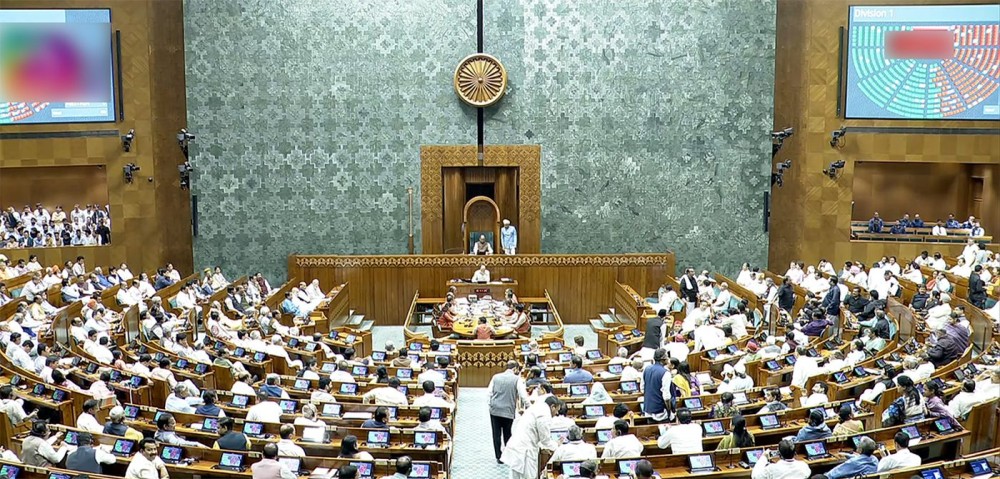
New Delhi, April 20 (IANS) The introduction of three key bills in the special sitting of Parliament – Constitution (131st Amendment) Bill 2026, Delimitation Bill 2026 and Union Territories (Amendment) Bill could have set in motion - one of India’s most consequential electoral reforms since Independence but the amendment failed to fetch two-thirds majority and eventually fell through in the House, stalling all three of them in one stroke.
The Women’s Reservation Bill, which could have become a reality and given 33 per cent reservation to women in politics after decades of waiting, was again pushed into cold storage as it became a “victim” of an intense face-off between the ruling party and the Opposition.
For three decades, the country’s polity has argued aggressively for “equitable representation” of women in legislative bodies by reserving one-third of Parliamentary and Assembly seats for women. The opportunity was once again lost in Lok Sabha, as the Centre’s Amendment Bill was defeated decisively over the Opposition’s objections of its linkage with the Delimitation exercise.
Bill’s purpose - to make women part of national policy-making
Presently, the women's representation in the country’s Parliament and State Assemblies remains low at around 14-15 per cent and 9 per cent respectively. This could be attributed to political parties' ignorance and undervaluation of their potential in politics as well as in policymaking.
The Constitution (131st Amendment) Bill 2026, by guaranteeing 33 per cent reservation to women, sought to institutionalise their presence in legislatures - not just as “tokenism or symbolism” but by seeking their active participation in shaping the country’s laws and budgets.
The bill, if passed, would have also given sub-reservation to women from the SC/ST community, within the stipulated 33 per cent quota. The bill had clearly stated goals, i.e. to make them part of the power matrix and bring a structural change in the way the country’s Parliament and legislatures function. This would have embedded their voice and opinions in decision-making, thereby facilitating their contribution in policy formulation.
Multiple missed opportunities for women’s quota in politics
Over the years, most political parties have pledged support for women’s quotas in politics, but the bill didn’t get Parliament’s approval in the past few decades, multiple times.
The constitutional amendments aimed at reserving seats for women in Parliament and state legislative assemblies were proposed in 1996, 1998, 1999 and 2008, respectively.
The latest instance in 2008 saw the bill passed through the Rajya Sabha, but it lapsed over the dissolution of the 15th Lok Sabha.
2023 and 2026 push for women’s quota
The Constitution Amendment Bill 2023, seeking to reserve one-third of seats in Lok Sabha and the state legislatures for women, was cleared by the Parliament decisively with near-unanimous support. This was seen as a major victory for women's empowerment, as it came after repeated rejections during the UPA eras, in the 1990s and 2000s.
In 2026, the Modi government, making a strong push for early implementation of women’s reservation, brought the Amendment bill linking it to Delimitation and exhorted all the political parties to support it, arguing that India cannot call itself a fully representative republic while women remain under‑represented in the core law‑making bodies.
It sought to fast-track the implementation of women’s reservation in politics and ensure its implementation before the 2029 General Elections, bypassing the earlier condition of holding it after the seat-redistribution exercise.
The amendment, if passed, would have turned the ‘idea’ of women's reservation in politics a reality, thereby stepping up their share from near 15 per cent to over 33 per cent, across party lines. This would have deepened women’s participation in politics, paving the way for their active role in decision and policy making. However, the defeat of the amendment in the Lok Sabha once again stalled it from operationalising.
Why did the opposition stonewall it
The women’s reservation bill, despite all-around support, failed to pass the Lok Sabha test primarily because of a united Opposition, which accused the government of pursuing its agenda of delimitation in the guise of women's quota.
From Congress to TMC to DMK, all expressed unequivocal support for the women’s reservation in principle, while reaffirming their support on previous occasions in 2010 and 2023, but opposed the 2026 amendment tooth and nail. Their prime contention was that the government reneged on its promise and attempted to amend the 2023 law, particularly over its stance on delimitation and federal balance.
They argued that linking the bill with the delimitation exercise and restructuring of constituencies was politically loaded and motivated. They claimed that this would not just change the electoral map of the country but would also alter the federal balance, expressing fears over increased demographic differences in the North and South states.
They raised an alarm over combining women’s reservation with delimitation and possible seat‑increase, stating that this could dilute their representation in the House.
A couple of Opposition factions argued for additional sub‑reservation within the 33% quota for women from Other Backward Classes (OBCs), claiming that the benefits would percolate to women from upper‑caste or socially dominant groups and therefore, insulating those from the disadvantaged class or community was essential.
They accused the Centre of using the women’s reservation debate as a pretext to rush through a broader delimitation plan.
What the LS setback means for women
The defeat of the Women’s Reservation Bill is widely seen as a major setback for women’s political empowerment in the country. The momentum for their greater presence in legislative bodies got significant momentum in 2023, but the latest blowback signals derailment of the drive.
This was an opportune moment to end their under-representation and ensure a healthy gender balance in Lok Sabha and State Assemblies, but that hope has been dashed.
The failure to convert the 2023 amendment into an implementable programme means that the tokenism and marginal representation of women will continue for another electoral cycle.
Many women activists and political watchers see this political divide, rather than politicking over delimitation and seat-redistribution, as the key reason for crushing women’s substantive gains at the altar of partisan calculations.
The opportunity, which could become a watershed moment in Indian polity by enhancing women’s share from 14-15 per cent to 33 per cent before the 2029 elections, stands lost and therefore rules out women’s influence in policy decisions on issues ranging from education, health, childcare and more.