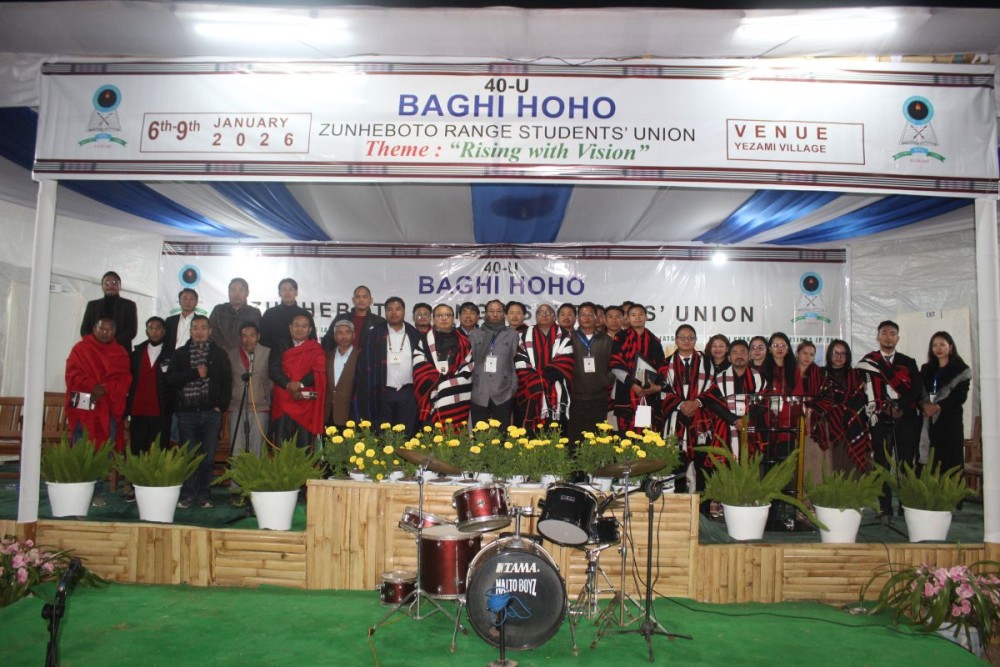
Programme officials along with ZRSU and LOC on opening day of the Zunheboto Range Students’ Union’s 40th General Conference at Yezami Village on January 6. (Morung Photo)
Morung Express News
Zunheboto | January 6
The Zunheboto Range Students’ Union (ZRSU) on January 6 officially kicked off its four-day 40th General Conference at Yezami Village under the theme “Rising with Vision.”
The opening was graced by Zhekugha Assumi, Proprietor of Step by Step School, Zunheboto, as the special guest, while Kakugha S Rotokha, President of the Zunheboto Area Public Organisation (ZAPO), shared greetings.
Viloto Aye offered the opening prayer, while the Baimho Students’ Union conducted the opening ceremony. The programme also featured a song by the host Yezami Village, followed by a welcome address by S Kivikhu Achumi, retired Additional Director, Department of Agriculture, and Chairman of the Yezami Village Council.
Meanwhile, the introductory session featured a special song by the Hekiye Students’ Union and the General Secretary’s report presented by Holonto S Zhimomi.
Delivering his address, ZAPO President Rotokha emphasised that conferences should not merely be ceremonial gatherings but platforms for vision-building and societal transformation. He encouraged the introduction of innovative programmes, career guidance initiatives, seminars on health and civic sense, and the effective implementation of resolutions.
Rotokha also expressed concern over the tendency of participants to disengage during the final sessions of conferences, stating that such practices undermine the purpose of the event. He further extended his best wishes to students promoted to the next class and those preparing for board and competitive examinations.
In his keynote address, Assumi highlighted Zunheboto’s historical identity, referencing Leucosceptrum canum (locally known as Zunhebo), and reflected on the values of giving and hospitality since 1973. Quoting Malcolm X, he said, “Education is the passport to the future, for tomorrow belongs to those who prepare for it today,” adding that education is not merely the learning of facts but the training of the mind to think.
Assumi spoke extensively on career awareness, noting that many traditional jobs such as postmen, typists, switchboard operators, printing press workers and elevator operators are gradually disappearing due to technological advancements. In contrast, he highlighted careers that did not exist 20 years ago, including app developers, influencers, podcast producers, social media managers and AI engineers.
He further discussed future job trends, pointing to agriculture-based workers, delivery drivers, software developers, shop salespersons, food processing workers, nursing professionals, food and beverage service workers, and general and operations managers as occupations likely to remain in demand.
Addressing the impact of Artificial Intelligence (AI), Assumi said AI is reshaping the world of work, while green economy jobs linked to sustainability and climate change, along with healthcare—particularly mental health services—will see growing demand.
He stressed that while AI may replace many roles, professions such as doctors, therapists, educators, lawyers, engineers, artists, leaders and politicians will continue to rely on human judgement and leadership.
Assumi also spoke on multiple intelligences, identifying nine types—logical, linguistic, spatial, musical, kinesthetic, interpersonal, intrapersonal, naturalistic and existential intelligence. He urged students to identify their unique gifts, stating that self-awareness is key to personal transformation.
He further stressed the importance of soft skills, critical thinking and adaptability, along with employability skills such as confidence, attitude, accountability, teamwork, time management and stress management.
“The real voyage of discovery lies not in seeking new landscapes, but in having new eyes,” he said, encouraging students to embrace change and lifelong learning.