EAC Kudazo Swuro along with participants during the skill development training programme held at Cultural Hall, Shamator on January 19. (DIPR Photo)
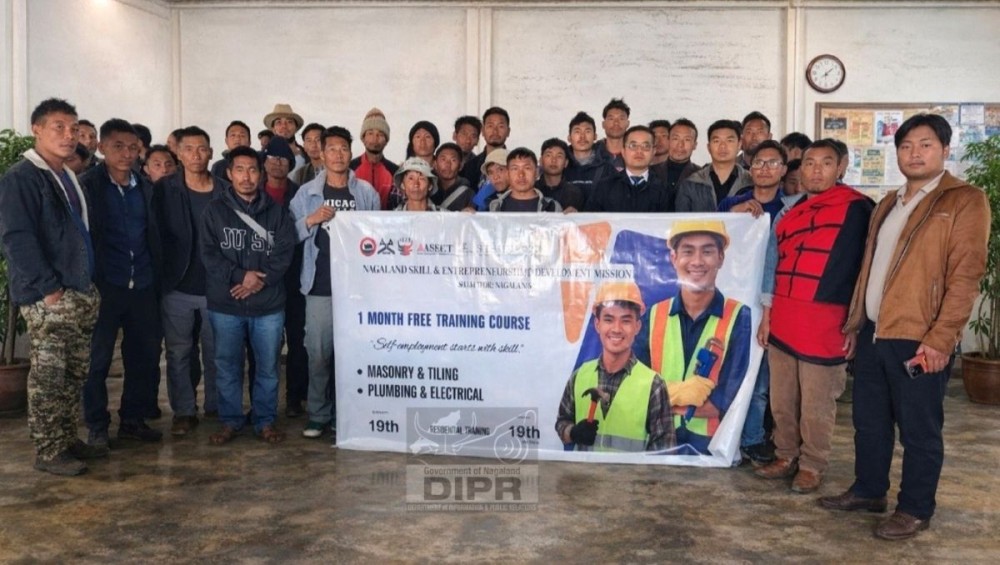
Shamator, January 19 (MExN): A skill development training programme was initiated in Shamator on January 19 in collaboration with the Nagaland Skill and Employment Development Mission (NSEDM), with AISECT as the training partner. The programme was launched at the Cultural Hall, Shamator.
Addressing the participants, Extra Assistant Commissioner (EAC) Shamator, Kudazo Swuro, highlighted the critical importance of skill development in the present socio-economic context. He said that with the rapid expansion of civil construction works in Shamator district as well as in neighbouring districts, there is a growing demand for skilled manpower in key trades such as masonry, tiling, electrician and plumbing.
Urging the participants to view these trades not merely as livelihood options but as avenues for long-term economic growth, the EAC said civil works within the district should be undertaken by skilled local workers instead of depending on outside labour.
He further encouraged the trainees to look beyond the district and explore employment opportunities in other districts by exporting skilled manpower, thereby strengthening the local economy. Highlighting opportunities in the international construction sector, Swuro said skilled workers are in high demand in foreign countries, where they can earn substantially and contribute to the local economy through remittances.
Drawing comparisons with countries such as Japan and South Korea, the EAC observed that their economies are largely driven by skilled manpower. He stressed that Shamator district must adopt a similar skill-driven development model to boost economic growth and self-reliance.
Swuro informed that the district administration has set an ambitious target of skilling 3,000 youths across various trades and is working towards making Shamator the first 100% skilled district in the coming years.
The EAC expressed appreciation to AISECT for partnering with the district administration and for deploying competent and experienced trainers. He expressed hope that the organisation would continue to support skill development initiatives in the district.
He also acknowledged the role played by the Rhimoru Society in mobilising and organising youths willing to undergo skill training, and urged the society to continue working towards the shared vision of a fully skilled district.
The response to the programme was encouraging, with 200 participants registering for the 30-day training programme, including 50 women, reflecting inclusive participation and a growing interest among women in skill-based livelihoods.
The programme marks an important step towards empowering youths through skills, promoting self-employment and fostering sustainable economic development in Shamator district.