For more than a century, our Naga ancestors have remained far from the hills where they lived and died. Their remains were taken during the colonial period and eventually became part of museum collections thousands of kilometres from their homeland.
Now, after years of negotiations, their return is becoming a reality.
The Forum for Naga Reconciliation (FNR) and Recover, Restore and Decolonise (RRaD) held the third September Dialogue at The Lighthouse Church in Dimapur on September 5, 2026. The dialogue, themed "Returning to Wholeness through Healing," focused on what the return of ancestral remains means for the Naga people and how repatriation can contribute to healing, reconciliation, and the reclaiming of history.
The dialogue came at a significant moment. After six years of negotiations, the University of Oxford Council formally agreed in July 2026 to return 39 Naga ancestral human remains held at its Pitt Rivers Museum. One additional set was not approved for return because the university said there was insufficient evidence to establish its Naga origin.
More Than Remains
For FNR Convenor Rev Dr Wati Aier, repatriation is about much more than returning human remains. It is connected to restoring dignity, memory, belonging, and a sense of wholeness to a people carrying collective and intergenerational wounds from colonial intrusion, political violence, and cultural disruption.
Rev Dr Aier called for a form of "redemptive memory," remembering historical suffering without allowing it to permanently define the future. The return, he suggested, should become an opportunity for Nagas to move from being merely recipients of a painful history to becoming the storytellers of their own past. This distinction is important because repatriation cannot, by itself, erase generations of historical trauma.
Dr Visier Sanyü, an academician and FNR member, described the repatriation journey as one marked by anger, hope, healing, and reconciliation. He said the return could restore a relationship interrupted by colonialism but would not automatically resolve every historical wound.
Who Tells the Story?
One of the deeper questions raised during the dialogue was, “Who has the authority to interpret Naga history?"
Dr Sanyü emphasised that the problem with colonial representation was not necessarily that everything Western observers recorded was false. Rather, colonial authorities possessed the power to decide which aspects of Naga life were important enough to document and represent.
This makes repatriation more than a question of returning physical remains. It also becomes a question of knowledge and representation. Decolonisation, Dr. Sanyü stressed, should not mean rejecting Western scholarship or refusing to engage with museums and archives. Instead, it requires examining the unequal relationships through which knowledge about the Nagas was historically produced and asking whose voices were left out.
For younger Nagas, this creates another responsibility: to research, question, and reinterpret historical records rather than allowing colonial archives to remain the only voice telling their story.
From Oxford to Home
The current repatriation effort began in 2020, when Pitt Rivers Museum Director Prof Laura Van Broekhoven approached FNR regarding the return of Naga ancestral remains. FNR subsequently established RRaD, bringing together Naga academics, researchers, elders, tribal leaders, and communities in the process.
A Naga delegation later visited the Pitt Rivers Museum in Oxford in June 2025. For those who saw the remains there, the issue was no longer an abstract historical debate. It became a deeply personal encounter with ancestors separated from their homeland.
The museum has also acknowledged that the historic acquisition of human remains does not meet present-day ethical standards and has moved towards greater engagement with communities over repatriation.
One Burial, Many Communities
Another significant decision concerns where the ancestors will rest.
Although the remains are connected to different Naga communities, tribal leaders and FNR have decided that they will be received as Naga ancestors and given a dignified communal burial in Kohima.
According to Angami Public Organisation President Thejao Vihienuo, the decision reflects the desire to treat the remains collectively as part of one Naga community. The intention is to avoid creating further divisions over lineage, and instead allow the burial to become a testimony to Naga oneness.
For the Phom community, the return carries particular significance, with Phoms accounting for about 24 of the 39 remains expected to come home. The decision to bury them together therefore carries a strong symbolism: ancestors who may have belonged to different communities in life will return to the homeland together.
What Happens After They Come Home?
The homecoming, however, is not the end of the story.
The September Dialogue suggested that repatriation should become part of a wider process of remembering, researching, and healing. The physical return of the remains may provide a moment of closure, but the deeper challenge is what the living choose to do with the history that comes with them.
The Pitt Rivers collection contains not only human remains but also photographs, objects, and records connected to Naga history. These materials can provide opportunities for younger researchers to examine the past while also questioning the colonial perspectives through which much of that history was originally recorded.
The ancestors coming home, therefore, may mark more than the end of a long journey from Oxford to Nagaland. It can also mark the beginning of another journey: one in which Nagas reclaim the authority to remember, interpret, and tell their own history. The return of 39 ancestors cannot undo colonialism or erase every wound inherited from the past. But it can create a space to confront that history honestly.
The September Dialogue ultimately asks the living to look beyond the remains themselves. The ancestors are coming home. The question now is whether their homecoming can help the living come home to their own history, their memory, and, perhaps, to one another.
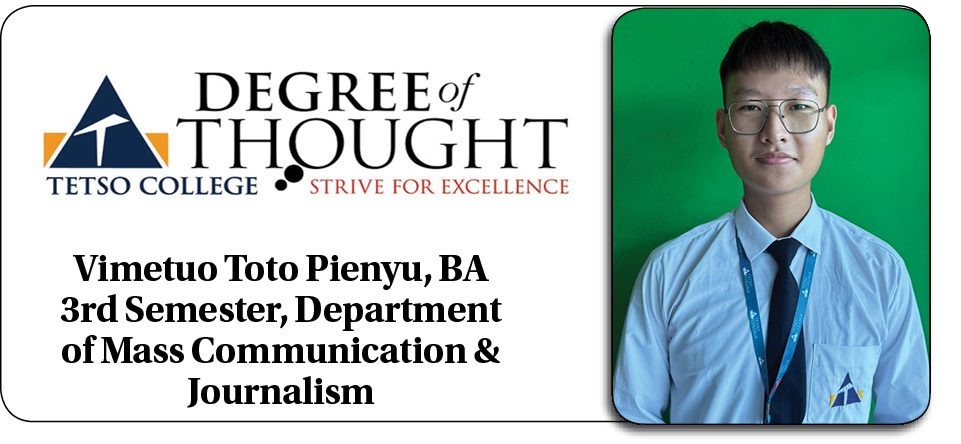
Degree of Thought is a weekly community column initiated by Tetso College in partnership with The Morung Express. Degree of Thought will delve into the social, cultural, political, and educational issues around us. The views expressed here do not reflect the opinion of the institution. Tetso College is a NAAC-accredited, UGC-recognised Commerce and Arts College. The editorial team includes Tenipumei Phom, Asst. Professor Dept. of English, Limajungla Walling, Asst. Professor Dept. of Linguistics, and Munkiri Taro, Multimedia Executive. For feedback or comments, please email: [email protected]