Vevoyi Wideo with Governor of Nagaland in Kohima on November 17.
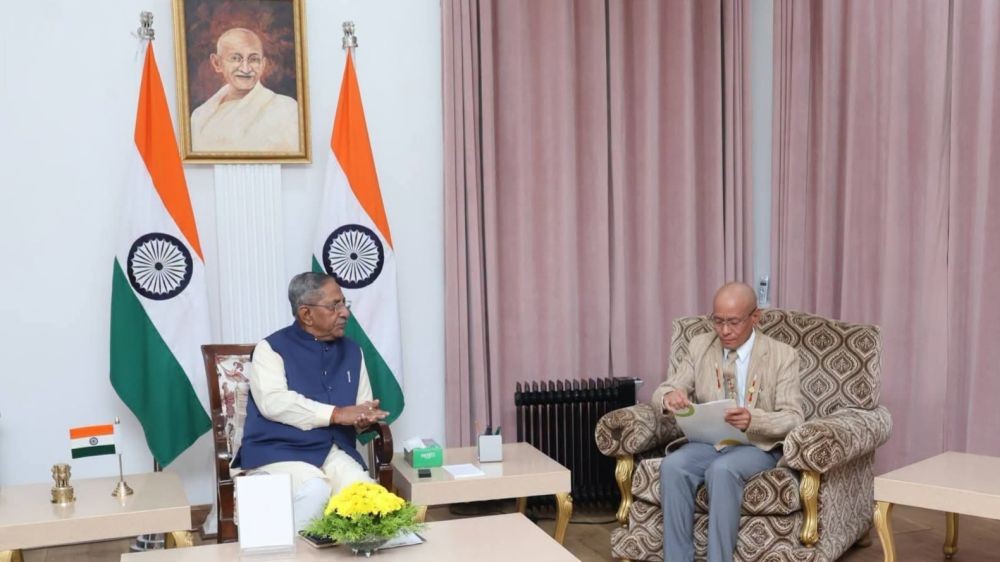
Submits representation to Governor of Nagaland
Kohima, November 17 (MExN): The National People’s Party (NPP) has submitted a representation to the Governor of Nagaland Nand Kishore Yadav, seeking a constitutional examination of the applicability of the Wild Life (Protection) Act, 1972, and its subsequent amendments to the state, citing the special safeguards under Article 371A of the Constitution.
In the representation submitted by NPP National Vice President Vevoyi Wideo on November 17, the party has urged the Governor to refer the matter to the state government for a thorough legal and constitutional review, emphasizing that the issue involves questions of customary law and protected community interests.
Constitutional questions raised
The representation points out that the Nagaland Legislative Assembly had adopted the Wild Life (Protection) Act, 1972, through a resolution on September 18, 1981. However, the party has sought verification of the terms and legal effect of that resolution, along with the relevant Gazette notification, from official records.
The NPP has raised concerns that the principal Act has undergone substantial amendments through the Wild Life (Protection) Amendment Acts of 1991, 2002, 2006, and 2022, introducing revised regulatory provisions, amendments to Schedules, additional institutional arrangements, and enhanced penalties. The party has questioned the legal basis on which these amended provisions are applicable in Nagaland, particularly where their operation may affect matters protected under Article 371A(1)(a).
Article 371A(1)(a) provides that no Act of Parliament in respect of specified matters shall apply to Nagaland unless the Nagaland Legislative Assembly so decides by a resolution. These matters include the religious or social practices of the Nagas, Naga customary law and procedure, and ownership and transfer of land and its resources.
“Hunting and the relationship of Naga communities with their natural environment have, in various local contexts, formed part of customary practices, community traditions and established systems of village-level regulation,” the representation stated, adding that the extent to which particular practices are protected under Article 371A requires consideration in light of relevant customary laws, facts, and applicable judicial precedents.
Concern over uncertainty
The NPP has clarified that it does not seek to question the importance of wildlife conservation or the legitimate objectives of wildlife-protection legislation. “The concern is limited to ensuring that the applicable legal framework is examined and implemented in a manner consistent with the constitutional protections guaranteed to Nagaland under Article 371A,” the representation stated.
The party has highlighted that in the absence of authoritative clarification, uncertainty has arisen among enforcement authorities and local communities regarding the legal position, particularly in circumstances involving customary practices and wildlife-related enforcement. “Such uncertainty has given rise to avoidable disputes and tensions,” it noted, adding that a considered examination by competent authorities would help ensure wildlife conservation is pursued in accordance with applicable law while giving due regard to the constitutional status of Naga customary practices.
Prayer to Governor
The NPP has prayed that the Governor may consider causing the representation to be referred to the Government of Nagaland for examination of the constitutional and legal issues raised, having regard to Article 371A and the Governor’s constitutional responsibilities.
The party has also requested that the matter be brought to the attention of competent authorities, including the Speaker of the Nagaland Legislative Assembly, and that the state government be asked to verify and furnish relevant official records, including the 1981 resolution and Gazette notification, along with any subsequent resolutions concerning the Act or its amendments.
Further, the NPP has sought a reasoned examination of the applicability of the Wild Life (Protection) Amendment Acts of 1991, 2002, 2006, and 2022 in Nagaland, particularly in relation to matters specified in Article 371A(1)(a), and consideration of whether any further resolution, legislative clarification, or other lawful measure is required.
The party has also urged consideration of whether a suitable Nagaland-specific administrative or legislative framework may be developed, consistent with the Constitution and applicable law, to address the relationship between wildlife conservation and recognised Naga customary practices.
“The National People’s Party respectfully submits that this representation is made bona fide in the public interest, with the objective of securing constitutional clarity, promoting lawful administration and avoiding unnecessary disputes, while recognising the importance of wildlife conservation and the constitutional safeguards applicable to Nagaland,” the representation concluded.