Case concerns appointment of Old Jalukie Village Council Chairman
Morung Express News
Kohima | November 17
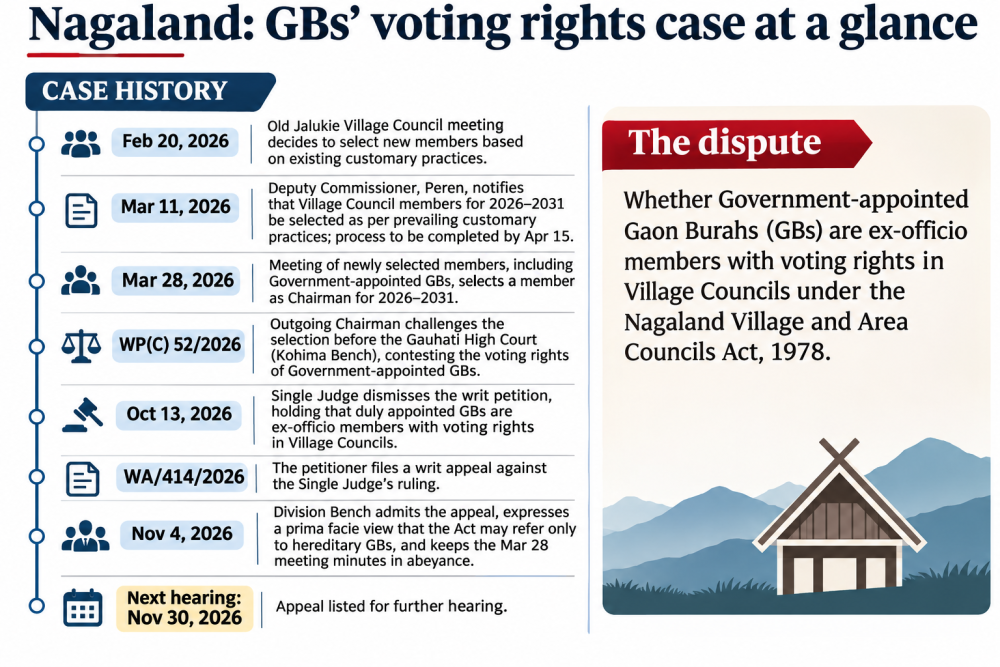
The Gauhati High Court has admitted an appeal challenging a Single Judge’s October 13, 2026 ruling that upheld the voting rights of Government-appointed Gaon Burahs (GBs) in Village Councils in Nagaland, expressing a prima facie view that the relevant provision of the Nagaland Village and Area Councils Act, 1978, may apply only to hereditary GBs and not those appointed by the State Government.
In an interim order dated November 4, a Division Bench comprising Justice Kalyan Rai Surana and Justice Rajesh Mazumdar directed that the minutes of a meeting held on March 28, 2026, selecting the Chairman of the Old Jalukie Village Council for the 2026–2031 tenure, remain in abeyance and not be given effect until the next date of listing.
The appeal filed by a former Chairman of the Old Jalukie CC challenged a single judge's October 13 order dismissing his writ petition challenging the selection of another as Chairman of the Village Council.
As per the November 4 order, the appellant contended that Section 4 of the Act grants ex-officio membership and voting rights only to hereditary Village Chiefs, GBs and Angs. He argued that Government-appointed GBs, whose positions are not hereditary, could not be treated as ex-officio members and therefore had no voting rights in the selection of the Village Council Chairman.
The State government opposed the appeal, maintaining that GBs have historically been integral to the customary governance framework of the Zeliang community.
It submitted that Sections 4 and 7(1) of the Act recognise GBs as ex-officio members without distinguishing between hereditary and Government-appointed office holders.
Prima facie observations
Examining the provisions of the Act, the Division Bench observed that Village Councils were required to comprise members chosen by villagers under prevailing customary practices, alongside ex-officio members.
The Bench noted that while hereditary Village Chiefs and Angs derived their positions through inheritance, the appointment of GBs involved a role for the Government.
It observed that the term ‘GB’ under Section 4 must be read in consonance with the words preceding and following it, and expressed the prima facie view that it referred to GBs holding the position by inheritance rather than through Government appointment.
The Bench further observed that allowing Government-appointed GBs to participate as ex-officio members with voting rights could affect the independence and autonomy of Village Councils, which did not appear to be the legislative intent of the 1978 Act.
Referring to the proceedings of March 28, the Court also noted that five newly selected Village Council members had initially expressed their intention to support the appellant for the chairmanship.
However, following the participation of Government-appointed GBs in the subsequent meeting, the numbers shifted in favour of the private respondent, with nine members supporting him.
“This primarily confirms our view that, with the introduction of Government appointed GBs, the independence and autonomy of the Village Councils to act and select the Chairman would be impaired,” the Bench observed.
Holding that the matter required further consideration, the Bench admitted the appeal and directed that the minutes of the March 28 meeting remain in abeyance and not be given effect until the next date of listing.
Issuing notices, the court listed the matter for further hearing on November 30.