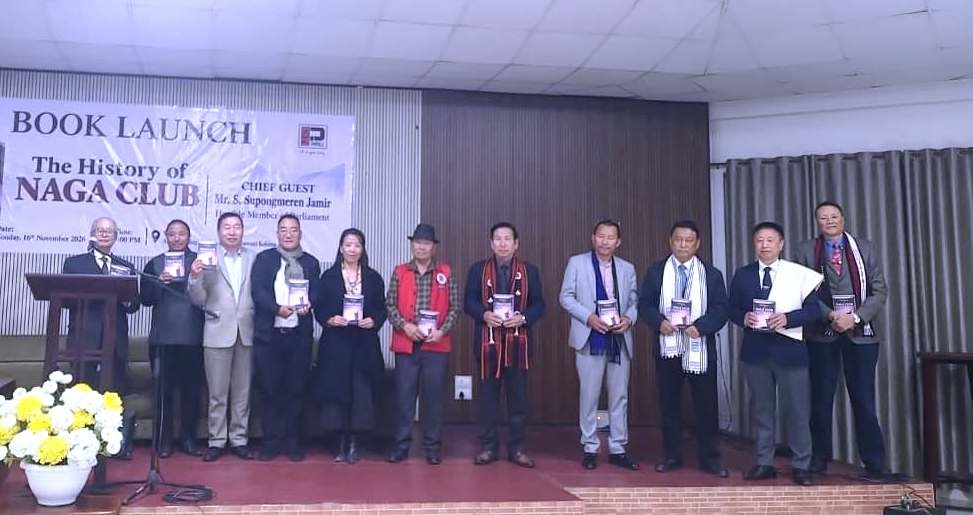
S Supongmeren Jamir with others during the launch of book “The History of Naga Club” in Kohima on November 16. (Morung Photo)
Our Correspondent
Kohima | November 16
A book on “The History of Naga Club,” authored by Kuolachalie Seyie and published by PenThrill Publishing House was launched today by MP Lok Sabha, S Supongmeren Jamir as the chief guest at AWO Building, Kohima.
Speaking on the occasion, Jamir described this book as step forward for Nagas, stating that it would serve as an important resource for the younger generation to understand the history and struggles of the Nagas.
Reflecting on the Naga struggle for freedom, Jamir recalled that the Nagas had clearly expressed their desire for independence before the Simon Commission, urging the British to leave the Nagas alone.
He said the message conveyed to the British was that the Nagas represented a distinct civilization with their own identity and aspirations.
Further, Jamir called upon the people to remain united and support one another for the progress and upliftment of Naga society.
Brief history of Naga Club
Sharing the brief history of Naga Club, Naga Club president Kuolachalie Seyie, said “The arrival of the British in our land in the 19th Century and the subsequent establishment of their administrative presence in Kohima provided our erudite and educated forefathers of those days, particularly among the Deputy Commissioner's staff in Kohima, to keenly observe the strong, unwavering unity and profound spirit of nationalism among the British colonial officers.”
Seyie said that inspired by the role played by the British Clubs, “our forefathers were convinced that they needed to create a platform where all Nagas could come together with the noble objective of promoting Naga unity, the spirit of Naga nationalism and the concept of Naga nationhood, our erudite forefathers established the Naga Club on 7 January 1918.”
He said that they established a magnificent free guest house below Mission Compound, Kohima, that provided accommodation and other essential facilities to their guests arriving from different parts of Nagaland.
The residents of Kohima consisting of various Naga communities would visit the guest house, interact with the visitors, read newspapers, then sharing the important events amongst them was the centre of an attraction in the Naga Club as newspapers were not circulated among the local Naga population in those days and others enjoy various indoor games and card games.
This significant institution became known as the "Naga Club", he said.
In this manner, the educated forefathers succeeded in establishing brotherhood and personal relationships with people from different parts of Nagaland.
Through the friendship and mutual understanding, they helped overcome the hated deep-rooted head- hunting culture for trophy, suspicions and mistrust among Nagas who traditionally regarded one another as enemies.
“This was how they gradually transformed a society of mutual hostility into one of brotherhood, a people and a nation with collective identity,” he said.
He said that the historic visit of the Simon Commission on 10 January 1929, and the subsequent representation made by the Naga Club, were significant consequences of these remarkable nationalist activities.
This historic event is commemorated today as Naga National Day, popularly known as Magna Carta Day by the Nagas.
The dedication, sacrifices and extraordinary vision of our forefathers coupled with efforts not merely directed towards establishing an organisation; laid the foundations of Naga unity, nationalism, brotherhood and nationhood for generations to come, he said
Publisher note
Sharing the publisher’s note, Vishü Rita Krocha of PenThrill Publication House, said that today’s book launch was its 130th publication. “Today, we are releasing a definitive account of an epoch that shaped the very course of our Naga political history,” she said.
The importance of publishing and preserving this kind of historical documentation cannot be overstated,” she said.
Formed on 7 January 1918 by a visionary group of educated Nagas, the Naga Club emerged as the first public organization dedicated to uniting a distinct people and preserving their unique way of life.
“At a time when our people were confronting unprecedented geopolitical changes, the founders possessed the foresight to understand that we had to unite and work together to survive as a society. They recognized that our independent way of life was of paramount importance if our ancestral land, culture, and history were to be safeguarded,” she said.
This thoroughly researched book chronicles that pioneering journey—from the fostering of fraternal bonds to the charting of our political destiny, she said.
At the heart of this legacy is the historic 1929 Memorandum to the Simon Commission, which stands as the first written political statement asserting the Nagas’ historical rights and our fundamental desire to determine our own future, she said.
Presidents of Chakhesang Public Organization, Angami Public Organization, Rengma Hoho, Kohima Lotha Hoho, Kohima Sumi Hoho and Kohima Gaon Bora also spoke at the programme.
Prasielie Pienyü, convenor, Descendants of the Signatories presented the books to the descendants of founders and signatories.
Rüsokhrie Group and Thejavir Tsiekha presented special numbers. Lujeka and Rev. Dr. Hotokhu P. Zhimomi, Chaplain, Naga Club prayed for the programme.
The programme was chaired by Vizosienuo Shüya.