• Holds written examination valid under 1999 Rules; finds no arbitrariness or prejudice
• Recruitment for 46 posts attracted 11,521 applications
Moa Jamir
Dimapur | November 16
The Supreme Court of India, on November 16, has dismissed an appeal challenging the introduction of a written examination midway through the recruitment process for 46 Excise Constable posts in Nagaland, upholding the Gauhati High Court Kohima Bench judgment that had allowed the State Government to proceed with the selection.
In its judgement, a Bench of Justice Prashant Kumar Mishra and Justice Shree Chandrashekhar held that the written examination was permissible under the Nagaland Excise Service (Revised) Rules, 1999, and did not render the recruitment process arbitrary.
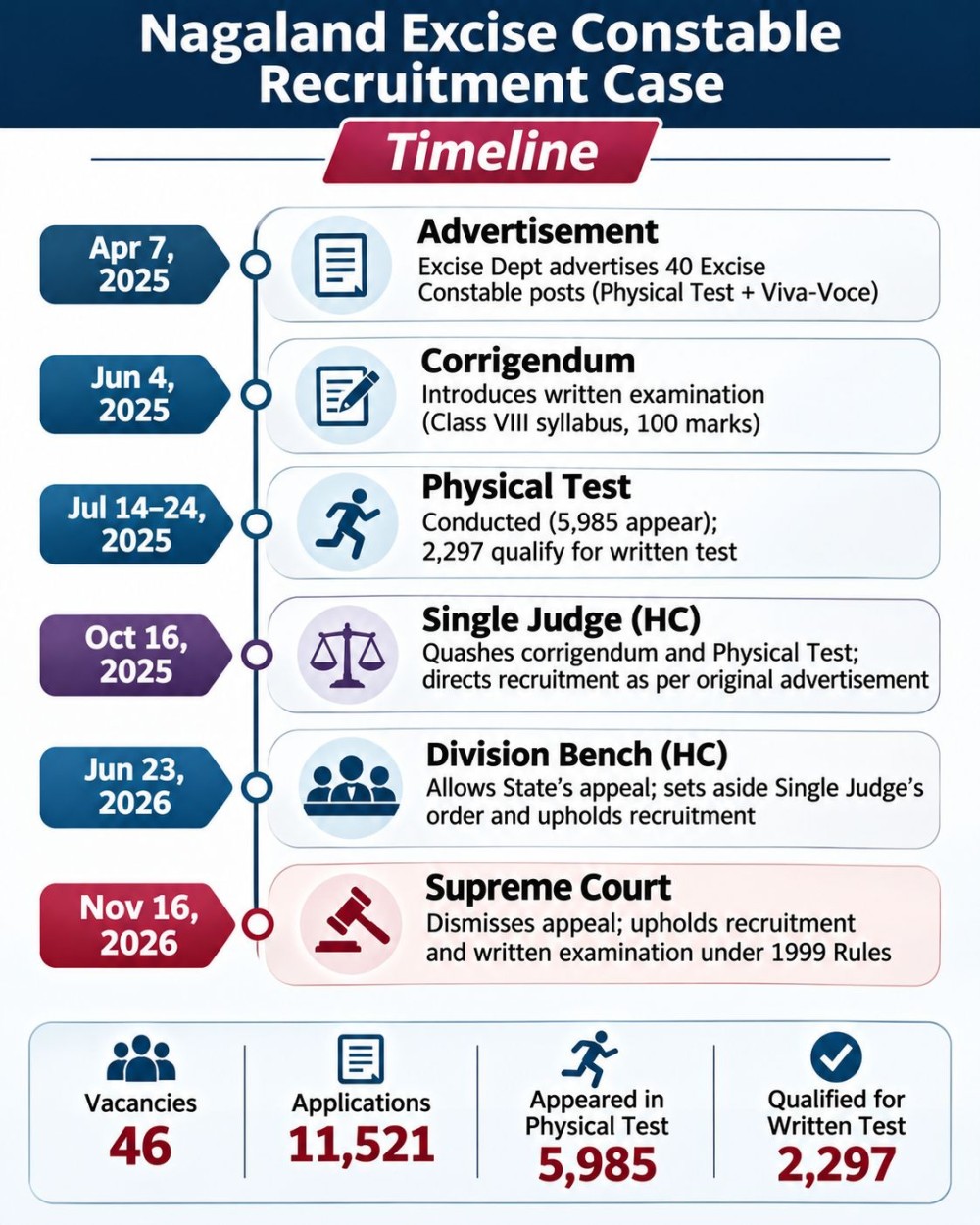
The Court found no ground to interfere with the Division Bench judgment dated June 23, 2026, which had set aside an earlier Single Judge order quashing the recruitment process and accordingly dismissed the special leave petition.
Background and challenge
As per the Court’s records, the case originated from the Department of Excise and Prohibition advertisement for 40 Excise Constable posts on April 7, 2025, subsequently adding six posts through an addendum dated May 14, taking the total vacancies to 46.
The recruitment was governed by the 1999 Rules, which prescribe direct recruitment through competitive examination/selection and Class VIII as the minimum educational qualification.
The original advertisement prescribed a two-stage process comprising a Physical Test and a Suitability Test/Viva-Voce. However, through a corrigendum dated June 4, 2025, the Departmental Recruitment Board introduced a written examination, based on the Class VIII syllabus, carrying 100 marks.
The appellants contended that the change violated the original advertisement and that selection criteria could not be altered after recruitment had commenced. Relying on the 1999 Rules and a July 19, 2016 Memorandum issued by the Commissioner of Excise and Prohibition, they also questioned the Board’s authority to modify the selection procedure midway.
However, the State respondents argued that the written test was necessary given the scale of recruitment. It received 11,521 applications for 46 posts; 5,985 candidates appeared in the Physical Test, of whom 2,297 qualified for the written examination. The State maintained that an objective screening test was required to manage the large number of candidates and ensure fairness.
It also pointed out that all appellants, except one, had participated in the Physical Test, while 10 of the 16 had appeared in the written examination.
Contrasting High Court rulings
Earlier, a Single Judge of the GHKCB had allowed the candidates’ writ petition on October 16, 2025, holding that although the Government could prescribe a selection method where the rules were silent, it had to be specified in the original advertisement and could not be introduced midway.
This, the Single Judge quashed the June 4 corrigendum and the Physical Test, directing the State to proceed under the original advertisement and the 2016 Memorandum or issue a fresh advertisement if it intended to introduce a written examination.
The State challenged the order. On June 23, 2026, the Division Bench allowed the appeal and set aside the Single Judge’s judgment. The candidates subsequently approached the Supreme Court.
During the proceedings, the State informed the Supreme Court that the recruitment had been completed by June 30, 2026. Of the 2,297 candidates who cleared the written examination, 211 were called for interview. Following interviews held from February 19 to 21, the list of 46 selected candidates was notified on June 29. All selected candidates conveyed their acceptance by July 8.
The State submitted that the process had remained in abeyance solely because of the litigation. The appellants, however, argued that publication of the select list did not render the appeal infructuous as the candidates were yet to be appointed.
Supreme Court’s reasoning
The Supreme Court held that the recruitment did not contravene the 1999 Rules. It noted that Rule 5(i)(a) provides for direct recruitment through “competitive examination/selection”, while Rule 7(1) provides for a Selection Board. The Court held that a written examination based on the prescribed Class VIII syllabus fell within the meaning of competitive examination/selection under Rule 5(i)(a). Consequently, the requirement under Rule 5(ii) for Government consultation with the Commission when adopting a different recruitment method was not attracted.
The Court also rejected the appellants’ reliance on the 2016 Memorandum, agreeing with the Division Bench that it had neither been confirmed by the Selection Board nor notified by the State Government, and had not been strictly enforced in previous recruitment processes. At its highest, the Memorandum merely prescribed minimum physical and medical standards for various athletic activities.
It further noted that the Departmental Recruitment Board had been constituted in accordance with Rule 7 and the decision taken at a September 16, 2024 meeting chaired by the Chief Minister. The original advertisement also empowered the Board to rectify omissions through notifications and addenda, and to take final and binding decisions on recruitment-related disputes.
On the central question of introducing the written test after the advertisement, the Court held that the measure was not arbitrary. The appellants had also questioned the written examination carrying 100 marks against 12 marks for the Viva-Voce.
Rejecting this contention, the Supreme Court observed: “An objective written examination, based on the already-prescribed Class VIII standard, provides a means of assessing candidates on a common basis and avoids placing disproportionate reliance on the comparatively subjective assessment inherent in a Viva-Voce.”
The Court considered the written test justified in view of the exceptionally large number of applicants for the limited vacancies. It also noted that the corrigendum had been widely publicised in local newspapers, in keeping with the earlier Government resolution.
Further, all candidates who qualified in the Physical Test were subjected to the same requirement and given an equal opportunity to participate.
The appellants, the Court held, had failed to demonstrate that the revised process operated discriminatorily or caused them prejudice, particularly as they had participated despite being aware of the change.
Holding that recruiting authorities have discretion to devise selection and shortlisting procedures where the applicable rules do not prescribe a detailed method, the Supreme Court found no ground to interfere with the High Court Division Bench judgment and dismissed the appeal.