Morung Express News
Dimapur | August 10
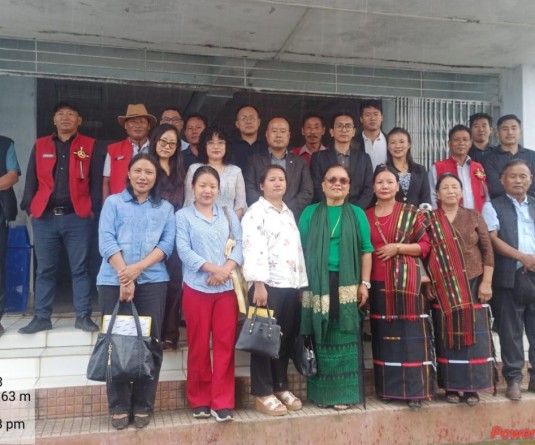
After a gap of more than five months since the Shiroi stand-off between the Assam Rifles and the NSCN (IM), the ceasefire monitoring group (CFMG) today held a meeting here at Chumukedima Police Complex, and discussed various “irritants” coming in the way of smooth implementation of the ceasefire ground rules.
Emerging from the closed-door meeting, CFMG chairman General Mandhita Singh told media persons that the meeting focused on how to keep the communication channels between the law enforcing agencies and the underground factions “open,” to prevent any misunderstanding. The chairman said the CFMG members discussed certain points of “mutual concern.” These issues included how to deal with “people” of criminal backgrounds, the issue of capital punishment and the rampant extortion in the state.
It was informed that the CFMG members also discussed on the situation in NC Hills, Assam, and Tirap and Changlang districts of Arunachal Pradesh. “Other irritants like the issue of passes to senior functionaries of factions and checking conducted by security forces on certain routes were also discussed,” the General said. On the current situation in Nagaland vis-à-vis factional violence, he said it was encouraging that inter-factional clashes and killings have reduced decreased. The CFMG chairman however noted that although the overall violence in the state had certainly come down, the biggest concern was that of “unbridled extortion and abduction for money” still remained.
On implementation of the standard operation procedure (SOP), which is strongly opposed by the NSCN (IM), Singh hinted on how the groups can be incorporated into the whole process. “We are not adverse to involvement of representatives of faction in sorting out problems,” he added.
Nagaland Commissioner HK Khulu, who also attended the meeting, said today’s CFMG meeting was held in a cordial atmosphere and termed the discussions as “fruitful.” He hoped that outcome would be positive and that things would improve. Nagaland’s Director General of Police K Kire and IGAR (N) JP Nehra and top officials from the security forces also attended the meeting.
‘SOP not part of CF agreement’
The NSCN (IM) has reiterated its opposition to the SOP. It has said that the SOP, issued by the Home Ministry during the brief stint of President’s Rule in Nagaland in 2007, had nothing to do with the ceasefire agreement between the Government of India and the NSCN (IM).
Convener of ceasefire monitoring cell of the NSCN (IM), “major general” Phungthing Shimrang who headed the six-member team of the faction in today’s CFMG meeting, later told media persons that the main point they put forward was that whatever agreement the Government of India had entered upon was the latter’s concern.
“If GoI is able to handle that (SOP) with other groups, well and good. But what GoI and NSCN have agreed upon should be followed. SOP has nothing to do with the ceasefire agreement between NSCN and GoI,” he said.
On earlier occasions, Phungthing had said that the SOP especially violated clauses (a) and (j) of the revised CFGR, which stated that the Indian Army would not carry out offensive operations against the group. Further, all cases of violation of the ground rules would be referred to a monitoring group comprising of the NSCN (IM), NGOs and representatives nominated by the Government of India.
On reports of Muivah’s recent “clandestine” visit to Nagaland, Phunthing refuted it and said it was mere speculation and mischief. To a query on their involvement in the NC Hills, he said, “If we have been involved, things would have been different long back. In fact we told our men there not to involve,” he asserted.