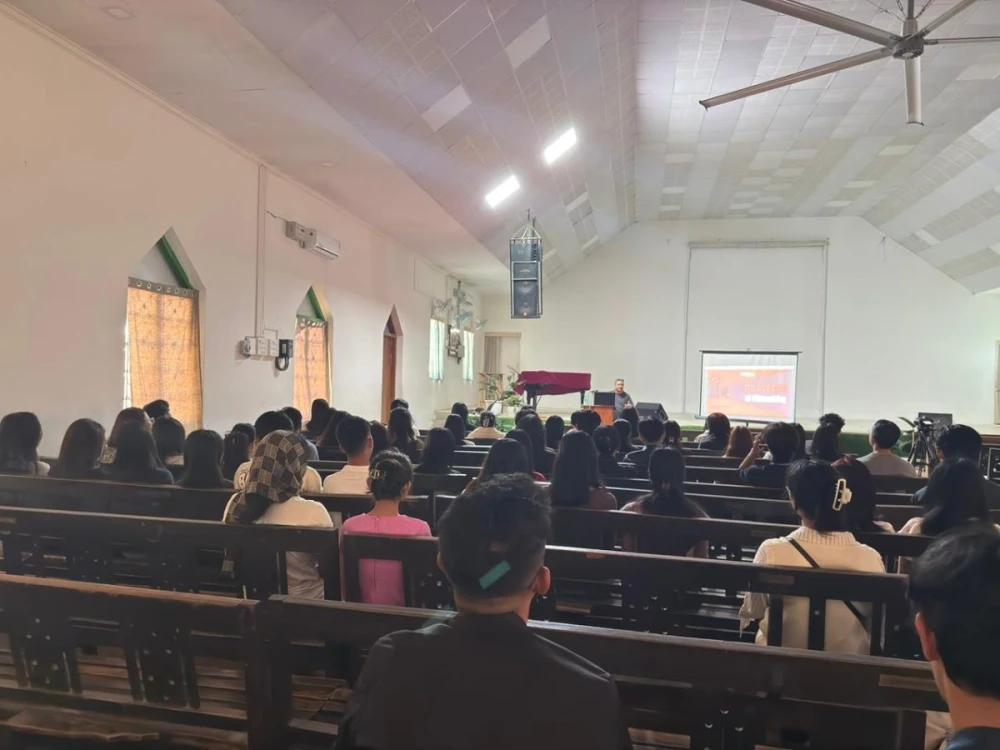
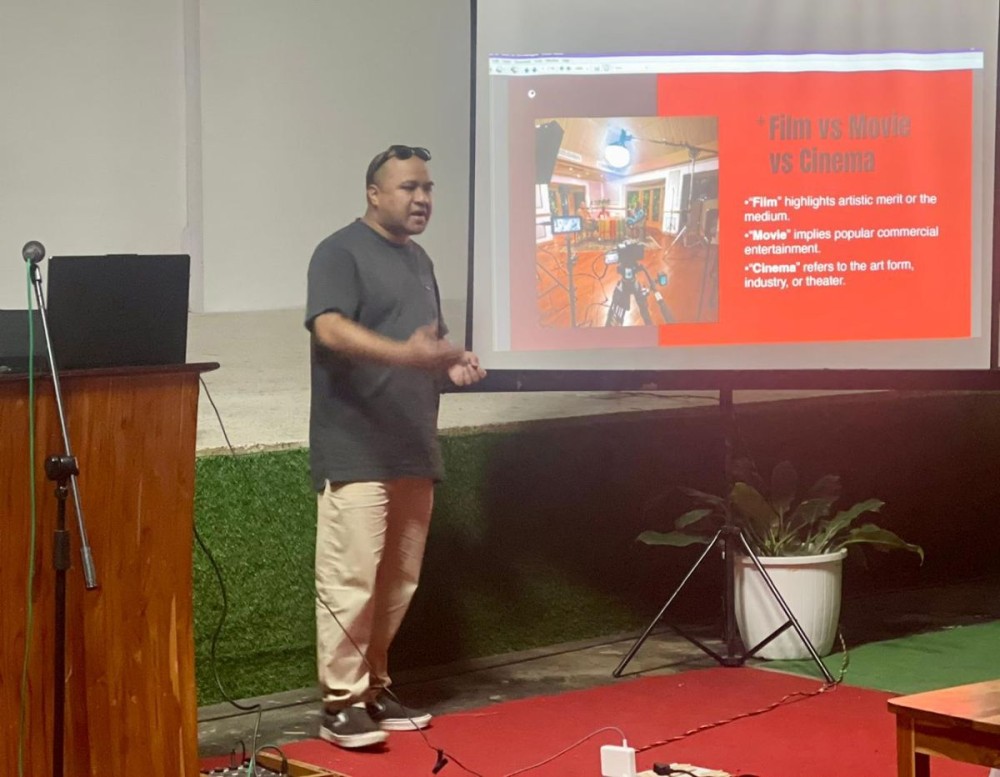
Co-founder and Creative Producer at The Hillspeople Collective, Meghalaya, Tyrel Reuben Lyngdoh addresses a filmmaking workshop on the concluding day of the three-day Campus Film Festival at Patkai Christian College (Autonomous) on January 24. (Morung Photo)
Highlights pathways and challenges in filmmaking
Morung Express News
Dimapur | January 24
Describing cinema as a medium through which communities preserve their own memory and shape how they are remembered by others, filmmaker Tyrel Reuben Lyngdoh on Saturday said regions like the North East must tell their own stories rather than rely on externally shaped narratives.
Addressing a film production workshop on the final day of the fifth edition of the three-day Campus Film Festival organised by the Department of Mass Communication, Patkai Christian College (Autonomous), he underscored the importance of authentic storytelling that responsibly reflects local histories, lived realities and contexts.
Explaining what filmmaking really is, Lyngdoh said that while passion often draws people to cinema, filmmaking is fundamentally a collaborative process. Individual creativity, he noted, must align with teamwork, shared vision and sustained effort to bring stories meaningfully to the screen.
From idea to screen
Outlining the process from idea to screen, Lyngdoh, who is also the Co-Founder and Creative Producer at The Hillspeople Collective, Meghalaya, stressed the importance of understanding pre-production, production and post-production as interconnected stages. Planning, preparation and patience at each phase, he said, play a decisive role in shaping the final narrative.
Drawing a distinction between craft and commerce, he also noted that while films can be deeply personal and artistic, movies operate within an entertainment economy.
Navigating this distinction, he said, is essential for filmmakers seeking creative integrity while functioning within a broader ecosystem.
On funding and economics, Lyngdoh pointed out that many filmmakers begin with self-funded projects. He also highlighted the role of government film policies, the National Film Development Corporation (NFDC), film festivals, labs and co-production platforms in supporting emerging filmmakers.
He also underlined the growing relevance of OTT platforms, advertising work, music and video production, and event-based assignments as practical avenues for sustaining oneself financially while continuing to pursue independent and artistic cinema.
Starting out: Resilience through rejection
Addressing the realities of entering the profession, the filmmaker described rejection as an unavoidable and recurring part of a filmmaker’s journey. Rather than viewing setbacks as failure, the Hillspeople Collective co-founder encouraged aspiring filmmakers to see rejection as a process of learning and building resilience.
Lyngdoh advised young filmmakers to prioritise discipline over inspiration, which is often fleeting. He also encouraged beginners to start with short films and documentaries and to be open to doing “odd jobs” within the industry to gain experience and remain connected to the filmmaking environment.
Networking, he stressed, should be viewed as a long-term process built through collaboration, reliability and consistency rather than short-term gains. Regular practice, showing up for projects and maintaining continuity in work, he said, often matter more than sporadic bursts of creativity.
He also highlighted evolving storytelling and distribution models emerging from the North East region, citing filmmakers from Nagaland such as Kivini Shohe, Theja Rio, Vito Sumi, K Miachieo, Yapangnaro Longkumer, Anungla Zoe Longkumer, Chentel Khiamniungan and Rebecca Changkija Sema.
Reiterating that cinema is how a region remembers itself, Lyngdoh called for approaching storytelling with patience, vision and a strong sense of responsibility. Meaningful cinema, he insisted, is sustained through collaboration and discipline rather than momentary inspiration.