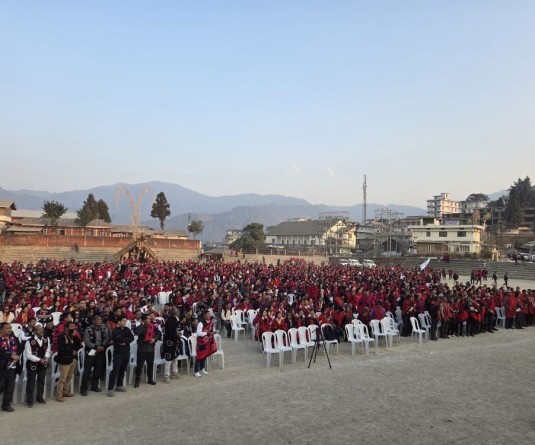
Dimapur, February 18 (MExN): Police and civil society in Dimapur today deliberated on ways and means to strengthen ‘community policing’ to restore law and order, maintain peace, safety and security of citizens in a state like Nagaland where ‘parallel governments’ function apart from the constitutionally-elected state government of Nagaland.
The ‘conference of police and civil societies’ organized by the Nagaland Police department, held at Town Hall in Dimapur on Saturday, witnessed a brainstorming session on ‘community policing’ in Nagaland. ‘Community policing’ prevailed in the Naga society before the advent of the British into Naga soil but the civil system slowly eroded over the years.
The conference was attended by Home Commissioner, Nagaland, J Alam, Director General of Police of Nagaland O Alem, Inspector General of Police PF Zeliang and senior police and district administration officials and a host of civil society leaders representing all sections and communities in Dimapur.
In his power-point presentation on ‘Community Policing in Nagaland’ DIG (Range) of Nagaland Armed Police Toshitsungba said that the then British India Raj also passed an Act in 1937 which recognized community policing in the Naga Hills. The DIG (R) said the Village Guards founded in 1956-57 is also part of the policy of community policing.
However, Community Policing in Nagaland has slowly eroded over the years due to various reasons: villages not in a position to deal with underground-related crimes, mushrooming of developmental activities without accountability, change of loyalty to district administration, trust deficit and large-scale corruption right from the grass root level to the top which is seen as responsible for the deterioration of law and order.
The power-point presentation also raised pertinent questions such as the peculiar law and order situation faced by Nagaland state, ceasefire with Naga underground groups in 1997 and 2001, different interpretations of ceasefire ground rules and whether ceasefire is a licence for extortion and crime.
It also raised questions on the complacency of the administration and the police, ‘misinterpretation of crime and national duty’ relating to acts of underground cadres, their ‘parallel’ governments and courts and whether there is lack of political will or direction
Some of the suggestions for debate in the power-point presentation also included Nagaland needing an administrative government rather than a developmental government. This aspect emphasized the priority of the government to administrate followed by emphasis on development. Another recommendation was that all stake holders of development, VDB and village councils should made accountable for maintenance of law and order and development. Another recommendation was that the police and public relation needs to improve. The deputy commissioner sand superintendents of police can be given a role in developmental activities so that they have direct contact with villagers and general public, the conference said.
Another suggestion was that the municipal and town councils should be given responsibility and accountability for maintenance of peace and security in their respective jurisdictions.
In his address Home Commissioner J Alam lauded the police department for taking initiative to organize the conference and said that it was new model of the ‘PPP’ mode (Public–Private Partnership) and termed the conference as “Police-Public Partnership.”
The Home Commissioner assured that if there is people’s “will” to control crime, the government’s “will” is already there. Alam however cautioned that civil society and public should not take law in own hands even if they are discontented with the government agencies ‘in certain cases or incidents.’ He said public and government agencies should work together or the result would be total chaos.
Also, state DGP, O Alem, said that members of civil society and police spending time and listening to each other, is appropriate.
“Conferencing is one thing but understanding and resolute decision to see that good points are taken in by all forums irrespective of the confines in different constitutions of respective society. That is homogenous. Go on the city is yours. Just get way from self righteousness ad cheap popularity,” the police chief told the civil society.
Former DC of Dimapur and current Commissioner of Excise Maongwati Aier, who also spoke at the occasion stressed on equal participation of the police, administration and civil society for effective community policy to combat social evils plaguing the state and Dimapur in particular. Describing alcohol and drugs as the root cause of most crimes, the Excise Commissioner updated the gathering on the extent of drugs and alcohol seized by the Excise department.
Leaders and representatives of civil society in Dimapur and others including the Naga Council, Dimapur Municipal Council, Dimapur Chamber of Commerce & Industry, GBs Association, Muslim Council, Bar Association, Vishwa Hindu Parishad, Naga Women Hoho and Marwari Samaj also gave their view points.
Earlier, additional DC Dimapur, S Khro, in an introductory note admitted that community policy introduced (or reintroduced) two years back is yet to be successfully implemented in the state.