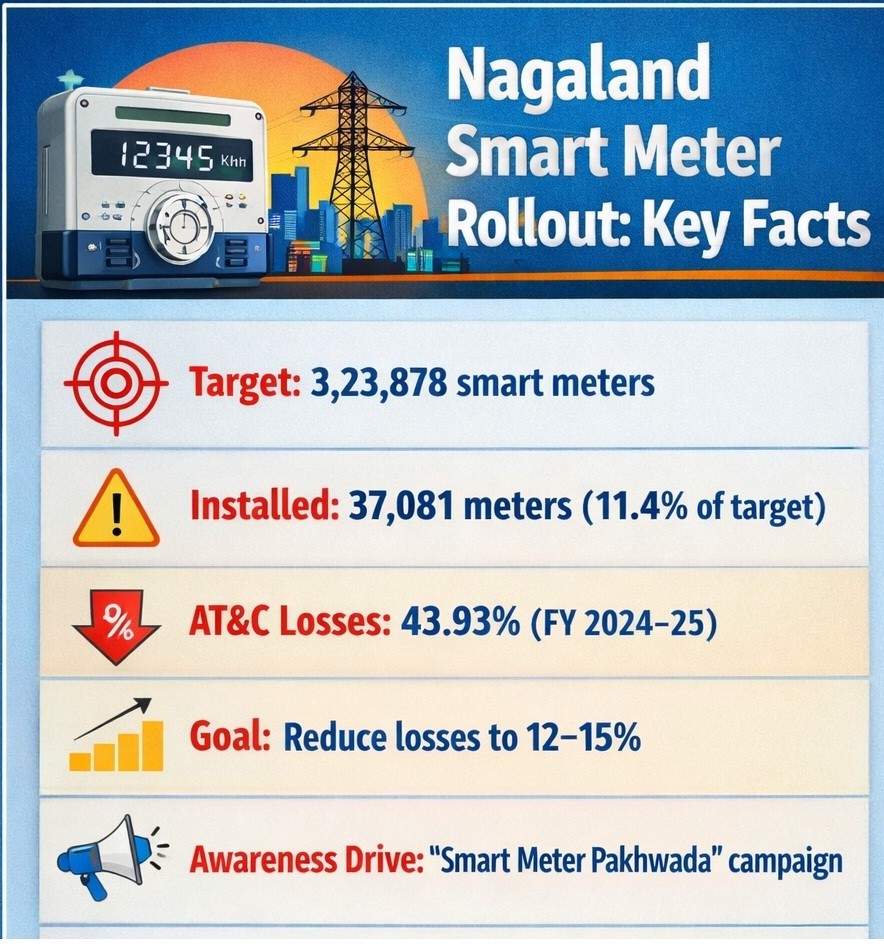
• Aggregate Technical and Commercial losses at 43.93%
• MP Jamir for intensifying awareness efforts
Kohima, March 3 (MExN): Only around 11 per cent of Nagaland’s smart meter installation target has been achieved so far, even as the state continues to grapple with high Aggregate Technical and Commercial (AT&C) losses, widening the gap between power supply cost and revenue realisation.
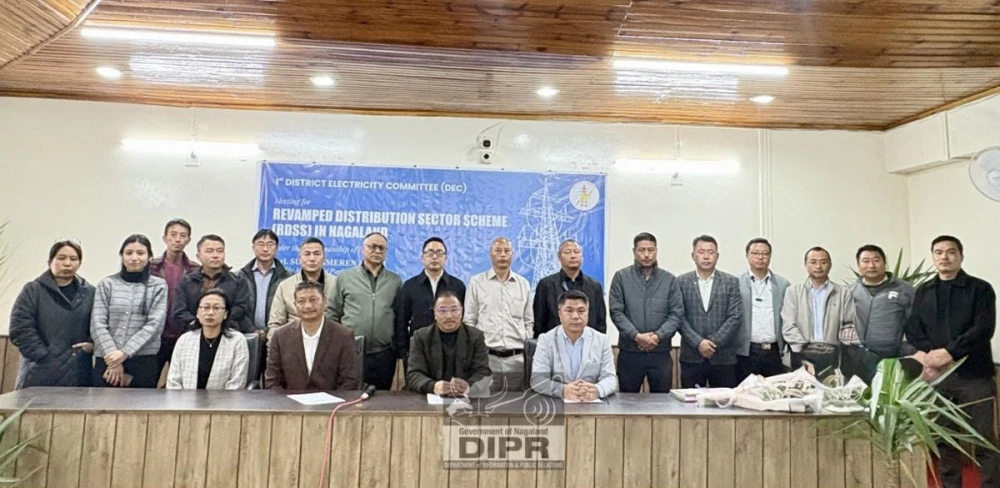
The issue came to the fore during the first meeting of the District Electricity Committee (DEC) on the Revamped Distribution Sector Scheme (RDSS), held at the Kohima Deputy Commissioner’s Conference Hall, Kohima on Tuesday.
According to the State DIPR, officials informed the meeting that against a target of 3,23,878 smart meters, only 37,081 or roughly 11.4 per cent, have been installed. The total includes 36,249 consumer meters, 667 distribution transformer meters and 165 feeder meters.
Presenting an overview of RDSS, Additional Chief Engineer (AEC), Power Department, Er Lobosang Jamir, said the gap between power supplied and revenue realised should ideally be zero, but remains a major challenge in the state.
He noted that the Government of India launched the reforms-based, result-linked RDSS in July 2021 to improve operational efficiency and financial sustainability in the power distribution sector, with financial assistance linked to reform targets. The State Level Distribution Reforms Committee was constituted on January 31, 2022, followed by the formation of DECs on July 14, 2022, to monitor implementation.
Under RDSS, projects sanctioned for the state include smart metering, loss reduction works, electrification of left-out households and engagement of a Project Management Agency. The scheme aims to improve supply reliability, reduce AT&C losses to 12–15 per cent and narrow the gap between average cost of supply and revenue realised.
However, the AEC pointed out that the state’s AT&C losses stand at 43.93 per cent for FY 2024–25. While smart metering is central to addressing the issue, he acknowledged that public resistance has slowed implementation, and called for greater awareness and cooperation.
From the department’s end, loss reduction works are under way in districts including Dimapur and Peren, alongside a State-wide “Smart Meter Pakhwada” campaign to create awareness, he added.
Meanwhile, Member of Parliament (Lok Sabha), Supongmeren Jamir, who chairs the DEC stressed the need to build consumer trust in smart metering.
He urged the department to intensify awareness efforts on the accuracy and benefits of smart meters, and to clearly communicate the advantages of transitioning from conventional systems.
Jamir also called for transparency in presenting departmental challenges and suggested detailed assessments and consumer reviews, particularly in view of electrification gaps.
In Kohima district, 27 habitations remain unelectrified and 14 partially electrified, with the rapid emergence of new habitations adding to the challenge, he added.
Chairing the meeting, DC Kohima, B Henok Buchem emphasised coordinated efforts among departments and stakeholders, and highlighted the potential of smart metering and rooftop solar in improving efficiency and reliability.
The meeting concluded with a renewed call to accelerate implementation, bridge revenue gaps and strengthen transparency in the state’s power sector reforms, the DIPR stated.