Shashank Pratap Singh (IAS), Principal Director of DoSE and Project Director of NECTAR, addresses the gathering during the training and orientation programme on ESS at the Directorate of School Education in Kohima on February 20.
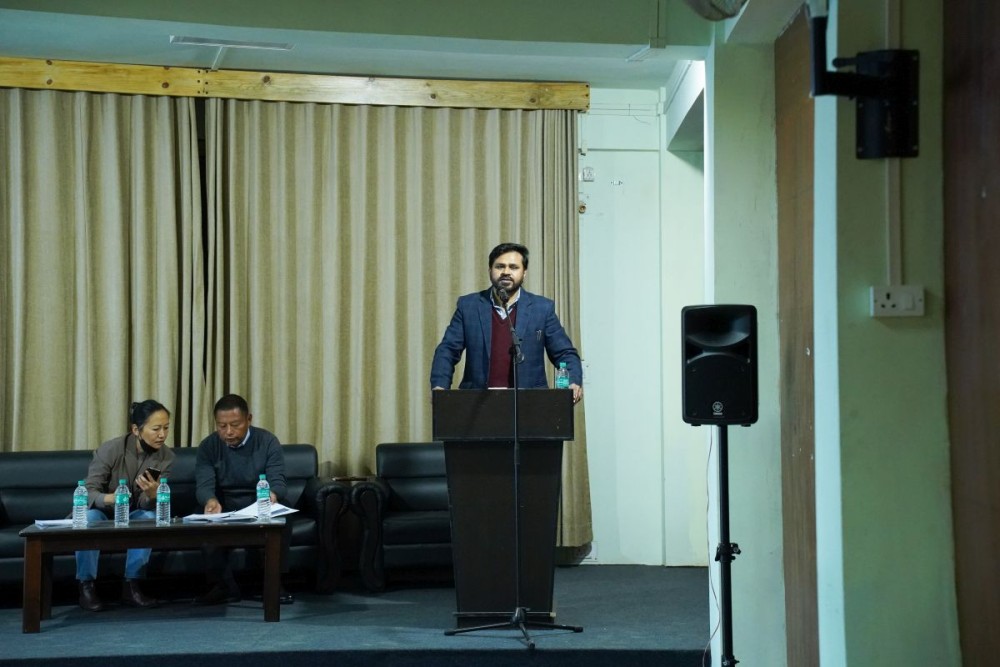
Kohima, February 20 (MExN): The Nagaland Education Project—The Lighthouse (NECTAR) organised a “One Day Training and Orientation on Environment and Social Standards (ESS)” for contractors of sixteen Lighthouse School Complexes (LSCs) at the Directorate of School Education (DoSE), Kohima on February 20.
Delivering the welcome address, Shashank Pratap Singh (IAS), Principal Director of DoSE and Project Director of NECTAR, underscored the significance of the LSC initiative. He stated that under the World Bank-supported NECTAR project, contractors for the LSCs were selected purely on merit through a fair and transparent tendering process.
Singh urged all contractors to ensure timely execution of quality work and strictly adhere to the Environmental and Social Standards (ESS) mandated by the World Bank.
In her keynote address, Kevileno Angami, Commissioner and Secretary of School Education & SCERT and Vice Chairperson of the NECTAR Project Steering Committee, said the department has envisaged LSCs with essential facilities in view of the prevailing poor condition of schools in Nagaland.
She said that with support from the World Bank, the Department of Economic Affairs and the State Government, the vision of establishing LSCs as hubs for spoke schools in each district would be realised.
Angami emphasised that contractors must complete civil works within the stipulated timeframe, noting that any delay would directly affect all stakeholders, particularly school children. She observed that while focus often remains on the end result, environmental and social costs are frequently overlooked.
In this regard, she stressed the need for strict adherence to all compliances to avoid adverse impacts on the environment and communities. Concluding her address, she said that as LSCs belong to everyone, contractors must ensure both quality and timely completion.
Dr Kekhrielhoulie Yhome, Advisor of School Education & SCERT, said that given the pitiable condition of schools in rural Nagaland, it would be unfortunate if the construction of LSCs fails to reach completion.
Highlighting that Public-Private Partnerships (PPP) and multilateral development projects are the need of the hour, he emphasised the importance of building competence in environmental and social compliance for the state’s progress.
He noted that as future development initiatives increasingly come under global evaluation standards, there would be little scope for advancement unless the state learns and adapts quickly, moving away from prevailing local practices in contractual work.
Yhome stressed that LSC contractors play a crucial role, as their performance in ensuring compliance would significantly influence Nagaland’s capacity to undertake future projects.
The one-day training and orientation focused on compliance aspects including labour welfare, safety, health, prevention of sexual harassment, working conditions and environmental pollution, among others.