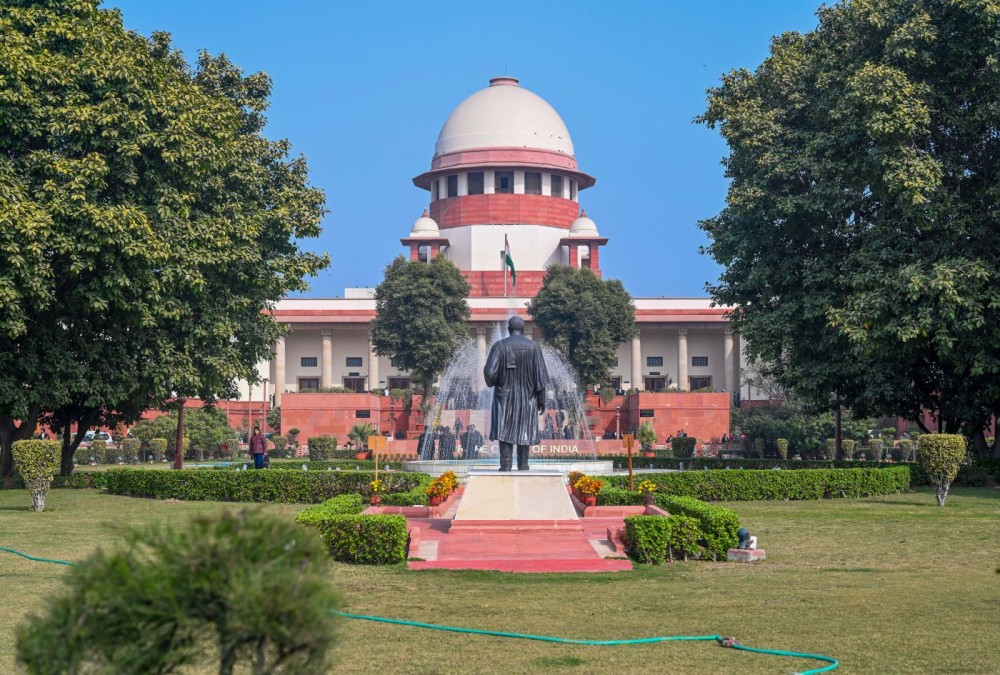
New Delhi: A general view of the Supreme Court of India standing tall under a clear sky, in New Delhi, Monday, January 05, 2025. (Photo: IANS/Deepak Kumar)
Morung Express News
New Delhi | March 25
The Supreme Court has clarified that conversion to another religion does not automatically result in the loss of Scheduled Tribe (ST) status, holding that tribal identity is rooted in cultural and community continuity rather than religion alone.
In its March 24 judgment in Chinthada Anand vs State of Andhra Pradesh, a Bench of Justice Prashant Kumar Mishra and Justice Manmohan drew a clear distinction between Scheduled Castes (SCs) and Scheduled Tribes (STs) in the context of religious conversion.
While reiterating that conversion leads to an “automatic and immediate” loss of SC status under the Constitution (Scheduled Castes) Order, 1950, the Court emphasised that no such religion-based exclusion exists for Scheduled Tribes under the Constitution (Scheduled Tribes) Order, 1950.
“No person who professes a religion other than Hindu, Sikh or Buddhist shall be deemed to be a member of a Scheduled Caste. This bar under Clause 3 of the Constitution (Scheduled Castes) Order, 1950 is categorical and absolute,” it held.
Conversion to any religion not specified in Clause 3 results in immediate and complete loss of Scheduled Caste status from the moment of conversion, regardless of birth, it added.
Any conversion to a religion outside these categories results in “automatic and immediate termination of all eligibility for statutory benefits, protections, reservations, preferences and entitlements that are predicated upon or flow from such membership,” it further stated.
ST status not tied to religion
However, with regard to STs, the Court clarified that unlike the Constitution (Scheduled Castes) Order, 1950, the Constitution (Scheduled Tribes) Order, 1950 does not prescribe any religion-based exclusion.
The determination of ST status, therefore, cannot rest on conversion alone, but must turn on whether the “claimant continues to possess and is recognised for the essential attributes of tribal identity, including customary practices, social organisation, community life, and acceptance by the concerned tribal community,” it stated.
Only where conversion or subsequent conduct results in a “complete severance from the tribal way of life and loss of community recognition,” the foundational basis for ST status stands eroded, the Bench further clarified.
Accordingly, the Court held that where tribal customs and identity continue, or are genuinely re-established and accepted by the community, the claim to ST status cannot be rejected “mechanically.”
The Court stressed that determination of ST status in cases of conversion is inherently “fact-specific” and must be assessed by competent authorities in accordance with constitutional principles.
The Court also referred to earlier rulings defining a ‘tribe’ as a close-knit social group with a common dialect, shared culture, territory and ancestry, bound by kinship ties and a collective way of life.
It further cited anthropological definitions describing a tribe as a community with a defined area, cultural homogeneity, social organisation and leadership, comprising smaller units such as villages or clans linked by social, economic and family ties.
Thus, the Court underscored that a tribe is not defined by religion, but by shared culture, community life and identity.
Background of the case
The case arose from an alleged assault on a pastor in Andhra Pradesh, who was born into the Madiga Scheduled Caste but had converted to Christianity. He had invoked provisions of the SC/ST (Prevention of Atrocities) Act against certain individuals; however, the High Court held that he could not claim protection under the Act after conversion and quashed the proceedings.
Challenging this, he approached the Supreme Court, which upheld the High Court’s ruling. It also upheld the quashing of charges under other laws, finding that the allegations were not sufficiently supported by evidence.