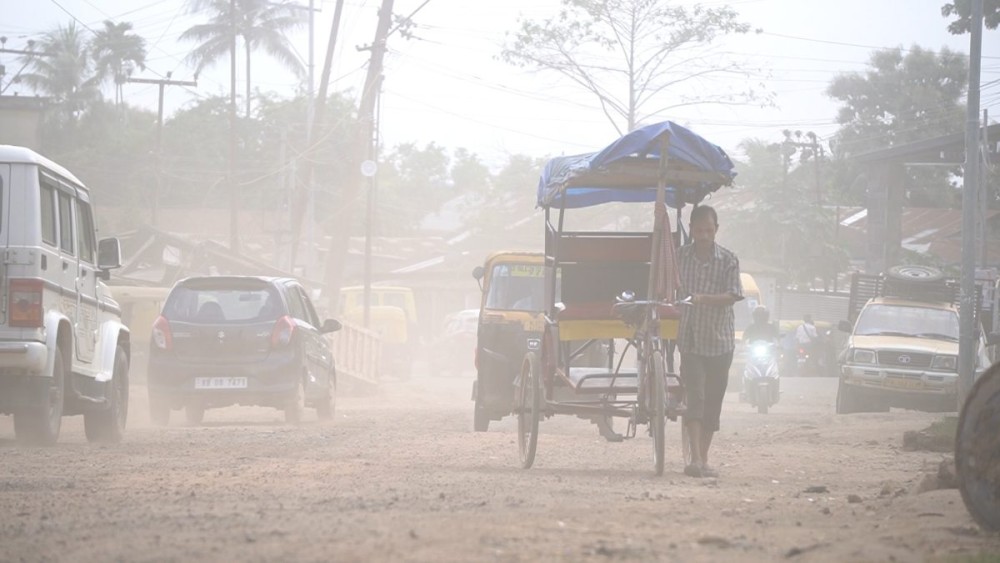
A man pulls his rickshaw through clouds of dust on a stretch of bad road in Dimapur. (Morung Photo)
Dust, vehicular emissions and waste burning identified as top causes
Morung Express News
Dimapur | September 19
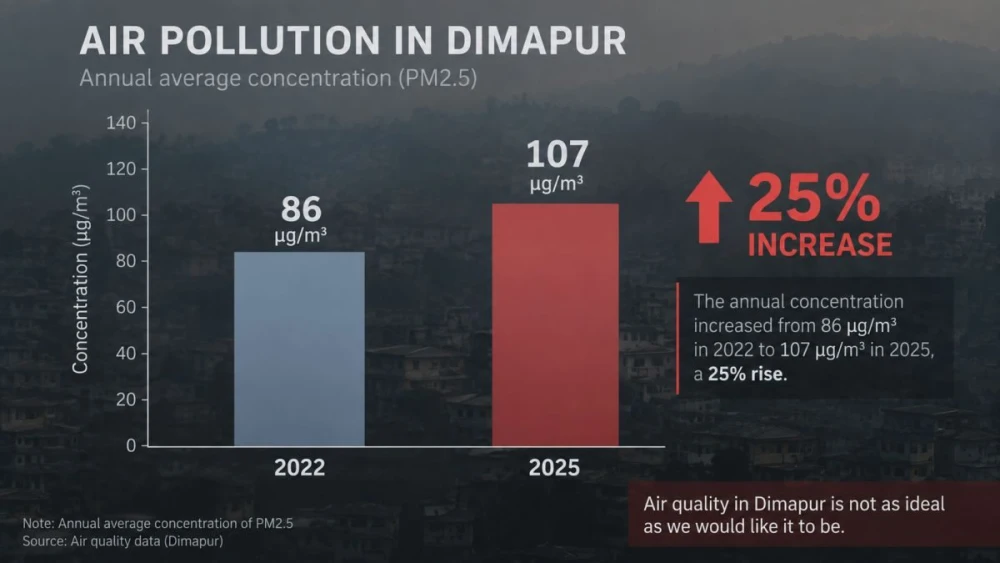
Air pollution levels in Dimapur have risen sharply over the past three years, with the annual concentration of pollutants jumping from 86 micrograms per cubic metre in 2022 to 107 micrograms per cubic metre in 2025, a 25% increase, according to data from the Nagaland Pollution Control Board (NPCB).
“With regards to the air quality status, we have seen that the concentration level has only been increasing over the past few years,” said Rongsenbenla Longkumer, Junior Scientific Assistant with the NPCB’s Air Division, who also looks after waste management.
“In that aspect, the air quality in Dimapur is not as ideal as we would like it to be,” she informed in an exclusive interview with The Morung Express.
The permissible annual limit under the National Ambient Air Quality Standards is 60 micrograms per cubic metre, a level Dimapur has consistently exceeded.
Commercial and residential areas both hit
The NPCB currently monitors air quality at seven locations in Dimapur, three commercial (Burma camp, Dhobinala and Tenyiphe), and four residential (Viola Colony, NPCB office campus, Kuda C and Bank Colony).
Commercial zones such as Dhobinala and Burma Camp recorded the highest concentrations, with one location logging an annual average of 139 micrograms per cubic metre, more than double the prescribed standard, Longkumer said.
What is more worrying, she said, is that residential neighbourhoods are not far behind. Areas like Kuda Village and Bank Colony recorded annual concentrations of 103 to 107 micrograms per cubic metre. “It is concerning because these are residential locations where lesser commercial activities take place,” she said, adding that field staff have attributed the spikes to ongoing construction, waste burning and poorly paved roads in these localities.
The Board has also set up two rural monitoring stations in Dimapur, operational since 2024. In Kohima, four stations are being monitored, while newer stations have been added since 2024 in Phek, Zunheboto, Peren, Wokha, Mokokchung, Mon and Kiphire. Longkumer said it was “too soon” to draw conclusions from the newer districts since data collection and tabulation are still under way, but early trends mirror Dimapur's, with concentrations peaking in winter and unpaved roads, waste burning and firewood use in kitchens emerging as common factors.
Dust, vehicles, waste burning among top causes
Asked about the major sources of pollution in Dimapur, Longkumer said a formal “source apportionment study,” currently under way in Kohima and planned for Dimapur, would give a scientific breakdown. However, a decade of monitoring has already pointed to several recurring contributors.
“Dusts from bad roads” was cited as a leading factor, with most Dimapur localities either unpaved or poorly maintained. Vehicular emissions were flagged as another major contributor, along with the burning of plastic waste in residential areas. “That is one of the major contributors of air pollution because plastic is made out of chemicals,” she said.
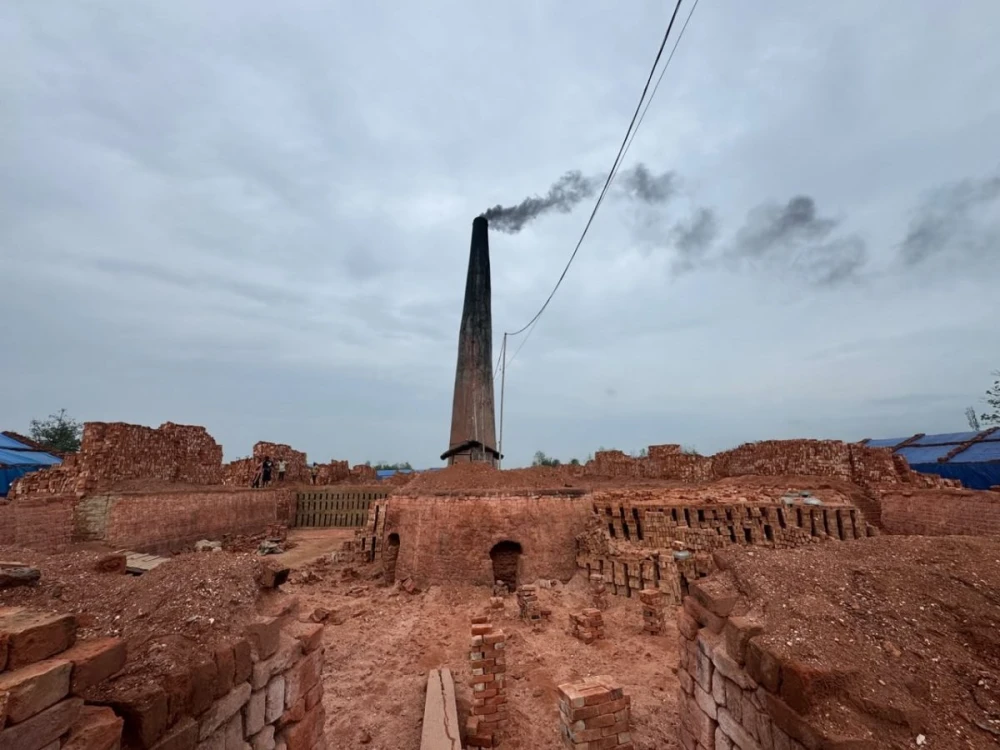
While Nagaland does not have large industries, the NPCB pointed to smaller units such as stone crusher plants, brick kilns, and plywood and wood-based industries as significant sources, particularly where operators do not use pollution control devices in chimneys or fail to sprinkle water during machine operations.
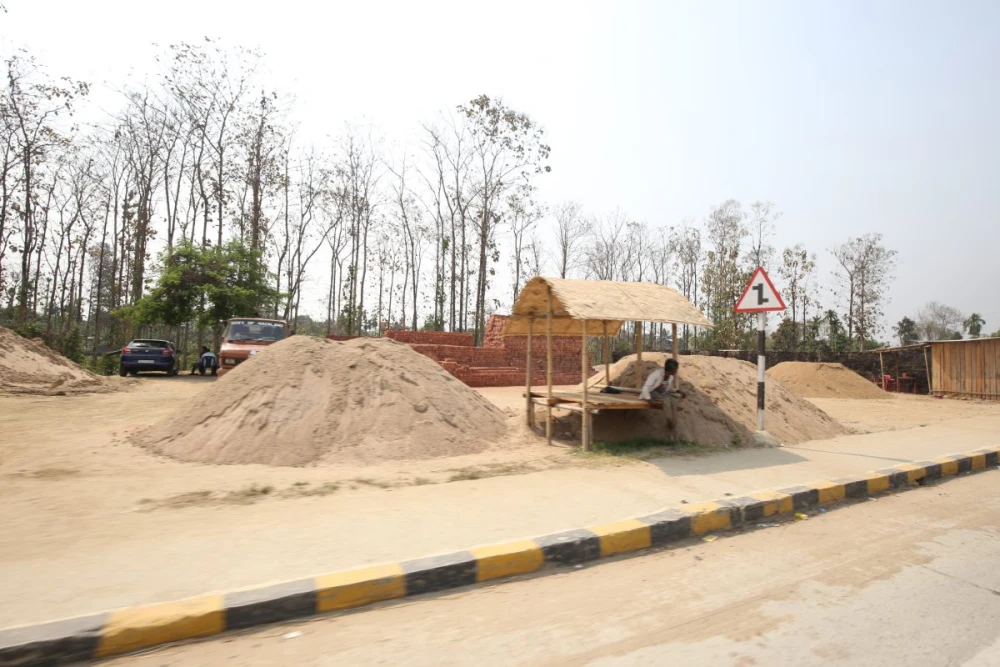
Sand stockists along highways were also identified as contributors to dust accumulation in the city. “They do not have a buffer zone which will stop the sand from coming into the main roads,” she said, noting that vehicles carry the loose sand into the city, adding to the dust load.
Waste burning in villages a growing concern
Responding to observations from ground reporting in Kuda and Aoyimti villages, where residents have resorted to burning waste within their own compounds despite restrictions imposed by the Dimapur Municipal Council on dumping, Longkumer said the practice remained one of the Board’s biggest concerns.
“Burning of waste doesn't mean that you're burning only one type of waste. You are burning multiple things at the same time - plastics, rubbers, paper, sometimes cloth,” she said, describing the practice as harmful both to health and the environment. She said the NPCB was running awareness programmes with government bodies, urban local bodies, village councils and peri-urban councils to discourage the practice and promote waste segregation instead.
“The key for solving pollution-related problems starts from our homes,” she said, noting that burning waste for disposal remains “a predominant practice” across towns in Nagaland because people see it as the easiest way to make waste disappear.
Awareness through media, religious bodies
On spreading awareness, Longkumer said the NPCB shares its weekly air quality status with The Morung Express as one channel of outreach, besides working with religious institutions. “We have been collaborating with churches and then councils, churches' councils, the Apex bodies,” she said, adding that the Board hoped to move beyond reactive reporting to more sustained, conversational engagement with the public on pollution issues.
How the monitoring works
Explaining the monitoring process, Longkumer said manually operated instruments at each station track particulate matter, PM10 and PM2.5, along with gaseous parameters such as nitrogen dioxide and sulphur dioxide. Machines are run for 24 hours at a stretch, three times a week, and twice a week on non-working Saturdays, using equipment prescribed by the Central Pollution Control Board. Filter papers and samples are analysed at the NPCB's in-house laboratory before reports are generated.
Preventive measures suggested
On precautions, Longkumer said tackling air pollution required collective effort, starting at the household level. She advised residents to stop burning waste and segregate it instead, while urging owners of commercial establishments and apartment complexes to keep surroundings clean and pave the areas outside their premises up to the roadside. Sprinkling water outside homes and shops during the dry season, she said, also helps settle dust. Stone crusher units were advised to use sprinkling methods, while brick factories were urged to install air pollution control devices in their chimneys.
For those with prolonged outdoor exposure, including street vendors and traffic police, Longkumer said the Board's advice, based on inputs from medical experts, was limited to wearing masks and staying hydrated.
Vehicular pollution and public transport
On vehicular emissions, Longkumer said the NPCB’s awareness campaigns encourage carpooling, use of public transport, cycling and walking for short distances. While the Board has not advocated for restricting the number of vehicles in the city, it supports and promotes the adoption of electric vehicles as a better alternative for curbing vehicular emissions.
Road conditions flagged with PWD
Acknowledging that Dimapur's potholed roads generate significant dust, Longkumer said the NPCB, through the National Clean Air Programme, has engaged implementing bodies such as the PWD to take up road and pothole maintenance. She said the issue is regularly raised during stakeholder meetings with departments responsible for road upkeep.
NPCB’s regulatory role
Longkumer clarified that the NPCB, set up under the Water Act as a statutory body, is regulatory rather than implementing in nature. “Our role is to ensure that various environmental related Acts and rules and compliances are taking place across various stakeholders, ranging from the governmental level to even the industries and business establishments,” she said.
The Board's work, she added, centres on monitoring pollution levels, advising the state government on mitigation measures, and driving advocacy through awareness programmes, sensitisation drives and workshops with stakeholders across the state. Asked whether greater public precaution could help reverse the rising pollution trend in Dimapur, Longkumer said, “Yes, we can do that.”