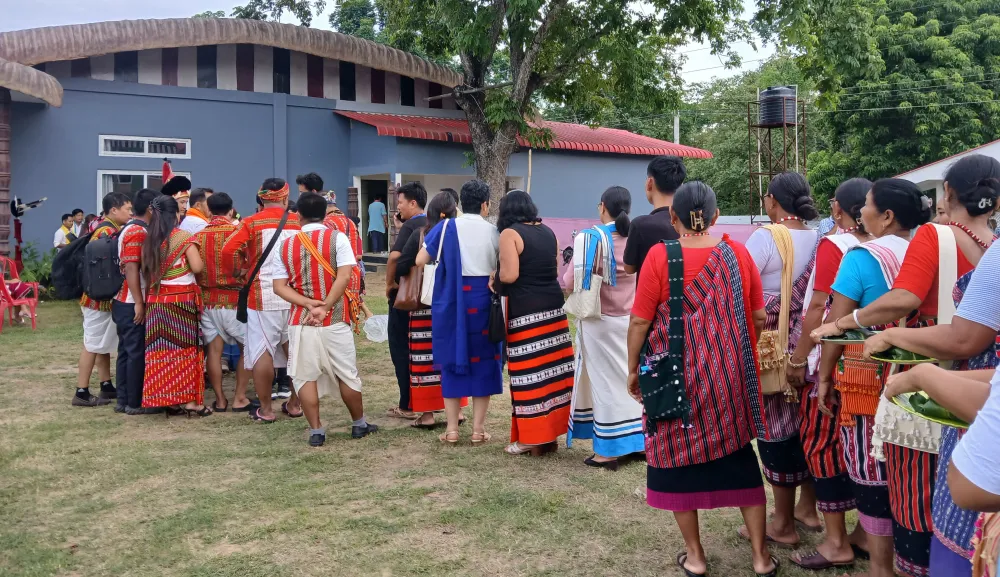
A moment of togetherness: indigenous community members share food and fellowship after an event in Diphu, Karbi Anglong. (Morung file Photo)
Indigenous communities must hold authority over eco-tourism and conservation
Morung Express News
Lumami | November 21
A member of the United Nations Expert Mechanism on the Rights of Indigenous Peoples (EMRIP) on Thursday said communities must hold the authority to define and govern eco-tourism and conservation, and that states should stop shifting that authority to state-run systems.
Gam Angkang was speaking at a two-day international seminar on “Ecotourism, Livelihood and Development in Northeast India” at Nagaland University, held on November 19 and 20. The seminar was organised by the university’s Departments of Sociology and Geography.
Speaking on the “Role of Community Initiative, Customary Institutions, Consent, and Local Ownership in Eco-Tourism, Conservation and Traditional Knowledge Systems,” Gam said community governance must be a precondition for legitimate development, not an element added to a state framework.
“Community governance must become the precondition for pursuing any of those goals to be legitimate,” he said.
He said a community’s right to authority over its territory does not depend on how well it performs. “Do they have the right to authority over this territory? Yes they do, whether they do well or bad. It’s not dependent on the success,” he said.
Three-question test
Gam proposed that every development activity, tourism included, be put through a test of three questions: whether it strengthens the community’s autonomy, including its ability to finance its own development; whether it erodes the community’s authority over its land and resources; and whether consent was properly obtained.
On consent, he said communities must have “the right to say no”. He cautioned against cases where authorities claim to have consulted communities and obtained signatures without ensuring that adequate information and legal support were provided.
He pointed to the ILO Convention 169 and the UN Declaration on the Rights of Indigenous Peoples as universal standards, adding that they must also account for gender disparity and inequality.
Article 371A and Nagaland
Describing Article 371A as “quite a unique law in the context of Asia”, Gam noted that it recognises customary law, religious practices, the justice system and the ownership and transfer of land and resources.
However, he said the provision only creates space and is not self-executing. “You may create an article, a law that is very good, but it is not self-executing,” he said. He also pointed out that the provision is administered through the State Legislative Assembly and not directly by communities, and that it has loopholes.
He suggested that Nagaland could use the “other effective area-based conservation measures” mechanism under Target 8 of the Convention on Biological Diversity’s global framework. This, he said, would allow community-conserved areas to be recognised and reported towards global conservation goals without becoming part of the state protected-area system. The target calls for equitable governance of protected areas that respects the rights of indigenous peoples and local communities, including over their traditional territories.
“That actually is a mechanism that is appropriate for Nagaland, because you already have the legal structure and the legal foundation,” he said.
Security and centralisation
Gam said India’s security framework and centralising tendencies could seep into conservation and tourism. “India is essentially a security state,” he said, adding that once the state uses a security framework, “it will permeate into our life in every sphere”.
He said the country struggles to delegate authority, and pointed to the principle of subsidiarity, delegating power from the bottom up, as a global challenge that Nagaland’s provisions offer a chance to address.
Lessons from a Malaysian community
Gam cited an indigenous community in Malaysia that has no legal rights over its land but has revived its governance by drawing on its own values and developing its own community protocol. The community’s philosophy, he said, is built on the concept of “use and protect”.
According to him, the territory was heavily logged in 1986, leaving only about 10 per cent of the trees, and the community faced eviction before it began conserving the land. Today, he said, 92 per cent of the territory is forest.
He said the community turned down offers from companies to scale up its tea production and to develop tourism. It declined the former because mechanisation “is not our identity”, and it was wary of depending on tourism, particularly after the pandemic. It instead welcomes visitors who are “genuine learners”, he said.
“The reason they succeeded is not because of development projects and not because of legal recognition,” he said. “They realised that something was going wrong, so they had to revive themselves.”
Rights and responsibilities
Gam said development should be community-designed and led, regenerative and non-extractive, meaning that revenue and authority are not taken away by outsiders and middlemen. He advocated looking at a “bundle of responsibilities” alongside rights, calling them “two sides of the same coin”.
“Rights help us to determine what is the legitimate claim that we can have,” he said, while responsibility “helps us to define the way of life that we ought to live by”.
Concluding his address, Gam said, “We should stop asking what indigenous communities can contribute to eco-tourism, and start asking what authority the state owes them to define it.”