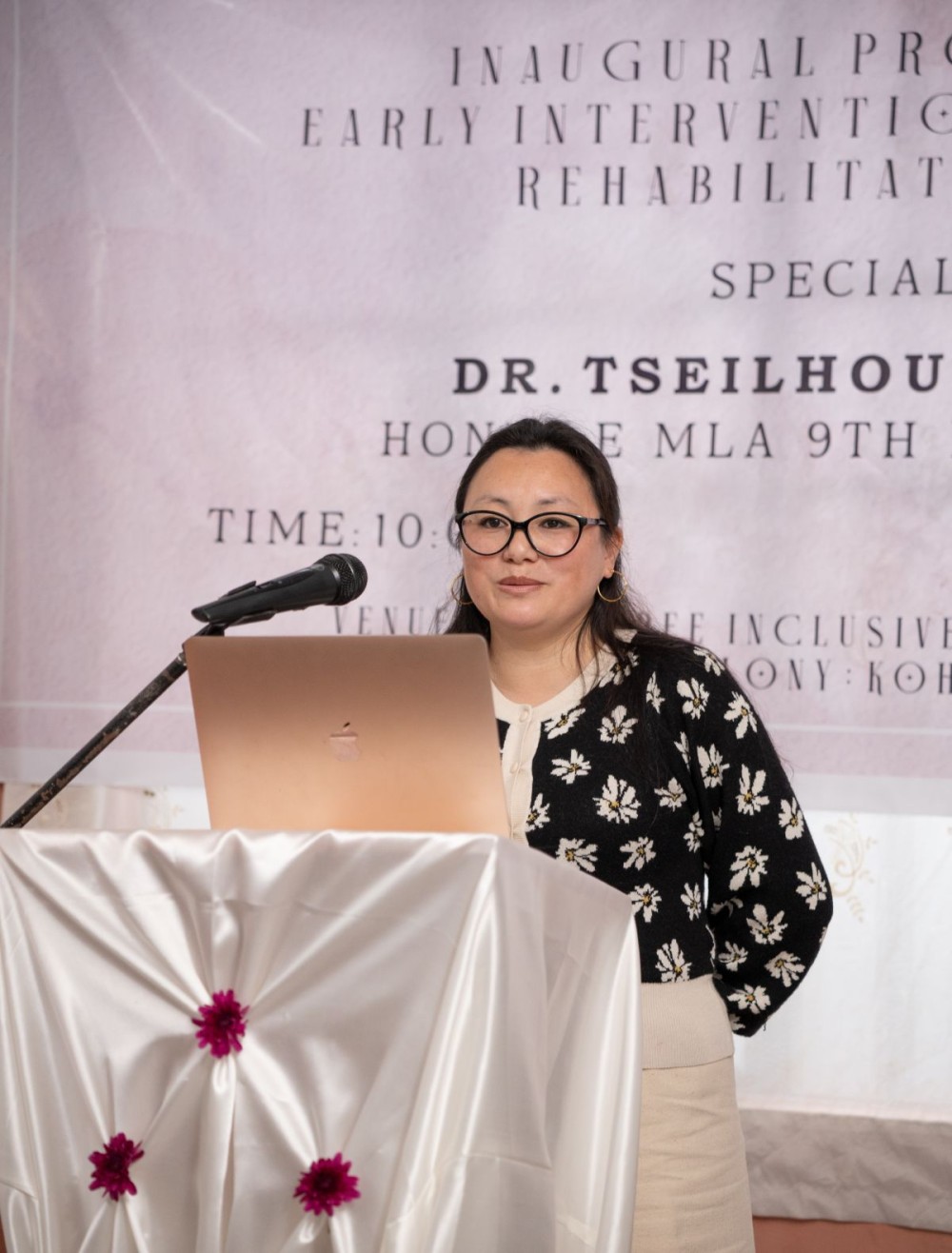
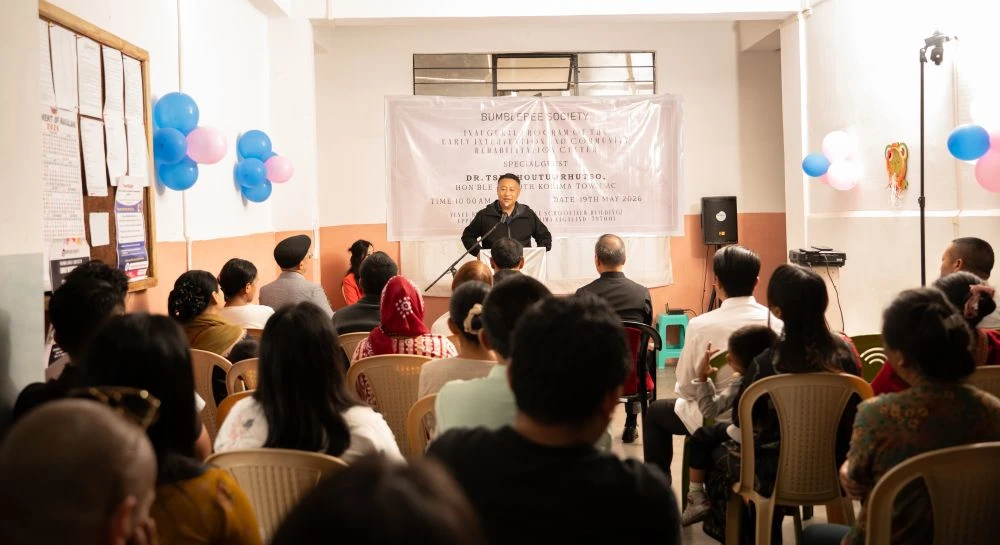
Kopele V Tepa, Founder Bumblebee Society addressing the launch of Early Intervention & Community Rehabilitation Center in Kohima on May 19. (Photo Courtesy: Jabu Krocha)
Early Intervention & Community Rehabilitation Center launched
Morung Express News
Kohima | May 19
According to the 2011 census, Nagaland is home to 29,631 persons with disabilities, of whom 12,904 are literate while 16,787 remain literate. Highlighting this during the launching of the Early Intervention & Community Rehabilitation Center at Bumblebee Inclusive School New Building Kohima on May 19, Kopele V Tepa, Founder Bumblebee Society however said that these numbers do not really capture reality.
In many parts of the state, she underlined that, “disability continues to go unreported because of stigma, fear and social exclusion.” At the same time, she emphasised that the data itself needs to urgently be updated because without accurate and current representation, it becomes difficult to advocate effectively for resources, policies, healthcare, education and support systems for persons with disabilities.
In this regard, she also asserted that when people remain invisible in data, their struggles and needs also remain invisible in society. Drawing from personal experience, she also said, “many families that I have worked with over the last few years spend their years hoping for a day that they would no longer need to identify themselves with a disability.”
“Once their child could leave the school and move out of support systems, many quietly chose to distance themselves and move to a community in the hope of blending into what society thinks is normal,” she further elaborated.
Stating that disability has been part of the human community since time immemorial and has existed across generations, cultures and societies, she lamented that despite this, “even today, many people with disabilities and their families continue to live in fear of stigma and fear of judgement.”
Asserting that when families remain silent about their journeys, struggles and victories, we lose the voices that would have encouraged countless others who are silently struggling in isolation, she underscored that disability is not something to outgrow, or disassociate from, but a part of human diversity and another dimension of consolidation.
Towards this end, she also underlined that regardless of their ability, “every child deserves dignity, opportunity, love, acceptance and a true sense of belonging.” With over a decade of working with persons with disabilities and their inclusion, she shared the need for early intervention and early family support that can change lives. “Not only does it improve the life of persons with disabilities, but it improves and empowers families with understanding, confidence and even the ability to advocate for their own children,” she added.
This is also where the Early Intervention Centre was born out of the vision that early diagnosis, family support systems, awareness and timely intervention will help families embrace disability without losing sight of the child along the journey.
Along with the support of their partners and well-wishers, the Center provides therapies, remedial support and family capacitation within the state towards ensuring that families who are earning below 20,000 are also able to access these facilities free of cost.
However, beyond centres and therapies, she asserted, “true inclusion must reflect in our society we build around persons with disabilities.” In this regard, she urged the need more schools that are willing to open their doors and their hearts to children with disabilities; more public spaces that are accessible, welcoming and safe; more opportunities and community spaces where persons with disabilities can simply make friends, participate in everyday life without the fear of being judged or ridiculed; and easier access to healthcare facilities, government schemes and support systems that will enable persons with disabilities and their families to live in dignity and independence.
Inclusion, she underscored, cannot remain limited to policies and discussions while emphasising that, “it must become visible in our schools, our communities and everyday interactions.”
In his inaugural address, Dr Tseilhoutuo Rhutso, MLA cited how the society celebrates when a new bridge is built, or a new flyover, a new institute, or a community-based center is developed. “But I'm sure the celebration here is a different celebration”, he said while expressing that, “I hope you are celebrating every day, when your child or your student can say a word- yes and no, thank you- And when they can speak a sentence correctly, I'm sure it is a priceless celebration.”
Commending the school and its teachers, he also assured his support and expressed that, “I hope this school will be the beginning in our very state” while stating the need for more of such schools in other districts as well. In this regard, he stated hope that other districts would further emulate to further enable a better future for special children, and for them to become assets and not liability to the society.
Highlights of the event included welcome address by Kezhalenuo Savi, Headmistress, Bumblebee Inclusive School, Physiotherapy in Neurodevelopmental disorders by Dr. Nzani, Physiotherapist, Special Education Support by Tsikhoii Medoze, Special Educator, Community Based Rehabilitation by Thejangunuo Leno, CBR Worker, 'Inclusion begins with understanding' by Atsonuo Thapo, Counsellor and Parents Review by Dr Sao Tunyi, Physician turned Agri-Entrepreneur respectively.
Mention may be made here that with the launch of the center, it would provide integrated access to Physiotherapy, Occupational Therapy, Speech Therapy, Special Education, Counselling and CBR home-based Services to support children with disabilities, offering a comprehensive range of services addressing various conditions including Autism, Down Syndrome, Cerebral Palsy among others.