Morung Express News
Kohima | July 20
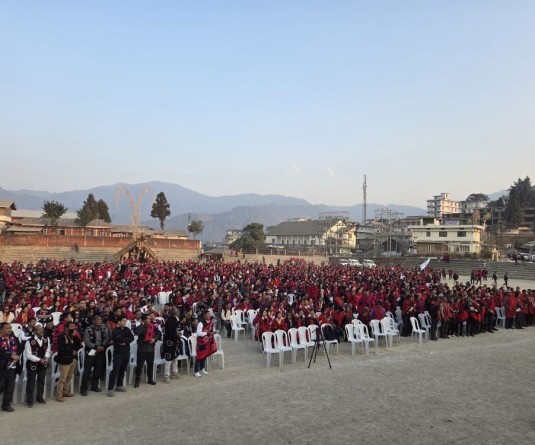
‘Learn to Drive’ – an initiative of the Department of Land Resources, Kohima district under the Livelihood Component of PMKSY is currently underway with an objective to train unemployed youth in Kohima for an alternative source of livelihood.
During the certificate distribution held on July 20, Menuosietuo Tseikha, District Project Officer mentioned that the idea of providing driving lessons started in the process of the watershed activities in villages where the department observed that many of the unemployed youth were either working as village guards or cutting trees to earn their livelihood. One objective was to prevent deforestation. Tseikha viewed that trees are a major source of water, and insisted on changing mindsets in order to understand that trees are what sustain life.
According to the All Nagaland Taxi Association (ANTA), there are over 450 taxis plying daily in Nagaland with 70 percent of the taxis owned by non Nagas. Tseikha therefore suggested that driving commercial vehicles can be one of the most viable forms of livelihood.
The selection process mostly focused on dropouts – two candidates from each village under Kohima district were selected for the training. The target at present is to train 120 to 130 youth; 69 is currently undergoing the driving training, while 52 youths completed the training and were awarded certificates on July 20.
Criticizing the general complacency in Kohima district, Tseikha viewed that people in Kohima are “lazy to work but they want money.” Therefore, he urged the trainees to use driving to earn a living, while adding, “And as you drive your way to earn a living, don't forget plant trees on the way.”
Johilo Seb, who spoke on behalf of the trainees, thanked the department for the initiative which has proven to be beneficial for all the trainees. Seb particularly thanked the department for choosing the undergraduates and dropouts despite having many graduates in the district. “I've always wanted to learn driving but never got the chance or money to afford driving classes. The training has opened up a way for us to earn a livelihood,” said Seb, who also informed that he will soon be driving the church vehicle in his village.
The ‘Learn to Drive’ is one of the best initiatives, according to Hoto Yeptho, Director, Department of Land Resources, because “it is building your lives.” Viewing that driving can build the foundation of many lives, Yeptho also believed that the skill of driving is unique as the skill remains intact even if it is not practiced for years. Besides the growing necessity of driving where it can save lives in emergency situations, Yeptho also pointed out the sustainability of livelihood through driving.
“Consider yourself privileged. Driving is a privilege. You should not feel that you are small. You are a driver and take pride in it,” affirmed Yeptho. He further stressed on the importance of driving rules, citing the lack of discipline in Nagaland which also incites arguments and misunderstandings. “Above everything, stay rooted in God. So many lives have been lost due to reckless driving. Don't indulge in substance abuse,” advised Yeptho.
Khrietuo Pienyü, Assistant Project Coordinator mentioned that the initiative, where the trainees are given a one month course, began in April. It was informed that the department will tie up with the Rutsa Driving School for job placements and recruitments in driving for the trainees in future.
Rutsa Driving School
“Learning to drive is one of the best ways to earn one’s livelihood,” said Khriesaneisa Rutsa, proprietor of Rutsa Driving School, which has trained 2500 people since it started in 2011. With the growing rate of unemployment, Rutsa established the school with a vision to enable the unemployed to choose driving as a source of livelihood. At present, the driving school has 8 vehicles, 5 instructors, one manager, an Assistant Manager and 30 learners are trained on a daily basis.
Besides the commercial aspect, another objective of setting up the driving school was to focus on the importance of teaching traffic rules. Rutsa Driving School provides one month course for beginners and a half month course for amateur drivers. Besides the practical skill of driving, the course includes the theoretical aspect where traffic rules and regulations, and the basics of mechanical skills are taught.
Rutsa also noted that some of the learners from the driving school are already employed in the driving sector either in government departments or commercial sectors. “There is no better initiative than inclusion of the grassroots. Don't take this opportunity lightly,” said Rutsa.