Source: Annual Administrative Report 2025-26, Land Resource Department, Nagaland.
Our Correspondent
Kohima | March 15
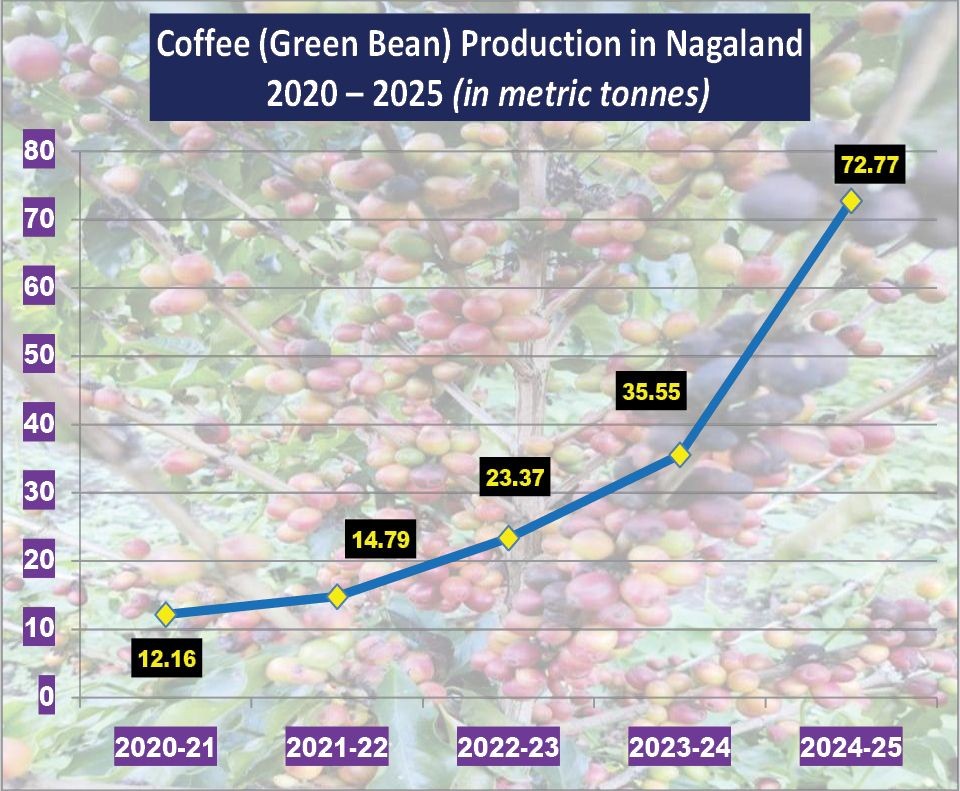
Coffee production in Nagaland has recorded a sharp rise over the past five years, increasing from 12.16 metric tonnes (MT) in 2020–21 to 72.77 MT in 2024–25, reflecting around near six-fold jump in production during the last five years.
As more plantations reach productive age, coffee output could cross the three-digit mark in the coming harvest season, noted the Annual Administrative Report 2025–26 of the Department of Land Resources, tabled recently during the 8th Session of the 14th Nagaland Legislative Assembly.
The steady increase in output mirrors the expansion of coffee cultivation in Nagaland, where 11,647.69 hectares have now been brought under coffee plantations across 16 districts, with an additional 461.41 hectares developed during the current financial year alone.
Kohima leads production surge
Among the districts, Kohima has emerged as the clear leader, producing 29.16 MT in 2024–25, accounting for roughly 40% of the state’s total output.
The district’s production has expanded rapidly over the past few years from 5.40 MT in 2022–23 to nearly 30 MT in 2024–25, indicating both the maturation of plantations and the large area dedicated to the crop.
With 1,900.87 hectares under coffee cultivation, Kohima also has the largest plantation area in the state.
Other districts are also emerging as key contributors. Tuensang recorded one of the most significant increases, rising from no production in 2020–21 to 8.86 MT in 2024–25, making it the second-largest producer in the state.
Zunheboto (6.38 MT) and Wokha (6.07 MT) followed closely, while Mokokchung (5.84 MT) continued to maintain a steady contribution to the state’s overall output.
Smaller districts are also beginning to show notable gains. For instance, Noklak, with just 128.91 hectares under cultivation, produced 1.37 MT, suggesting promising productivity despite limited land coverage.
Alternative to shifting cultivation?
The Department of Land Resources has identified coffee as a key commodity for strengthening rural livelihoods, particularly because the crop grows well under Nagaland’s natural forest canopy and can be cultivated without chemical inputs.
As a shade-loving perennial crop, coffee supports agroforestry practices, helps prevent repeated slash-and-burn cycles associated with shifting cultivation, and contributes to ecological restoration and climate resilience, the report said.
To expand the sector, the department has been promoting coffee plantations through various initiatives, including PMKSY-WDC 2.0, NABARD’s Rural Infrastructure Development Fund (RIDF) projects, and state-funded programmes, aimed at strengthening sustainable livelihoods and developing coffee-based value chains.
Strengthening the value chain
Meanwhile, the report noted that coffee production involves a long “field to cup” value chain, beginning with nursery development, plantation and harvesting, followed by processing, roasting, packaging and finally brewing.
In the early stages of the sector’s development in Nagaland, when many plantations were just reaching harvest age, farmers often relied on manual pulpers and traditional processing methods, it said.
These methods frequently resulted in uneven drying, contamination and mixed-quality coffee lots, affecting both consistency and market value, it added.
With around 1,530 hectares of plantations reaching maturity, strengthening post-harvest infrastructure has become a priority.
However, currently, the state’s processing capacity covers only about 900 hectares, highlighting the need for additional facilities to maintain bean quality and handle rising production, the report noted.
To address this gap, the report informed that six coffee washing stations are being established across different clusters with support from the North Eastern Council, which are expected to improve processing efficiency, enhance bean quality and increase the market value of Nagaland’s green coffee beans.
The project titled “Post harvest coffee processing facilities for sustainable economic development in Nagaland” are in various stages of implementation, it added.
Emerging identity product
Nagaland is increasingly positioning itself as a specialty coffee-producing region in the North-East, with growing participation from young entrepreneurs and farmer groups.
Recognising the crop’s branding potential, the Government of Nagaland has adopted coffee as one of the state’s Unique Selling Propositions (USP)—an initiative acknowledged by the Ministry of Development of North Eastern Region (DoNER). The state has also launched a branding initiative under the label “Coffees of Nagaland” with the slogan “Taste of Eminence.”
With new plantations steadily maturing and infrastructure gradually expanding, the current output levels may represent only the early phase of Nagaland’s coffee sector, which could see substantial growth in production and value-added processing in the coming years.
Area Covered Coffee plantation in Nagaland (in hectares) | |||
District | 2025-26 (Ha) | Total Area covered (Ha.) | |
1 | Chümoukedima | 22.05 | 459.55 |
2 | Niuland | 29.63 | 346.27 |
3 | Peren | 29.43 | 578.61 |
4 | Kohima | 67.35 | 1,900.87 |
5 | Tseminyu | 23.62 | 1,027.69 |
6 | Wokha | 48.75 | 1,134.74 |
7 | Zunheboto | 33.86 | 1,278.70 |
8 | Mokokchung | 35.22 | 788.03 |
9 | Longleng | 31.88 | 546.89 |
10 | Mon | 28.36 | 848.78 |
11 | Tuensang | 21.08 | 488.75 |
12 | Shamator | 21.75 | 462.13 |
13 | Noklak | 22.91 | 128.91 |
14 | Kiphire | 8.27 | 626.90 |
15 | Phek | 32.57 | 885.19 |
16 | Meluri | 4.68 | 145.68 |
Total | 461.41 | 11,647.69 | |
Source: Annual Administrative Report 2025-26, Land Resource Department, Nagaland
District-wise Coffee (Green Bean) Production in Nagaland 2020 – 2025 (in metric tonnes) | ||||||
District | 2020-21 | 2021-22 | 2022-23 | 2023-24 | 2024-25 | |
1 | Chümoukedima | 0.27 | 0.11 | 0.08 | 0.7 | 0.84 |
2 | Niuland | 0 | 0 | 0.69 | 1.98 | 1.65 |
3 | Peren | 0.09 | 0.16 | 0.13 | 0.45 | 0.62 |
4 | Kohima | 1.07 | 1.58 | 5.4 | 9.72 | 29.16 |
5 | Tseminyu | 0 | 0 | 0.36 | 1.21 | 3.31 |
6 | Wokha | 1.94 | 1.73 | 0.32 | 3.95 | 6.07 |
7 | Zunheboto | 1.83 | 1.36 | 2.63 | 5.42 | 6.38 |
8 | Mokokchung | 5.72 | 4.29 | 9.79 | 5.26 | 5.84 |
9 | Longleng | 0.06 | 1.33 | 0 | 0.95 | 2.02 |
10 | Mon | 1.04 | 2.74 | 2.41 | 1.75 | 3.33 |
11 | Tuensang | 0 | 0.72 | 0.25 | 1.44 | 8.86 |
12 | Shamator | 0 | 0 | 0.6 | 0.3 | 0.86 |
13 | Noklak | 0 | 0.29 | 0.12 | 1.27 | 1.37 |
14 | Kiphire | 0.13 | 0.25 | 0.59 | 0.54 | 1.33 |
15 | Phek | 0.01 | 0.25 | 0 | 0.62 | 1.14 |
16 | Meluri | |||||
TOTAL | 12.16 | 14.79 | 23.37 | 35.55 | 72.77 | |
Source: Annual Administrative Report 2025-26, Land Resource Department, Nagaland