Photo Courtesy: Amartya Bag
Anu As
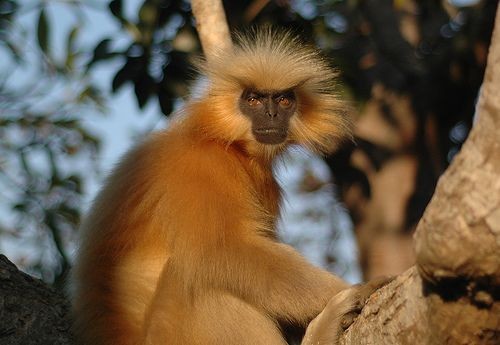
Hidden in the dense forests of the India-Bhutan border is a treasure perhaps still unknown to most people outside the Northeast. This treasure can be called as the region's gold. They appear even more golden when sunlight passes, with faces so calm and innocent that you could simply gaze at them like anything. These are golden langurs, or Trachypithecus geei, which look quite different from other langur species. As we've all seen, langurs typically have round noses. Still, these have long, elongated noses with thin, downward-opening nostrils, and their nails are also very flat. They have thick fur on their body, but their black faces are completely hairless. Due to the golden hue intensifying in the monsoon, earning the animal its name, the golden langur, or Sonali Bandar, in the local language. Yet this colour is seasonal. In summer, the coat fades to pale cream or white; in winter, it deepens to rich gold or orangish yellow. Newborns are born white, sometimes with a reddish tinge due to erythrism (a rare pigmentation condition). You won't even need to even look for them as their long, shiny, golden tails can be seen waving from a distance. Typically, adult males are larger and more robust than females, weighing about 10.8 kilograms compared to the females' 9.5 kilograms.
Amazingly, this striking species was recorded in scientific literature in the early 1950s. A naturalist and tea estate owner, Edward Pritchard Geei, encountered these unusual monkeys in the forests of the Assam region. He photographed them and sent the images to the Zoological Survey of India in Kolkata, where they revealed a previously unknown primate and added a new chapter in primatology. In recognition of his discovery, the species was named Trachypithecus geei.
The golden langurs are also diurnal and arboreal, spending most of their lives in the forest canopy. They come down, but on rare occasions, to drink water, lick the salt-laden soil, or navigate patchy areas where forests have been fragmented. They rest at night high in the air, on tall trees they selectively choose. They are found in small groups of between three and fifteen individuals, often in single-male, multi-female groups.
One of the most touching episodes has happened very far from forest canopies. In 1984, a devotee who believed the golden langurs were descendants of Lord Hanuman moved some of them to Peacock Island near Umananda Temple in Assam. The population's deprivation of its natural environment led to its gradual depletion. In 2020, the final surviving langur, lovingly known as Govinda (a name given by a tea seller on the island), passed away, leaving the island silent.
The world of the golden langur has never been large and they are classified as endangered by IUCN. However, it is a rarest primate with a limited range, distributed in western Assam and a small area of southern Bhutan. Its total distribution in India spans about 2,500 square kilometers, containing the Manas River on the east, the Sankosh River on the west, and the Brahmaputra River on the south. Its distribution is also narrow in Bhutan, where it is restricted to a river system of the Sankosh, Aie, Chamkhar, Mangde, and Manas.
Current estimates of 2024 indicate that this endangered species has decreased to 7400 in India. The population decline may increase due to significant threats, including habitat loss and fragmentation, electrocution caused by roads and power lines, extinctions, disease and inbreeding, pesticide poisoning, and ongoing pressure from human activity over the years. If this golden glow fades, it will not be just a species lost, but a warning from the forest itself.
Anu is a PhD scholar at CSIR-NIScPR with a keen interest in science writing.