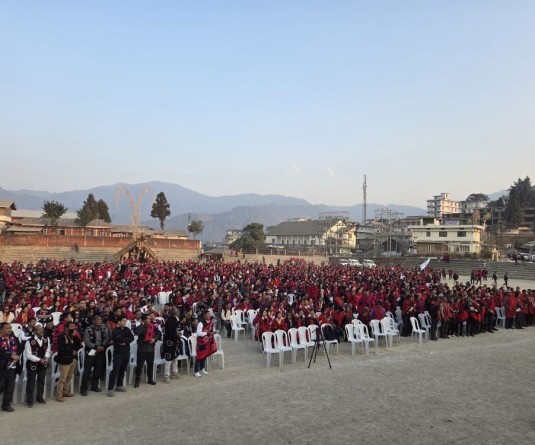
Urges restraint for Chakhesang landowners, links issue to military presence in civilian areas
Dimapur, April 5 (MExN): The Global Naga Forum (GNF) has expressed serious concern over the proposed installation of an Indian Air Force (IAF) Mountain Radar system at Pfutsero, located in the area under the jurisdiction of the “Chakhesang country.” The GNF cautioned that the move carries far-reaching political and social implications beyond its technical description.
In a press release issued by its Media Cell, the GNF acknowledged that the radar is “not a weapon system but a surveillance installation intended to monitor airspace and strengthen India’s defence preparedness” and therefore “may not be immediately dangerous to the lives of the Naga people.”
However, the Forum cautioned that reducing the issue to a mere technical deployment would be a “grave mistake.” It said that the implications are far-reaching and must be understood in their full political, social and historical context. “Every such installation comes with consequences that go far beyond its technical description. Land around the site will inevitably become restricted. Military presence will increase. Infrastructure will follow. And most importantly, the area will be drawn into India’s strategic defence grid. Once that happens, the land will no longer just be a village asset. It becomes part of a larger military framework with implications that go far beyond what is being told to the people today,” the release stated.
The GNF noted that the proposed radar is “part of India’s larger strategy to strengthen its defense posture in response to China and Pakistan” and that Nagaland is being positioned within that framework because of its geography. “But the question before us is not about India’s security concerns alone. The real question is about the rights, the future, and the consent of the Naga people,” it said.
Citing Article 371A of the Constitution, which provides special safeguards to Nagaland on land and its resources, the Forum asserted that “no authority, including the Ministry of Defence, has the right to take or use land in Nagaland without the knowledge, consent, and involvement of the rightful owners and the community.”
“At the same time, we cannot ignore how such processes unfold in reality,” the GNF cautioned. It added, “The Centre rarely comes directly. It moves through the State Government, through agencies, and through intermediaries. There will be negotiations and pressure. There will be financial offers and compensation packages designed to make the arrangement appear beneficial and attractive.”
The forum also stressed that i is not in the Radar itself but in how decisions are made. “If individual landowners begin to sell or lease land driven by immediate financial gain without weighing the long term implications, it will have consequences that cannot be reversed. Land once committed to such a framework does not easily return to its original character or control,” it cautioned.
The Forum made a “direct and sincere appeal” to landowners of the Chakhesang community to “exercise restraint and responsibility,” stressing that the matter should not be treated as a private transaction but one concerning the collective future of the people.
“Decisions of this nature must arise from collective wisdom and not individual compulsion,” the GNF said, calling upon tribal apex bodies, village councils and civil society organisations to step in with clarity and firmness. “If necessary, there should be intervention to prevent any sale or leasing of land for such purposes unless it is thoroughly discussed and agreed upon by the community as a whole.”
The GNF also reiterated its consistent appeal to the state government, student bodies and tribal Hohos to pursue the relocation of Assam Rifles camps from the heart of towns across all Naga areas.
“Our position has always been that civilian spaces and urbanisation must not be gradually overtaken by expanding military presence. The present issue must be viewed in that same spirit and concern,” it said.
“The question before us is larger than a single project. It is about safeguarding our land, our rights, and our collective future. The responsibility lies with all of us to act with foresight and unity,” the GNF added.