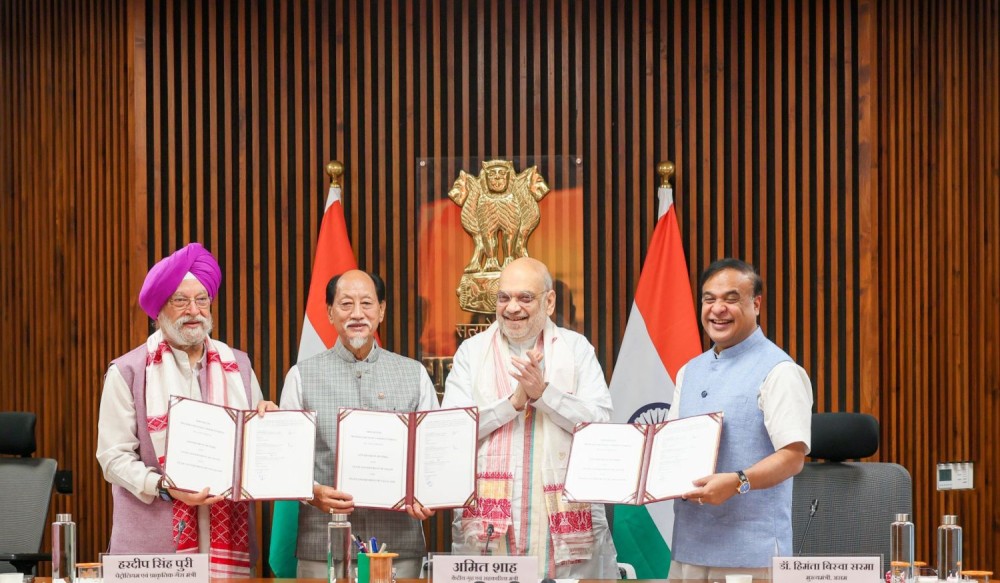
Union Home Minister Amit Shah and Union Petroleum and Natural Gas Minister Hardeep Singh Puri with Nagaland Chief Minister Dr Neiphiu Rio and Assam Chief Minister Himanta Biswa Sarma during the signing of a tripartite MoU on ‘Mineral Oil Operations in the Assam-Nagaland Boundary Areas’ in New Delhi on June 11. (PIB File Photo)
Moa Jamir
Dimapur | July 8
The Tripartite Memorandum of Understanding (MoU) between the Government of India (GoI), Assam and Nagaland for the “expeditious exploration, development and production of mineral oil resources” in the Assam-Nagaland boundary areas lays down a framework for joint administration, revenue sharing and coordinated regulation, among other provisions.
It further explicitly stated that the arrangement will not prejudice the territorial claims of either State.
The agreement, signed on June 11, 2026, was placed before the ongoing Budget Session of the Assam Legislative Assembly on July 8 as part of a written reply by Border Protection & Development (BP&D) Minister Atul Bora to a starred question on encroachment by neighbouring states and border dispute resolution.
The details revealed that the GoI, represented by the Ministry of Petroleum and Natural Gas (MoPNG), and the two States (the Parties) intend to jointly regulate petroleum operations in the disputed boundary areas through an interim arrangement pending adjudication of the decades-old boundary dispute before the Supreme Court.
Six sectors covered
The MoU applied to an “area of interest for mineral oil operations” comprising Sectors A, B, C, D, E and F along the Assam-Nagaland boundary, which it describes as being “fully agreed” by both States.
Although the schedule identifying the sectors was not annexed to the document tabled in the Assembly, previous Assam Government Border Outpost (BOP) records indicated that Sectors A to D fall in Golaghat district, Sector E in Jorhat, and Sector F spans Jorhat and Sivasagar districts.
Collectively, these correspond to the Disputed Area Belt (DAB) along the Assam-Nagaland border.
Assam and Nagaland share an approximately 512-km interstate boundary, according to a 2017 Union Ministry of Home Affairs reply in the Lok Sabha. In his written reply, Bora also informed the Assembly that 59,490.21 hectares of Assam's land is under alleged encroachment by Nagaland.
The MoU, however, makes it clear that its implementation shall neither prejudice the territorial claims of either State nor affect the pending Supreme Court proceedings arising out of Original Suit No. 2 of 1988 filed by the Assam Government.
Responsibilities & Joint approval mechanism
The agreement also assigned specific responsibilities to the Union Government and the two States. While the Union Government, through the MoPNG and the Directorate General of Hydrocarbons (DGH), will support regulation and development of petroleum resources, Assam and Nagaland have agreed to facilitate statutory approvals, promote private participation and ensure compliance with applicable petroleum laws.
One of the MoU’s most significant provisions establishes a joint approval mechanism for petroleum leases.
Applications for exploration or production within the designated areas will first require approval from the Union Ministry of Petroleum and Natural Gas before being placed before a committee comprising two representatives each from Assam and Nagaland.
Two officers nominated by the MoPNG will participate as special invitees, with their role limited to providing assistance and clarification.
Petroleum leases can be granted only through the committee, with both States jointly issuing all subsequent licences, permissions and statutory clearances.
The agreement also requires inspections and audits to be conducted jointly by officials of both State Governments, accompanied by representatives of the MoPNG.
Exploration and production companies will also be required to regularly submit all data and information relating to their exploration and production activities to both State Governments and the Government of India.
Equal revenue sharing
The MoU also establishes an equal revenue-sharing formula stating:“For mineral oil operations carried out in any area situated in the 'area of interest for mineral oil operations', the Exploration & Production Companies shall be required to make deposit of amounts (fees, security deposit, dead rent, royalty, taxes) into two separate accounts held by the State Government of Assam and Nagaland respectively, in equal shares (50:50).”
Royalties, licence fees, dead rent, security deposits, taxes and other statutory payments arising from petroleum operations within the designated areas will be shared equally between Assam and Nagaland through separate accounts maintained by the two State Governments.
Notably, the 50:50 sharing arrangement applies not only to future projects but also to existing producing fields located within the notified “area of interest for mineral oil operations.”
Interim arrangement only
The agreement repeatedly emphasises that it is not a boundary settlement, acknowledging that the Assam-Nagaland boundary dispute has remained unresolved for more than six decades and is pending before the Supreme Court.
Accordingly, it establishes an “interim arrangement for cooperation and collaboration” between the Parties for carrying out mineral oil operations in the “area of interest for mineral oil operations” during the pendency of the case.
The MoU expressly states that the arrangement is “without prejudice” to the respective rights, territorial claims, legal positions or jurisdiction of either State, and neither creates nor alters any boundary or legal entitlement.
Any disagreement over implementation will first be considered by an Empowered Committee of Secretaries. If unresolved, it will be referred to an Empowered Group of Ministers comprising the Union Home Minister, the Union Minister for Petroleum and Natural Gas, and the Chief Ministers of Assam and Nagaland, whose decision will be final and binding.
The agreement further clarifies that it applies solely to petroleum operations within the designated sectors and does not extend to the broader Assam-Nagaland boundary dispute.
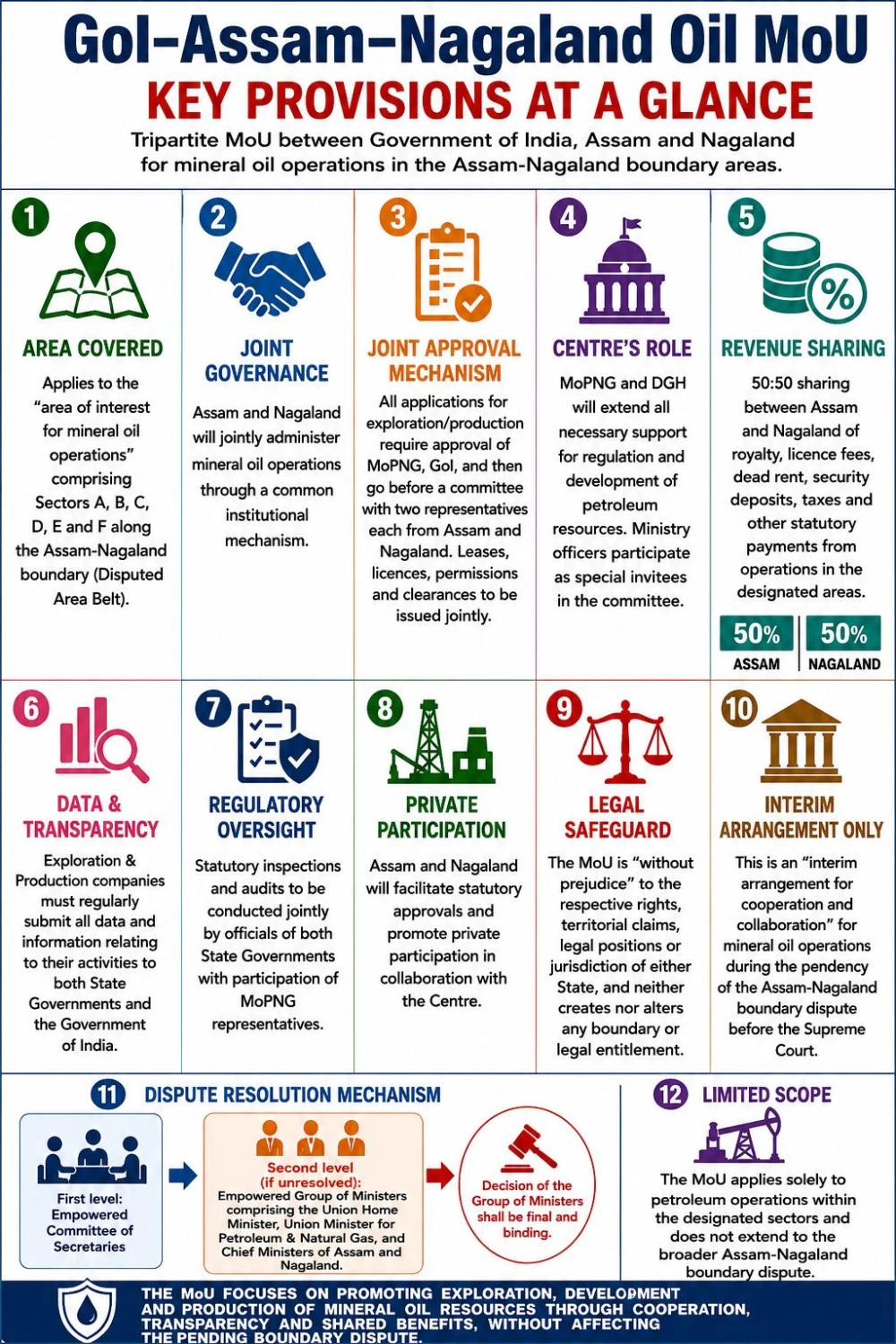
Key provisions of the GoI-Assam-Nagaland Tripartite Oil MoU
• Interim arrangement: Establishes an interim framework for petroleum operations pending final resolution of the Assam-Nagaland boundary dispute by the Supreme Court.
• No impact on territorial claims: Explicitly states that the MoU is “without prejudice” to the rights, territorial claims, legal positions or jurisdiction of either State and does not alter any boundary or legal entitlement.
• Area covered: Applies to the designated “area of interest for mineral oil operations” comprising Sectors A-F along the Assam-Nagaland boundary.
• Joint governance: Petroleum operations to be jointly administered by Assam and Nagaland under a common institutional mechanism.
• Joint approval process: Petroleum leases, licences, permissions and statutory clearances to be processed through a joint committee comprising representatives of both States.
• Centre's role: The Ministry of Petroleum and Natural Gas (MoPNG) and the Directorate General of Hydrocarbons (DGH) to provide regulatory and technical support, with Ministry representatives participating as special invitees in the joint committee.
• Regulatory oversight: Statutory inspections and audits to be carried out jointly by officials of both State Governments with participation of MoPNG representatives.
• Mandatory data sharing: Exploration and production companies must regularly submit operational data and information to both State Governments and the Government of India.
• Equal revenue sharing: Royalties, licence fees, dead rent, security deposits, taxes and other statutory payments to be shared equally (50:50) between Assam and Nagaland.
• Existing and future fields: The 50:50 revenue-sharing arrangement applies to both existing producing fields and future petroleum operations within the notified area.
• Private participation: Assam and Nagaland will facilitate statutory approvals and promote private investment in collaboration with the Centre.
• Dispute resolution: Implementation issues to be considered first by an Empowered Committee of Secretaries, and if unresolved, by an Empowered Group of Ministers comprising the Union Home Minister, Union Petroleum Minister, and the Chief Ministers of Assam and Nagaland, whose decision will be final and binding.
• Limited scope: Applies only to petroleum operations within the designated sectors and does not extend to the broader Assam-Nagaland boundary dispute.