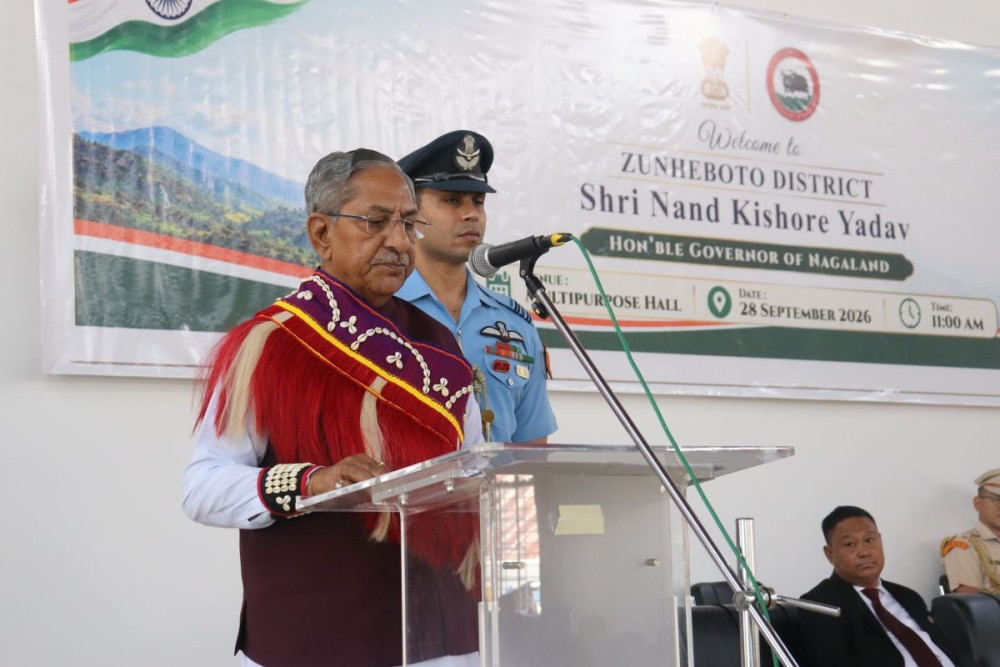
Nagaland Governor Nand Kishore Yadav addressing officials at the Multipurpose Hall in Zunheboto on September 28.
Morung Express News
Dimapur | September 28
Nagaland Governor Nand Kishore Yadav on September 28 stressed the need for effective last-mile delivery of government services, inter-departmental coordination and time-bound implementation during his visit to Zunheboto district.
Addressing officials at the Multipurpose Hall, Zunheboto, Yadav said the visit was intended to understand the “actual situation on the ground”, identify what was working and examine gaps and constraints in implementing government programmes.
“The district administration is the face of government for the common citizen,” he said, stressing that for people in remote villages, government is represented by teachers, health workers, agricultural officers, police personnel, village-level functionaries and district administration.
He urged officials to give particular attention to remote and difficult areas, saying development must reach beyond district headquarters and administrative centres. The Governor cautioned against measuring the success of schemes merely through financial expenditure or administrative milestones.
“While reviewing schemes, we should not be satisfied merely because funds have been released, work orders have been issued or expenditure has been booked,” he said. “The real question should be: What has changed on the ground because of the government intervention?”
On education, Yadav called for greater focus on learning outcomes, attendance, retention, infrastructure and transition from school to higher education or vocational opportunities. He asked the Education Department to identify schools requiring urgent intervention and prepare a priority list. “Our objective should be simple: every child should have access to quality education and every school should produce measurable learning outcomes,” he said.
On healthcare, he said the focus should be on the functionality and accessibility of health institutions rather than infrastructure alone. Health centres, he said, must have adequate personnel, essential medicines and functional equipment to provide timely treatment.
Yadav called for agriculture to move beyond a subsidy-oriented approach towards productivity, value addition, processing, packaging, market linkages and income generation. He encouraged the promotion of farmer groups, cooperatives, self-help groups and producer organisations.
“Farmers should be connected not only with schemes but also with markets,” he said, pointing to the potential of Zunheboto’s horticulture, vegetables, spices and other agricultural products to reach markets beyond the district.
On connectivity, the Governor said roads should be viewed as essential links between people and economic and social services. “A road is not only a physical structure. It connects a farmer to the market, a student to an educational institution and a patient to a hospital,” he said. He called for critical connectivity gaps to be identified and works prioritised based on public need, while stressing road quality and durability to avoid repeated expenditure. Electricity, drinking water, telecommunications and digital connectivity, he added, should similarly be treated as essential infrastructure.
Yadav placed particular emphasis on coordination among departments, saying development could not take place “department by department”. He cited schools as an example, noting that education infrastructure also requires roads, electricity, drinking water and sanitation.
He directed that where projects are delayed due to issues involving multiple departments, the matter should be identified, responsibility fixed, timelines established and outcomes monitored. “Identify the issue, identify the responsible department, fix a timeline and monitor the outcome. That should be our approach,” he said.
On law and order, Yadav appreciated the role of police and security agencies in maintaining peace and safety, while calling for continued coordination with village authorities, civil society organisations and community institutions. He stressed early identification of emerging issues and timely intervention, particularly concerning women, children and vulnerable sections.
The Governor also highlighted Zunheboto’s tourism and ecological potential, including Satoi Wildlife Sanctuary and Ghosü Wildlife Bird Sanctuary. He encouraged responsible tourism involving trained local youth, homestays, clean surroundings, improved roads, information facilities, local cuisine, handicrafts and cultural experiences.
He further called for greater use of technology in governance while cautioning that digital governance should not exclude citizens with limited digital access. He suggested district-level dashboards covering targets, achievements, pending works, financial progress and major bottlenecks. “The strength of governance is ultimately measured not by the number of meetings we conduct but by the difference those meetings make in the lives of our people,” Yadav said.
Concluding his address, the Governor urged officers to remain accessible, responsive and accountable.
“My message to all officers is simple: Be accessible to the people. Be responsive to their needs. Be accountable for your responsibilities. And above all, ensure that government programmes produce visible results on the ground,” he said.
MLA and Advisor K. Tokugha Sukhalu said Zunheboto and the Naga people had faced prolonged challenges that affected the district’s development compared with other parts of the State. He noted that Zunheboto became a district in 1973, but subsequent violence further hampered its progress.
Sukhalu said the district is now witnessing development in education, healthcare, administration and infrastructure across areas including Suruhuto, Satakha, Akuluto, Atoizu and Pughoboto.
He said Zunheboto, once known as the “land of warriors”, is now being described as the “land of peace”, attributing the transformation to the leadership of the Chief Minister, village elders, public representatives and citizens.
Deputy Speaker, NLA, S. Toiho Yeptho expressed hope that Zunheboto would witness further development, with government schemes and programmes reaching the grassroots.
The programme was chaired by Zunheboto Deputy Commissioner Dharam Raj, IAS, and included addresses by the Sümi Hoho, Sümi Kukami Hoho and Zunheboto Area Public Organisation, followed by departmental presentations from PHED, Forest and Medical.