Participants during the field day organized by ICAR Nagaland Centre, Medziphema to showcase seven newly developed rice varieties.
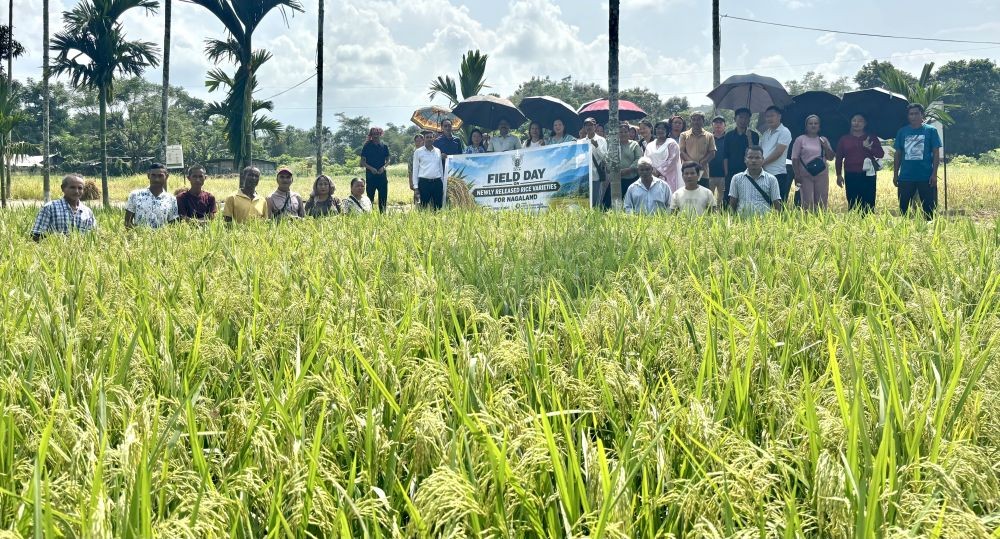
Medziphema, October 9 (MExN): The ICAR Research Complex for NEH Region, Nagaland Centre showcased seven newly developed rice varieties during a Field Day on Thursday, with farmers and agriculture officials assessing their performance and suitability for Nagaland’s agro-climatic conditions.
The seven varieties, approved for release in April, mature in about 115–120 days and have a yield potential of 5–7 tonnes per hectare, with tolerance to major biotic and abiotic stresses. They were developed to address the prolonged crop duration and low productivity associated with some existing rice cultivars in the State.
The field day brought together 56 participants, including farmers from Sovima, Henvi, Chümoukedima village, Dhansiripar and Singrijan, along with officials of the Department of Agriculture, scientists and technical personnel of ICAR Nagaland Centre and KVK officials.
During the field visit, Dr Harendra Verma, Scientist, Plant Breeding and Genetics, ICAR Nagaland Centre, explained the performance and characteristics of the seven varieties. He said the varieties were developed with a focus on major constraints faced by rice farmers, including prolonged crop duration, drought vulnerability and losses caused by diseases and insect pests.
According to the ICAR Nagaland Centre, the varieties are the outcome of more than nine years of research. Nearly 990 breeding lines were evaluated, with 30 promising lines shortlisted before the seven superior varieties were identified.
Farmers who had already cultivated some of the varieties also shared their experiences, reporting encouraging performance in terms of yield and other yield attributes. Several participating farmers expressed interest in cultivating the varieties after observing their field performance.
Head of Regional Centre, ICAR Nagaland Centre, Dr H Kalita, said the focus should be on taking improved technologies from research stations to farmers' fields. He highlighted the importance of short-duration varieties in improving the efficiency and profitability of rice-based farming systems.
District Agriculture Officer, Chümoukedima, Moaienla Pongen, appreciated the performance of the varieties and encouraged farmers to consider their adoption. She said improved varieties suited to local production conditions could help farmers secure better returns.
Deputy Director of Agriculture, David Awomi, also interacted with the farmers and highlighted the prospects of adopting improved, high-yielding and stress-tolerant varieties. He said such varieties could contribute to increased production and improved farm income and livelihood opportunities.
Joint Secretary, Department of Agriculture, Limanenla, urged farmers to adopt the newly developed varieties and make use of scientific innovations reaching the field from agricultural research institutions.
She said the shorter duration, higher yield potential and stress tolerance of the varieties could enable farmers to "harvest more in less time", improve cropping opportunities and enhance farm income. She also called on the Agriculture Department and field functionaries to facilitate wider dissemination of the varieties among farmers across the State.