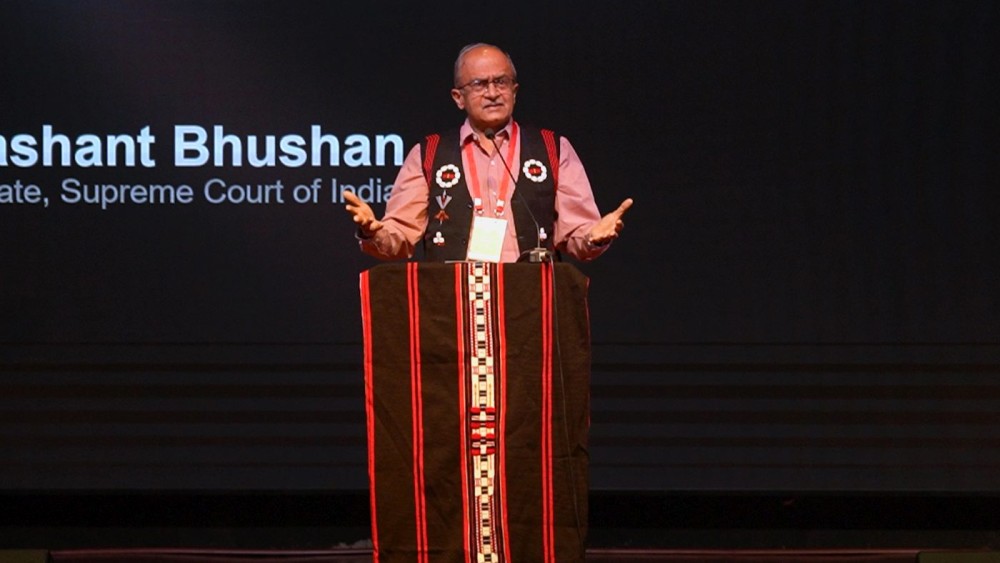
Prashant Bhushan, senior advocate of Supreme Court. (Morung Photo)
Morung Express News
Dimapur | August 29
The preservation of indigenous heritages, reportedly, does not necessarily depend on physical restrictions. “If your culture is strong, if your culture is rich, then others will imbibe your culture,” remarked Prashant Bhushan, speaking at the ‘national seminar’ on the Bengal Eastern Frontier Regulation (BEFR), 1873. The two-day seminar organised by the Inner Line Regulation Commission-Naga Students Federation (ILRC-NSF), in Dimapur, concluded on August 29.
Bhushan, a senior advocate of the Supreme Court, was invited to present his perspective on the Inner Line regime vis-à-vis the Indian Constitution. His topic was titled— Fundamental Rights and the BEFR, 1873, A Constitutional Correlation.
As opposed to protective isolation, he advocated for intercultural openness. In a closely connected world, he said that it would be impractical to put up barriers as the outside can still come inside through the various modes of communication. “You will be shutting yourself in a bubble from which nothing valuable from outside can come in and nothing valuable from inside can go out,” he said.
According to him, isolationism or trying to isolate a people, or their cultural traditions, is not the way to preserve a culture.
He though made a distinction between the isolationisms created within, to the lived experiences of the Naga communities divided by the arbitrary Indo-Myanmar border.
Addressing the legal framework, Bhushan examined the potential tension between different constitutional provisions. While acknowledging that Article 29 guarantees the right of societies to conserve their distinct language, script, and culture, he raised questions regarding how physical barriers align with Article 19, which ensures the freedom of movement and profession for all Indian citizens.
To address apprehension surrounding land and resource preservation without restricting movement, Bhushan proposed putting in place strict regulatory limits on the volume of land outsiders can acquire.
Decentralisation of governance was another key focus. By inverting the prevailing governance model to empower grassroots bodies within the framework of fundamental rights, Bhushan suggested that communities could more effectively address local issues directly. Looking to future technological shifts, he also discussed how the rise of rational, highly advanced systems could eventually minimise the need for physical barriers and permit regimes.
Bhushan’s inclusivist standpoint was contrasted by a paper on enforcement of the BEFR in Mizoram. The paper— ‘Enforcement of BEFR 1873 in Mizoram: A Success Story’ by Dr Lallianchhunga of Mizoram University’s Department of Political Science was presented in absentia. The paper termed the ILP an essential to protecting the tribal socio-economic fabric and managing population growth, and highlighted how it has helped the indigenous Mizos helped retain business ownership. It recalled that prior to 1994, ownership of commercial establishments in Aizawl were dominated by non-Mizos. Today, it said that civil society organisations remain vigilant against ‘benami’ business practices as well.
According to Dr Lallianchhunga’s research, Mizoram's implementation of the permit system relies on a cooperative model involving the state government, civil society groups like the Central Young Mizo Association (YMA) and the Mizo Zirlai Pawl (MZP).
The paper detailed joint verification drives, including a March 2024 operation that identified 1,187 permit defaulters, and a February 2026 student-led initiative that detected 68 undocumented individuals. It also noted the Mizoram government’s ongoing commitment to managing undocumented residency.
It also featured enforcement challenges posed by infrastructure development such as railway. Following the opening of the Sairang Railway Station in September 2025, it said that the new train station processed 72,778 permits between June and July 2026 alone.
While maintaining necessary regulatory oversight, it said that the Mizoram government ensured balancing security with economic growth by digitising the ILP application process, facilitating entry for over eight lakh tourists in 2025.