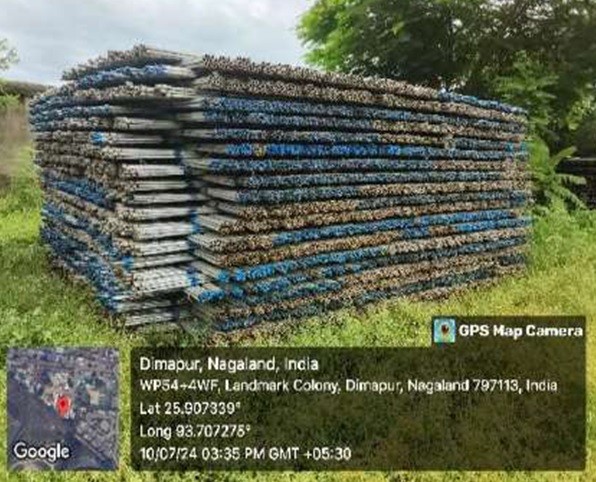
Galvanised Mild Steel (GMS) pipes were found lying in the Central Store at Dimapur in July 2024. As per the CAG, the Department’s claim of full distribution of pipes to PIUs was found to be incorrect, as 5.14 lakh metres of pipes valued at Rs 18.18 crore were found in the store, indicating violation of Rule 211(i) of the GFR, 2017. The State Government attribute the same to heavy monsoon.
CAG flags Rs 288-cr procurement excess and other major gaps
Moa Jamir
Dimapur | September 4
Nagaland’s implementation of the Jal Jeevan Mission (JJM) has come under sharp scrutiny, with the Comptroller and Auditor General of India (CAG) finding significant gaps between official records and the situation on the ground.
The CAG’s Performance Audit covered JJM implementation from 2019-20 to 2023-24 and examined four district -Longleng, Dimapur, Wokha and Kiphire, covering nine blocks and 34 of 577 habitations, besides surveying 493 beneficiaries and conducting Joint Physical Verifications (JPVs).
Launched in 2019 to provide rural households with Functional Household Tap Connections (FHTCs), JJM saw Nagaland receive Rs 1,416.08 crore, of which Rs 1,376.33 crore was spent during 2019-2024.
But the audit found that despite expenditure, the objective of the JJM to provide adequate amount of portable water was not fully achieved, with problems beginning at the planning stage.
Plans without proper baseline
As per the CAG, none of the test-checked Project Implementation Units (PIUs)conducted baseline surveys before preparing Village Action Plans (VAPs).
The plans also failed to capture existing water-supply infrastructure, despite 32 of the 34 habitations already having water-supply assets such as reservoirs, sedimentation tanks, diversion weirs and filters.
The audit also found that VAPs projected a rural population of 6,19,986, against 4,12,669 in the 2011 Census, a 50.24% increase in nine years despite Nagaland recording negative population growth in the preceding Census period.
Household figures were equally inconsistent: FHTC requirements stood at 16,400 in VAPs, 16,288 in DPRs (Detailed Projects Report) and 14,835 in IMIS (Integrated Management Information System), while District Administration records showed 18,696 households.
Rs 288 crore procurement excess
One of the biggest financial findings concerned procurement of GMS pipes and GPS tanks.
According to the audit, PHED awarded supply orders worth Rs 888.10 crore without inviting tenders, with the CAG calculating an avoidable extra expenditure of Rs 288.12 crore, representing a corresponding financial benefit to the supplier.
A separate comparison found Nagaland’s pipe rates were 18% to 58% higher than tendered rates in Manipur, with audit calculating another Rs 247.74 crore as avoidable excess expenditure.
Pipes shown as issued, still in store
A Joint Physical Verification in July 2024 found 5.14 lakh metres of GMS pipes worth Rs 18.18 crore still lying at the Central Store in Dimapur, although departmental records showed the entire stock had been issued to PIUs.
Audit also found transport records involving non-existent vehicles and vehicles lacking the capacity to carry the quantities of pipes and tanks recorded, raising questions over the authenticity of material movement records.
Only half the targeted taps found on ground
One of the most direct setback to JJM’s stated objective came from physical verification of household connections.
Against 16,288 FHTCs sanctioned in the DPRs for the 34 test-checked villages, PHED reported 14,102 connections in IMIS by March 2024.
However, verification through WATSAN Committees found only 8,251 FHTCs, or 50.66% of the DPR target, actually provided.
The CAG said expenditure of Rs 21.57 crore on 5,851 purported FHTCs was fictitious, as the services had not been provided.
The beneficiary survey further found 89 households sharing connections, including connections shared by as many as six households.
In seven villages, Rs 10.83 crore had reportedly been spent for FHTCs for 3,045 households, but individual pipelines had not been laid.
Among the 493 beneficiaries surveyed, 382 received four buckets of water a day, 74 received fewer than four, while 37 said regular supply had not commenced.
Rs 2.53 crore works not executed
JPVs of works in 11 habitations found another major gap with Rs 4.27 crore spent, but works worth Rs 2.53 crore remaining unexecuted to the quantities specified, despite release of full payment.
In another verification, 20 of 30 recharge structures worth Rs 5 lakh were found not constructed despite being recorded and paid for; the CAG termed the expenditure suspected fraudulent expenditure.
Water testing and community oversight weak
Water-quality monitoring was also found deficient. The four district laboratories had only eight of 35 required instruments, while laboratory testing showed a 64% to 95% shortfall.
Against a target of 71,448 Field Test Kit-based source tests, only 14,231 (19.92%) were conducted.
Meanwhile, 30 of 34 WATSAN Committees had not opened bank accounts for community contributions, and only 10 villages had conducted social audits.
CAG seeks stronger oversight
The CAG has recommended a series of measures to address the shortcomings, including mandatory baseline surveys and need assessments before preparing Village Action Plans, with projections aligned to Census and verified household data. It also called for greater capacity-building and supervision of Gram Panchayats and Village Water and Sanitation Committees (VWSCs).
On financial management, the audit recommended ending nomination-based procurement and adopting centralised e-tendering in line with JJM guidelines and financial rules, besides adhering to timelines for release of Central and State shares.
For infrastructure, the CAG recommended mandatory use of Hydro-Geo-Morphological (HGM) maps and smart sensors, along with third-party validation of completed works to establish their physical and functional status.
The audit also called for fully equipped and staffed water-quality laboratories, 100% source testing and Field Test Kit (FTK) usage, and proper recording of test results in the Water Quality Management Information System.
To strengthen community ownership, the CAG recommended proper accounting of beneficiary contributions through designated bank accounts, regular social audits, public display of water-quality results, and intensified information, education and communication campaigns.
Finally, it recommended operationalising the JJM dashboard across all Project Implementation Units (PIUs), integrating it with local MIS for real-time monitoring, and conducting annual independent evaluations whose findings feed into future planning.