Language is an essential part of human life and culture. It allows people to communicate, express emotions and feelings, share information, and build understanding among individuals and communities. Through language, people convey their thoughts, beliefs, traditions, and values, making it a fundamental tool for social interaction. More than a means of communication, language shapes how people perceive the world and how they relate to one another. Every human society, regardless of its size, depends on language to preserve its collective memory and identity.
Each language is a representation of the identity and history of the communities that speak that language. It carries within it stories of origin, struggles, achievements, and everyday experiences of its speakers. Cultural practices such as rituals, songs, proverbs, and oral narratives are deeply rooted in language, and their meanings often lose depth when translated. Language, therefore, acts as a living archive of a community’s past, present, and worldview. When people speak their language, they reaffirm their belonging and cultural continuity.
However, there are numerous languages that are vanishing globally owing to globalisation, migration, urbanisation, and the dominance of major languages such as English, Mandarin, or Spanish. As people move to cities or adopt global languages for education, employment, and social mobility, smaller languages are often neglected. In many cases, younger generations are encouraged to prioritise dominant languages, while their native tongues are viewed as less useful or outdated. This gradual shift leads to a decline in the daily use of indigenous and minority languages, making language a vulnerable aspect of cultural heritage.
Language preservation refers to the efforts directed towards safeguarding endangered languages from extinction. A language is considered endangered when it is no longer passed down from one generation to the next. When children stop learning or using their ancestral language, its future becomes uncertain. Over time, if no active speakers remain, the language eventually dies. According to linguists, hundreds of languages have disappeared in the past century alone, and many more are at risk of extinction if immediate action is not taken.
Language loss is more than just the loss of words or grammar; it involves the loss of values, oral history, folklore, folktales, songs, and indigenous knowledge systems. Many traditional societies possess unique knowledge about nature, agriculture, medicine, and environmental sustainability that is embedded in their language. These concepts often do not have exact equivalents in dominant languages, making translation insufficient. When a language disappears, humanity loses a unique way of understanding the world, developed over generations through lived experience.
Moreover, language plays a crucial role in shaping personal and collective identity. For many communities, especially indigenous and marginalised groups, language is closely tied to dignity, self-respect, and cultural pride. The erosion of language can lead to feelings of cultural inferiority and alienation, particularly among younger members of the community. Preserving language, therefore, is not only about maintaining communication but also about safeguarding human rights and cultural equality.
Several steps can be adopted to ensure effective language preservation. One important method is language documentation. Recording native speakers, compiling dictionaries, writing grammars, and collecting oral narratives help create permanent records of endangered languages. These materials can serve as valuable resources for future generations, researchers, and language learners. Documentation ensures that even if a language falls out of daily use, it is not entirely lost.
Education in the mother tongue also plays a vital role in language preservation. When children are taught in their native language during early education, they develop stronger cognitive skills and a deeper connection to their culture. Mother-tongue education helps children value, preserve, and appreciate their linguistic heritage rather than seeing it as inferior. Schools, therefore, can act as powerful spaces for promoting multilingualism and cultural respect.
Community engagement is another crucial factor, as language can only survive through active and regular use by its speakers. Families, elders, and community leaders must encourage the use of the native language in homes, cultural events, and social gatherings. Intergenerational interaction is especially important, as elders often hold linguistic knowledge that must be passed on to younger members. Without community involvement, preservation efforts remain incomplete.
In the modern world, technology has also become a powerful tool for language preservation. Digital media, social networking platforms, mobile applications, and online dictionaries allow languages to reach wider audiences. Audio-visual recordings, podcasts, and educational apps make learning engaging and accessible, especially for young people. Technology bridges the gap between tradition and modernity, making endangered languages relevant in contemporary contexts.
In conclusion, language preservation is essential for ensuring the survival of cultural diversity and human identity. Every language, regardless of the number of its speakers, holds equal value and significance. The loss of any language is a loss for humanity as a whole, as it diminishes the richness of human expression and knowledge. By supporting documentation, education, community participation, and technological initiatives, societies can ensure that future generations inherit a world rich in linguistic and cultural diversity. Preserving language is, therefore, not just a responsibility but a commitment to protecting the shared heritage of humankind.
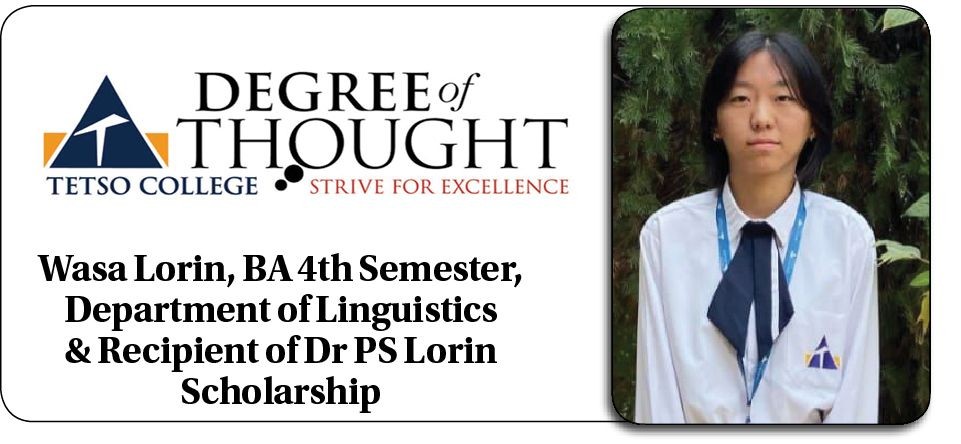
Degree of Thought is a weekly community column initiated by Tetso College in partnership with The Morung Express. Degree of Thought will delve into the social, cultural, political and educational issues around us. The views expressed here do not reflect the opinion of the institution. Tetso College is a NAAC Accredited UGC recognised Commerce and Arts College. The editorial team includes Chubamenla, Asst. Professor Dept. of English and Rinsit Sareo, Asst. Manager, IT, Media & Communications. For feedback or comments please email: dot@tetsocollege.org