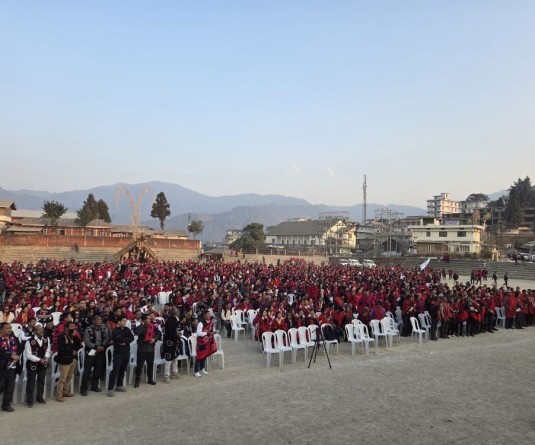
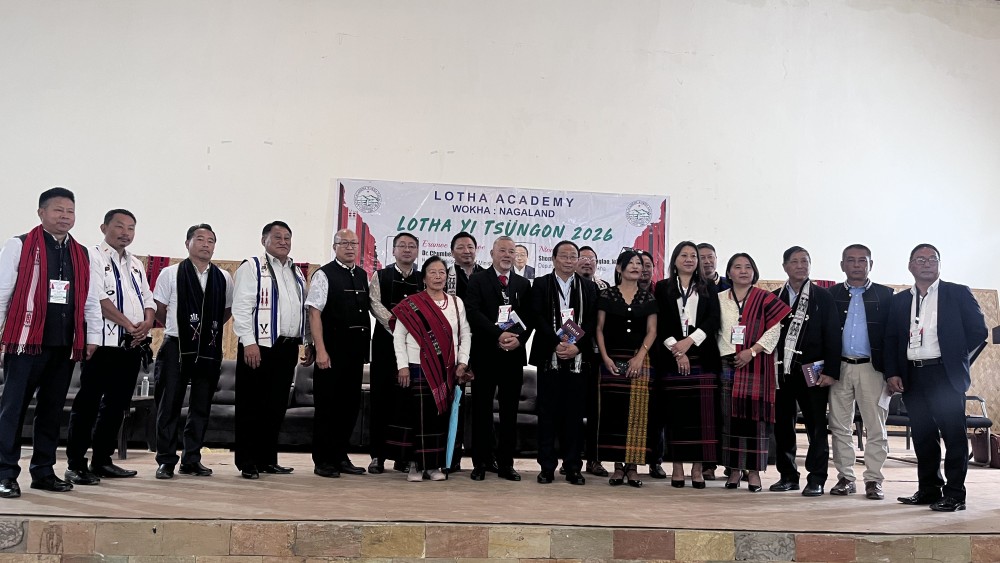
Lotha Academy members along with the special guest and other officials during the Lotha Language Day held at Town Hall, Wokha on May 1. (Morung Photo)
Morung Express News
Wokha | May 1
The Lotha Academy observed Lotha Language Day at Town Hall, Wokha with Advisor to the Chief Minister, Dr Chumben Murry, attending as the special guest on May 1.
Addressing the gathering, Dr Murry underscored the relevance of the observance, particularly for the younger generation. “This day holds deep significance, especially for our youth. It is not merely about refining the Lotha language, but about preserving our identity and cultural heritage,” he stated, while encouraging wider participation from all sections of the community.
Reflecting on his personal experiences, he remarked, “During my early years away from home for studies, I had limited engagement with my language and traditions. Over time, I have come to realise their true value.” He urged the younger generation to remain rooted in their culture, adding, “Stay connected to your roots and take pride in your language and traditions.”
Dr Murry further emphasised the role of language in fostering unity and strengthening relationships. “Our shared values, resilience, hospitality, and wisdom are deeply embedded in our language,” he noted, adding that folk songs, folklore, and ancestral knowledge continue to be preserved through it.
Calling for sustained efforts, he said, “Promotion and preservation of our language must go beyond formal programmes and become part of our daily lives.” He encouraged families, including those residing outside Wokha, to continue using the language at home, stressing that “regular usage is essential for its continuity.”
He also highlighted the importance of action-oriented initiatives. “We must translate our discussions into meaningful action by promoting literature through writing and documentation,” he said, urging the community to take collective responsibility in safeguarding their linguistic heritage.
In his exhortation, Deputy Commissioner of Wokha, Mhathung Tsanglao, NCS, appreciated the Lotha Academy’s efforts in promoting the language. “Language is central to our identity, and it is the responsibility of elders to ensure that the younger generation learns and understands it,” he said.
He further encouraged the use of Lotha in everyday communication. “Simple vocabulary can be taught and practiced daily. Social media, too, can serve as an effective platform for language promotion,” he added. Highlighting the role of institutions, he noted, “Churches and Sunday schools can play a vital role by incorporating storytelling, writing, and prayer in Lotha.” He urged that the message of the observance be carried forward beyond the event.
Lolano Patton, DPRO and member of the Lotha Officers’ Association, Wokha Unit, in her greetings, described the programme as impactful. “This programme is truly an eye-opener. Despite having a rich language, many of us rely more on Nagamese and English,” she observed, encouraging greater community participation in such initiatives.
A highlight of the programme was the launch of the book “Rücholan” (Lotha Folktale and Short Stories) authored by N Janbemo Humtsoe, which was formally released by the special guest. The programme was chaired by Dr Bijano Murry Odyuo, Member of the Lotha Literature Committee. Invocation was pronounced by Limathung Patton, Catechist of St. Paul’s Church, Wokha, while Fr. Abraham Yanthan, PhD, President of the Lotha Academy, delivered the welcome address. Cultural presentations included ancestral poetry and songs by Jenibemo Ezung of Bailey Baptist College, Wokha, and a folk song by Fernbrook School, Wokha. The programme concluded with a benediction by Rev L Renathung Yanthan, Pastor of Niroyo Baptist Church.
Speaking to the media, Fr Abraham Yanthan informed that the observance was held not only in Wokha but also in Dimapur and Kohima. “The aim is to promote pride in our language and ensure its continued relevance,” he said, adding that Lotha language studies are now being introduced at the college level.
He stated, “There is a need for well-prepared books and learning materials. The Academy is actively working towards developing more literature and organising activities such as folk song, folk dance, reading, and writing competitions to encourage wider participation and ensure preservation for future generations.”