(Photo: IANS)
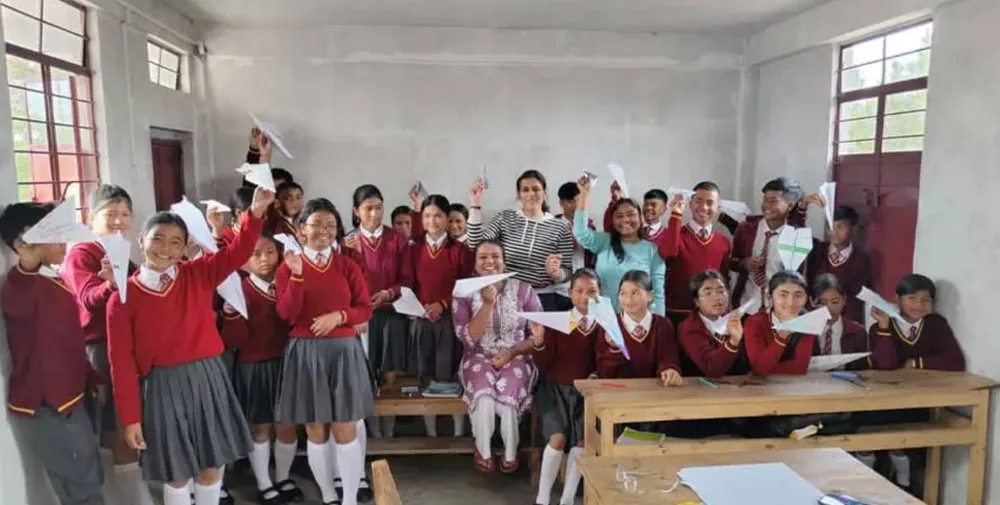
Shillong, November 29 (IANS) The Meghalaya government has announced February 8, 2027, as the start of the next academic session, introducing a series of reforms focused on foundational literacy, practical education and community-based skill development in schools across the state, officials said on Sunday.
According to a senior official, the academic session for pre-school to Class 2 students will conclude on November 26, while students from Classes 3 to 10 will continue classes until December 16.
Winter vacation will commence on December 17.
The revised academic calendar mandates a minimum of 200 working days and 1,000 instructional hours for Classes 1 to 5. For Classes 6 to 8, schools must ensure 220 working days and 1,320 instructional hours, while Classes 9 to 12 will have 220 working days and 1,540 instructional hours.
A key feature of the new guidelines is the introduction of at least 10 bagless days in every school during the academic session.
The initiative aims to encourage experiential learning through activities such as traditional crafts, interaction with artisans and farmers, visits to heritage sites, sports, cultural programmes, nature walks and environmental conservation.
The department has also made Community-Integrated Skill Learning (CISL) compulsory for Classes 6 to 10 from the 2027-28 academic session.
Integrated into Health and Physical Education, the programme will carry 50 marks out of 100, with students receiving exposure to agriculture, traditional occupations, digital skills, entrepreneurship, arts and community service.
Another major initiative is the Read & Rise (R&R) – Meghalaya Universal Reading Readiness Mission, which will be mandatory for children below seven years.
Schools will assess children's reading preparedness and provide additional support in listening, sound recognition, comprehension and basic reading skills.
Children meeting the prescribed benchmarks will be honoured at an R&R Graduation Ceremony.
The notification also fixes school timings at 9 a.m. to 2 p.m. for lower primary, 9 a.m. to 3 p.m. for upper primary and 9 a.m. to 4 p.m. for secondary and higher secondary institutions.
Morning assemblies will be compulsory and primarily student-led, while schools must ensure complete syllabus coverage through advance planning and regular monitoring.
The guidelines also emphasise competency-based assessments in accordance with the National Education Policy, 2020, encouraging projects, practical exercises, presentations and oral evaluations alongside written examinations.