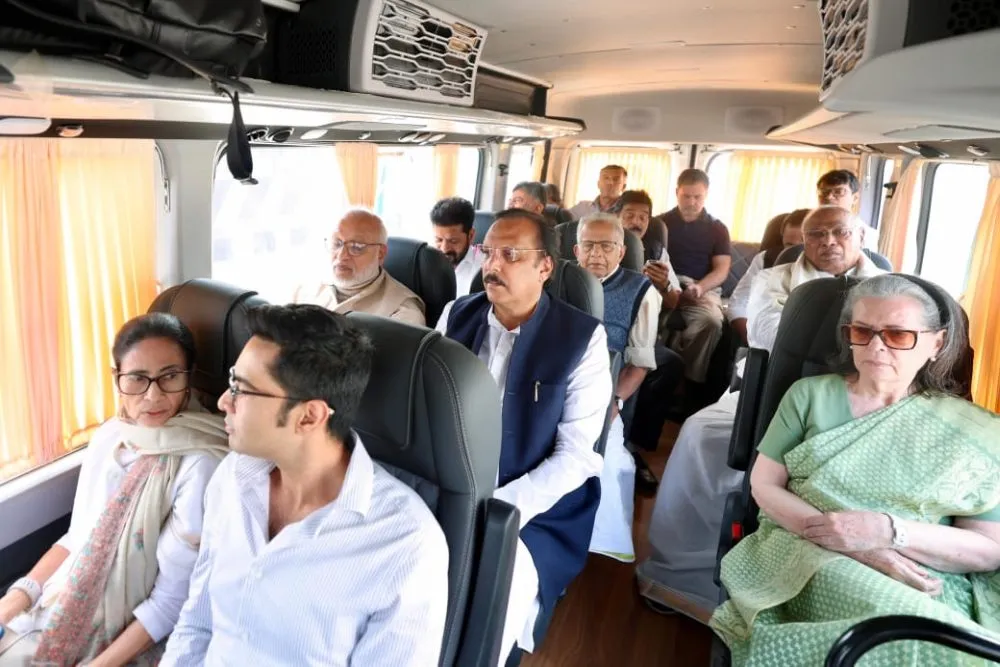
(Photo source: INDIA bloc)
New Delhi, November 29 (IANS) When the Constitution (131st Amendment) Bill, 2026, which was introduced alongside the Delimitation Bill, 2026, was defeated in Parliament seven months ago, the Rahul Gandhi-led INDIA bloc was quick to claim victory, saying that it had stopped Prime Minister Narendra Modi. The united Opposition had stood as one, and the Congress leader appeared to have found a political issue on which he could bring the INDIA bloc together against the ruling party.
But politics has a way of changing rather quickly. Seven months later, the Opposition is no longer speaking in one voice on the issue, with some important regional parties willing to support the revised Bill -- the Constitution (132nd Amendment) Bill, 2026, and the accompanying Delimitation (Second) Bill.
DMK chief M.K. Stalin, who was the Tamil Nadu Chief Minister seven months ago, had celebrated the defeat of the Bill by distributing sweets and lighting firecrackers, claiming that it had dealt a "severe blow" to PM Modi and the BJP. But today, there has been a turnaround by the southern party, which has 22 MPs in the Lok Sabha. Stalin, in a post on X, announced his support for the Bill incorporating the demands of 'fair delimitation'.
"The two demands for which we opposed the Delimitation Bill last April have been included in writing in the new Bill. This is a victory for the sustained struggles waged by the DMK since 2024! A victory for all the southern states, including Tamil Nadu!" he said.
He even urged the Opposition to "think calmly" over the delimitation move and not get emotional about what would happen if they missed the opportunity to support the Bill, which provides for a 50 per cent increase in constituencies for all states while retaining their existing relative representation.
Then there is another important Opposition ally -- veteran leader Sharad Pawar's NCP (SP) -- which has also indicated its support for the revised Bill. Party leader Jitendra Awhad has announced that the party will support the delimitation exercise, provided the uniform 50 per cent increase in seats is retained.
What Rahul Gandhi once projected as a collective victory against PM Modi has now turned into a difficult test of his own leadership and his ability to keep his political allies together.
He is trying hard to get bloc allies, especially the DMK, to stand with him. But past actions have come back to haunt Congress. The Congress top leadership rallied other allies, like Mamata Banerjee, to travel to Chennai to coax the DMK chief to change the stance.
Even other Opposition members, such as the BRS, have questioned the Congress party, asking it to present the reasons for opposing the delimitation bills.
The revised delimitation bills have certainly created major turbulence in the Opposition, with Congress feeling the jitters after a spell of unity shown over some issues.
The Modi-led government, having learnt from its earlier setback, revised the delimitation formula and addressed one of the major objections raised by several political parties, particularly those from southern India. The new proposal provides for a uniform 50 per cent increase in Lok Sabha seats for every state and Union Territory, while maintaining the existing relative share of states until 2051. This is an important political shift and a significant change from the earlier proposal, which is now acknowledged by some regional parties.
In the process, the very North-South divide that Rahul Gandhi had hoped to highlight has become much more difficult to sustain. His attempt to project delimitation as a battle between the interests of northern and southern states was aimed at bringing regional parties together against the Modi government. But the revised proposal has changed the political situation. It is precisely this change that has complicated Rahul Gandhi's political calculations. Regional parties have their own political reasons for taking this position, but their decisions have certainly weakened the Congress' attempt to present a united Opposition front. The fact that some important political partners are no longer on the same page tells its own story.
For Rahul Gandhi, this is an uncomfortable situation. He had taken considerable political credit for bringing the Opposition together in April and defeating the government's constitutional amendment. In a post on X after the Bill's defeat in April, Rahul Gandhi highlighted Opposition unity, saying, "The amendment bill has fallen. They used an unconstitutional trick to break the Constitution in the name of women. India has seen it. INDIA has stopped it."
He sought to present the defeat of the Bill as a moment of Opposition unity and a setback for the Prime Minister. But now, when the government has returned with a revised proposal, Congress is finding it difficult to get all its political partners on board.
The problem with the Rahul-led Congress is that it often appears to believe that its political position should automatically become the position of the entire Opposition. Regional parties are not necessarily going to put Congress' political strategy above their own calculations.
There is another problem for Rahul Gandhi. His reported insistence that Congress will oppose the Bill even if the Opposition does not have the numbers to defeat it could prove counterproductive. With some of his political partners deciding to support the proposal, the party could end up fighting not just the government but also its own allies. Such an approach would further expose the differences within the Opposition.
And this is where the Modi government has managed to turn the tables. It has not only brought the issue back to Parliament but has also changed the political equation around it.
Sensing the situation, Gandhi has tried to widen the argument by bringing in the SIR and the role of the Chief Election Commissioner. He has called the Narendra Modi government's delimitation plan the BJP's "final weapon", saying that the proposed 850-seat Lok Sabha would become "a symbol of the murder of democracy".
But the political reality is that the Opposition is no longer speaking with one voice on the issue. While Congress is determined to oppose the proposal, some important regional parties have chosen to support the bills. This time, the Opposition will not be approaching Parliament with the same unity it displayed in April. The Modi-led front has managed to regain the initiative and put the Congress on the defensive.
What was projected as a major Opposition victory in April has now turned into a political challenge for Rahul Gandhi. And, with the 2029 Lok Sabha elections not too far away, this episode may well offer a glimpse of the political battle ahead -- one in which keeping the Opposition together could prove as difficult as taking on the ruling party.