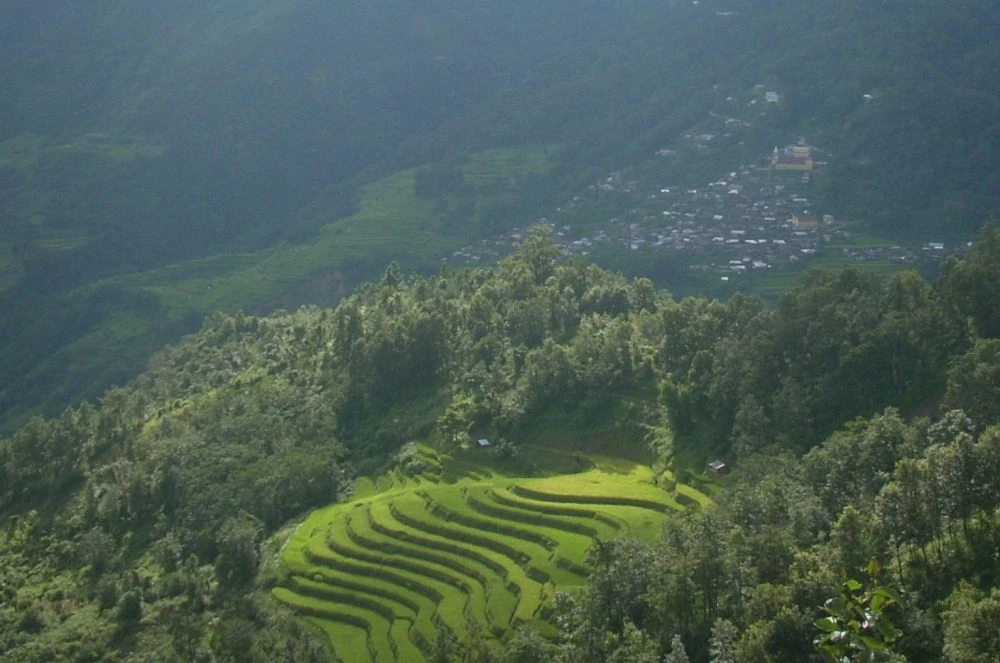
Terrace field in Longleng district. (Morung Photo)
Our Correspondent
Kohima | February 6
The National Bank for Agriculture and Rural Development (NABARD), Nagaland Regional Office, Dimapur has recently highlighted the major socio-economic indicators of Nagaland through a State Focus Paper for the year 2026-27.
“Nagaland is a developing economy with a vast potential for economic growth. The currently unutilized and underutilized potential including untapped natural resources as well as demographic dividend can be optimally allocated for the growth and development of the state,” the State Focus Paper stated, which was released during the State Credit Seminar 2026 in Kohima on February 3 last.
At present, Gross State Domestic Product (GSDP) (2025-26 at current prices) stands at Rs 43,470 crore.
It projected a 12% growth in its Gross State Domestic Product (GSDP) for the 2025-26 fiscal over the revised estimates of 2024-25. The GSDP growth rate for the current financial year (2024-25) at constant prices is estimated at 7.69%. The per capita income for 2024-25 is pegged at Rs 1,78,304 with the estimated revenue surplus of Rs 1,618 crore, which is 3.6% of its GSDP. The fiscal deficit is targeted at 3% of GSDP, amounting to Rs 1,350 crore.
Agriculture continues to be the mainstay of Nagaland's economy, providing livelihood to more than 60% of the population. The total crops production increased by 2%, rising from 1157520 MT (metric tonnes) in 2022-23 to 1179057 MT in 2024-25.
The economy of Nagaland is predominantly agrarian with more than 60% of the total workforce dependent on agriculture and allied activities.
The percentage sectoral contribution to GSDP in 2024- 25 as per advance estimate shows that the tertiary sector is the principal contributor to the state's economy with 63%. The primary and secondary sector contributes 25% and 12% respectively.
The sectoral share in 2024-25 is in line with the recent trend of sectoral composition of the state's economy.
The provisional sectoral contribution for 2024-25 was 62% for tertiary (Services), 26.77% for primary culture) and 11.27% for secondary (Manufacturing/Industry) sector. In terms of sectoral growth rate, tertiary sector is expected to register a robust growth rate of 9.12% during 2024-25 (advance Estimate) ate) while the secondary sector is expected to grow by 7.34% and primary sector is expected to grow by 4.14%.
State economy driven by agriculture
Agriculture is the mainstay of Nagaland’s economy with more than 60% of the population engaged in agricultural activities.
Nagaland has a total geographical area of 16579 sq km, of which total cultivable area is 1006204 ha, gross cropped area is 315618 ha, double cropped area is 95020 ha, net cropped area is 283840 ha, Gross Irrigated Area is 122394 ha and Net Irrigated Area is 117799 ha.
During 2024-25, there was 386620 ha area for production of crops of which cereals were 280070 ha with production of 881850 MT with a yield of 2435 kg.
The Pulses covered an area of 273300 ha with production of 3372000 MT yielding 1234 kgs.
The oilseeds covered area of 399500 ha with production of 4222000 MT and yield of 1057 kg while commercial crops were spread over area of 3927000 ha area with production of 43254000 MT and with yield of 11016 kg.
Major Crops grown in Nagaland are Jhum Paddy, WTRC Paddy, Maize and others like Small Millets, etc. Among Horticulture, flowers like Anthurium and Gerbera, Ginger, Pineapple, Banana, Limes and Citrus are predominant. Coffee, Arecanut and Coconuts are also found in large numbers besides presence of Sericulture activities.
As per latest Agricultural Census, the total holding of land was 178000 nos., of which Marginal Farmers were 6000, small farmers were 20000, and Big Farmers were 152000, which could possibly be because land is held by the Village Community.
Out of the total geographical area of the State (16,579 sq.km), Forestland constitutes the largest share at 52.08% (862,930 ha), followed by net sown area at 22.07% (365,605 ha). Fruit production increased by 3%from 333,435.3 MT in 2023-24 to 342,475.5 MT in 2024-25. Vegetable production and productivity dropped by 1.6% and Spices saw a 3% rise in total production.
Sericulture production increased in the State with Mokokchung registering the highest sericulture production.
The state produces 42.57% of its meat, egg, and dairy needs, valued at Rs 1,020.67 crores, with a 57.43% shortfall. To meet the gap, it imported animal husbandry products worth Rs. 271.99 crores. The total fish production increased from 9,284.99 MT in 2023-24 to 9,695.71 MT in 2024- 25, marking a growth rate of 4.42%
Manufacturing sector’s growth estimated at 7.3%
The State Focus Paper stated that the manufacturing sector's growth in Nagaland was estimated at 7.3% in 2024-25, a significant increase from 1.7% in 2023-24.
Agriculture and forestry are the primary contributors to Nagaland's GVA. The services sector is the largest contributor to the state's economy, accounting for an estimated 63% in 2023-24.
There are 11 District Industrial Office and 14 Sub District Industrial Office in the state as on 2023-24.
There is a Nagaland Industrial Development Corporation and 11 Nagaland Khadi & Village Industrial Board.
There are six Emporiums within the state and two outside the state. There are six Weavers Training Centre and eight Rural Artisan Programme Training Centre. Major leadings are retail/wholesale trade except for motor vehicles and motorcycles with 2398 numbers and 1106 nos. of food products and Beverages. It generated an employment of 39046 nos.
There are also three International Border Trade Centres and one Special Economic Zone. Around 720 beneficiaries were covered under Prime Minister Employment Generation Programme (PMEGP) during 2024-25.
With an aim to accelerate and promote local entrepreneurs in the state of Nagaland, the Department of Industries & Commerce, Government of Nagaland has been appointed as the Nodal department to implement the Startup Policy for the slate which will create an enabling environment for startups to grow by ensuring knowledge exchange capacity building policy interventions and access to funding.
Under the startup policy, the state government aims to facilitate the growth of at least 500 startups the next five years with a focus on establishing innovative Made in Nagaland products and services.
The Government of Nagaland will establish a world class state Incubator in partnership with leading global organizations under a PPP model to nurture, guide and support existing and aspiring start-ups, enabling them to become successful business ventures and generate direct and indirect employment in the private sector, the State Focus Paper stated.