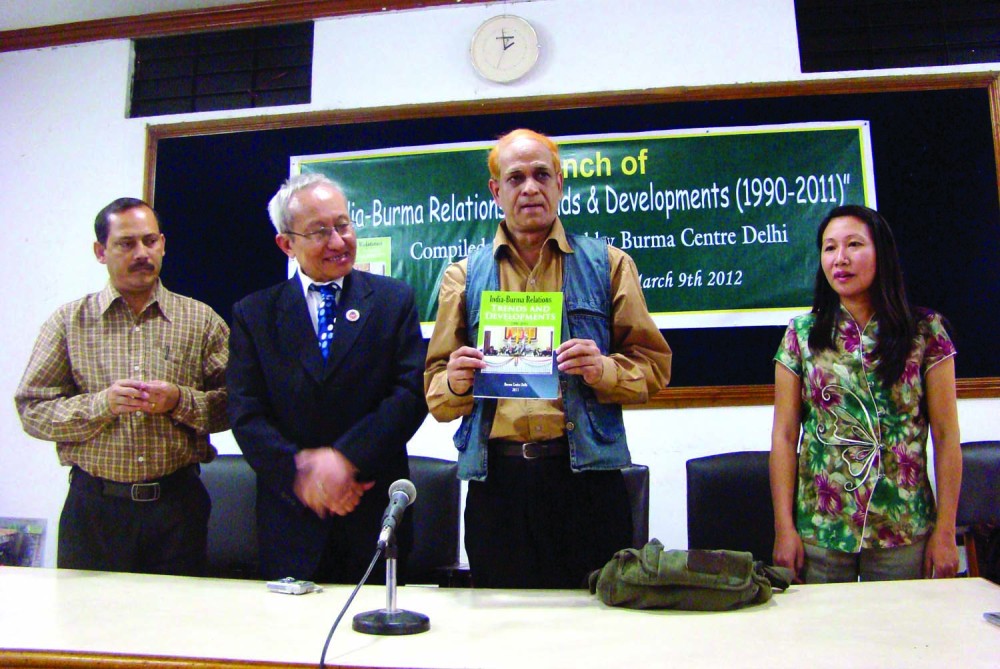
President of Journalists Forum Assam, Rupam Baruah (2nd from L) releases a book on “India-Burma Relations: Trends & Developments (1990-2011)” as Dr. Tint Swe (2nd from R) former MP Burma and others look on at Press Club Guwahati on Friday. (Morung Photo)
GUWAHATI, MARCH 9 (MExN): With the objective of updating the civil societies, media and social activists in India on the current transition taking place in Myanmar, an “Interactive Session on Changing Policies in Burma: Opportunities and Challenges” was held at Press Club, Guwahati on Friday, organised by the Burma Centre Delhi in collaboration with Journalists Forum Assam (JFA). It was also to assess the challenges and opportunities of political reforms and to come up with an appropriate strategy to respond in a constructive approach.
Dr. Tint Swe, an Elected Burmese Member of Parliament in 1990 belonging to National League for Democracy (NLD) of Aung San Suu Kyi and living in India for two decades, pointed out that the Naga areas in Myanmar were “under-developed and isolated.” He said the Naga areas were the least developed among the ethnic minorities in Burma pointing out that the lack of infrastructure especially road was pathetic. Dr. Swe said that no government doctor, teacher or nurse was willing to be posted in Naga areas due to lack of everything. “Nagaland can also do a lot for their fellow Nagas,” he said.
Dr Swe said there were visible changes taking place in Burma like the ceasefire agreements with ethnic armed groups, the suspension of the unpopular Myitsone dam, release of political prisoners, relaxation of media censorship, allowing Suu Kyi’s NLD to register as a party to contest in the upcoming by-election on 1 April 2012 etc. He, however, added that these were not enough and that international pressure on Burma was very much needed at present to embrace total democracy. He said the main manifesto of the NLD was amendment of the constitution, internal peace and maintaining the rule of law.
Dr. Swe pointed out that countries like the USA and China were making its presence strongly felt in Burma while, India, the nearest neighbour was maintaining a very slow pace. He said India’s concern in Burma was mainly on security and that more needed to be done adding “India needs to change as things are changing in Burma.”
He said Burma needs India to spread education, information technology and agricultural activities and “not only exploiting dams.” Dr. Swe relayed Suu Kyi’s message that India needed to do more in Burma. He said the two countries would be benefitted if genuine democracy dawns in Burma. “I want India to be more pro-active,” he added.
Dr. Alana Golmei, coordinator of Burma Centre Delhi (BCD) pointed out that the continuing waves of reforms in 2011 and 2012 including the release of several prominent political prisoners by the Burmese government in January gave optimism to many international observers, people in the country and governments around the world that Burma is finally on the track to irreversible reforms. Nevertheless, it will be too early to assume that the reform is irreversible when there are many serious questions still to be answered and challenges to be addressed in the country, she added.
Lalremruata, director of Zo Indigenous Forum delivered a brief report on “Kaladan Multi Modal Transit Project: Concern for People of India and Burma.” Some of the negative impacts, he said were, forced displacement and poverty, increased human rights violation, human trafficking, increased land confiscation leading to food insecurity etc.
He appealed the authorities to take up the project in such a way that it benefits the people of the project area many of whom were living below the poverty line. The land compensations also were not well paid.
K. Filip Sumi of The Morung Express spoke on “The relation between Myanmar and Nagaland in the present context.” He said if the physical integration of the Nagas seemed difficult, given the current situation, the Nagaland and Myanmar governments should strive more than before to facilitate the emotional and cultural integration of the Nagas on both sides by keeping the trades centers and routes active regularly. He that the Nagas in Nagaland would like to see that their fellow brethren in Burma get to fully enjoy their rights and benefits when that country shifts to democracy. He, however, expressed apprehension that the military might continue to work to see that the government play by the rules laid down by it even after a democratic government is put in place. Sumi said Myanmar would be seen by the world as truly moving towards a full-fledged democratic country when all political prisoners were released.
Later, a report on “India-Burma Relations: Trends & Developments (1990-2011)” compiled and published by Burma Centre Delhi was released by Rupam Baruah, president of the Journalists Forum Assam. Contributors to the book include Indian and Burmese Parliamentarians, Dr. Shashi Tharoor, Mani Shanker Aiyer, Dr. Tint Swe, Social activist Jaya Jaitley, C.S Kuppuswamy, Dr K.Yhome, Prof Ganganath Jha, Prof Baladas Ghoshal, strategist and security analyst Rahul. K. Bhonsle, Anil Bhat, journalist Subir Bhaumik, Nava Thakuria, Satya Sagar, intellectuals, analysts and researchers.
Speaking about the report, Dr. Alana Golmei said change in Burma invited change from India through the Northeast. She added that it would be appropriate for India to move beyond its self-centered strategic and economic interest in Burma and now play the role of a responsible neighbour by taking initiative towards improving education, healthcare, trans-national civil society capacity-building and peace- initiatives.
Nava Thakuria, secretary, Journalists Forum Assam said New Delhi could help the people of northeast region since the trouble in Burma was affecting the region as more people fled to Mizoram. He said some northern areas of Burma has been used by northeast Indian militants for training and taking shelter. “If a progressive, democratic and friendly regime takes over in Nay-Pyi-Taw, the 60 million northeast Indian habitants will be directly benefited,” he said.