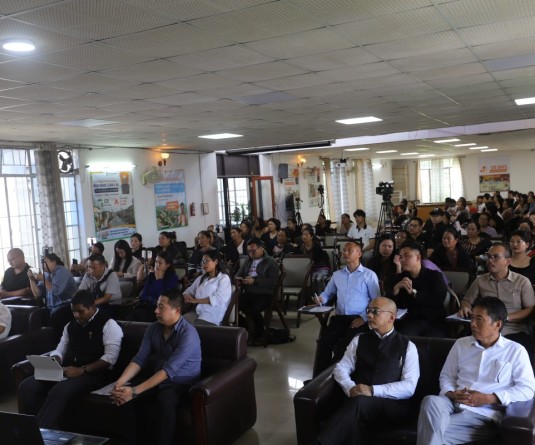
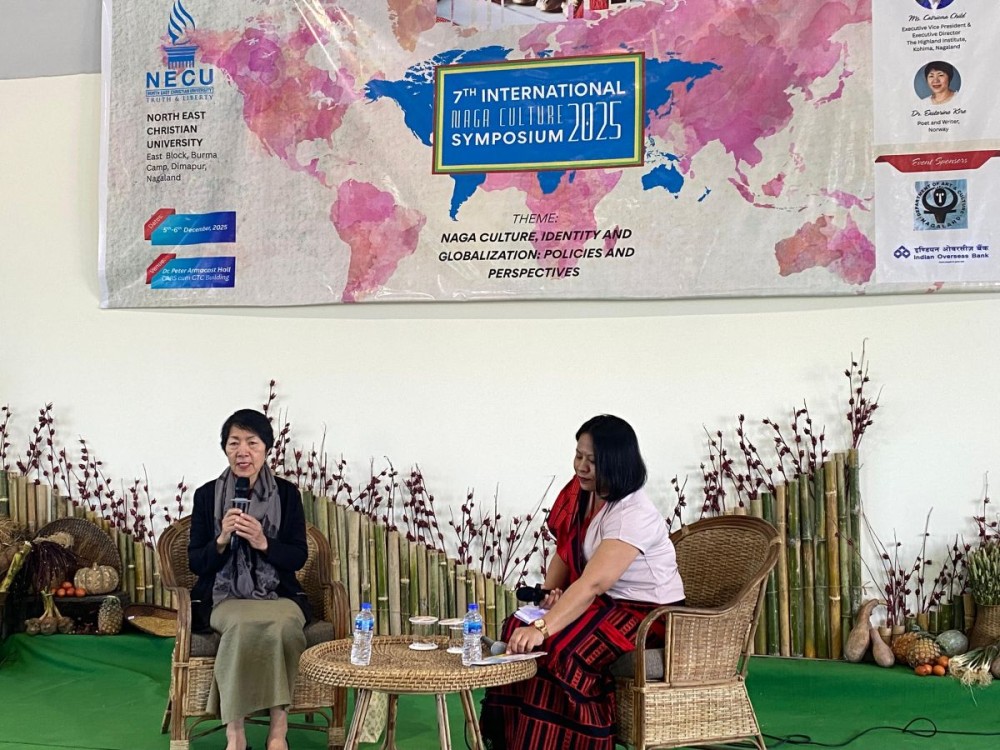
Dr Easterine Kire in conversation with Dr H Salome Kinny during the session on ‘Naga Literature’ at NECU, Dimapur, on December 5. (Morung Photo)
Morung Express News
Dimapur | December 6
Dr Easterine Kire, renowned poet and writer, noted that what the Naga society needs to relook is for quality writing. “I think we should support the writing but not encourage bad writing.” There are a lot of books coming out, but not necessarily all are qualitative, she continued, while observing this as the problem.
Speaking during an interaction with Dr H Salome Kinny at North East Christian University (NECU) Dr Kire’s remarks formed part of a session on ‘Naga Literature,’ held under the 7th International Naga Culture Symposium 2025, which began on December 5. Organised on the theme ‘Naga Culture, Identity and Globalisation: Policies and Perspectives,’ the two-day symposium concluded on December 6.
Acknowledging the surge of young writers in Nagaland, Dr Kire noted that while creativity must be nurtured, quality must remain central to the growth of Naga literature. She put emphasis on the value of thorough editing. “Please use editors. Please edit your work,” she encouraged, adding that editing is now a profession even in Nagaland. While professional editing may be expensive with the rates at one rupee per word, she said it is a necessary investment. “Think of the end result. It is really worth it.”
Speaking on the evolution of Naga literature, Dr Kire underscored the continuity between oral and written traditions. While written Naga literature has developed only in the past 25 years, she observed that the creative impulse remains deeply linked to traditional storytelling. She shared that she has written three books using folktales as a seed. “Every writer is always looking for a seed. It’s easy to go back to our folklore and get seeds from some folktale or something that has happened in the past.”
However, she emphasised that novel writing is not solely about folklore or the past. There is also a significant push toward historical fiction, driven by the need for the “insider’s voice.”
Dr Kire pointed out that for many years, narratives about Nagas were largely authored by non-Nagas. “That’s why we have been trying to bring out the insiders perspective, insider history,” she said. Recounting stories passed down in her own family, such as the aftermath of World War II in Kohima, she underscored the importance of recording experiences that younger generations have not heard of.
Reflecting on her novels ‘Mari’ and ‘A Terrible Matriarchy,’ Dr Kire clarified common misunderstandings. “Many think that Marie is a love story,” she said. “But it’s not a love story, it’s historical.” However, she was happy that because of the love element, it has incidentally helped youngsters as young as 12 year-olds to read the book, allowing them to learn history.
On ‘A Terrible Matriarchy,’ she noted that the story grew out of an unusual character, one that helped her explore social dynamics without suggesting that all Naga families function similarly. “It’s about a unique person and a unique situation,” she said, adding that it was not true for every Naga family. The novel, set in the 1960s and 70s, reflects a period of social change in Kohima, marked by expanding access to education and shifting urban life.
On poetry, drama, & writing process
Addressing the current wave of poetry among young authors, Dr Kire advised patience and restraint. “Anyone who wants to be a writer should leave poetry for the last,” she remarked, describing poetry as “condensed thought” that requires maturity. Young people should write poetry, she added, but “don’t rush to publish it.”
When asked about the limited presence of drama in Naga literature, she said that perhaps time hasn’t come for theatre to fully be established in Nagaland. She viewed the form may simply be awaiting its moment, noting that talent and interest certainly exist among students.
On her own writing process, Dr Kire described herself as a “listener,” often gathering material from everyday conversations and chance encounters. She narrated an incident where she overheard a story about sweet oranges from Wokha, on her way to work. She said that such instances become a seed for a story or a poem. Mood, weather, and environment also influence what she writes. “Sometimes you don’t want to write any prose, maybe a poem will come.”
Teaching Naga literature & challenging stereotypes
Dr Kire also advocated for including Naga literature as a complete subject in schools, when asked by Dr Kinny. Such a move, she said would help students learn history that is often absent from textbooks and counter deeply ingrained stereotypes. Recalling an incident last year where an educated listener asked her about “cannibalism,” she said it revealed how misinformed public perceptions on Nagas can be. “Our children need to know the truth,” she said.