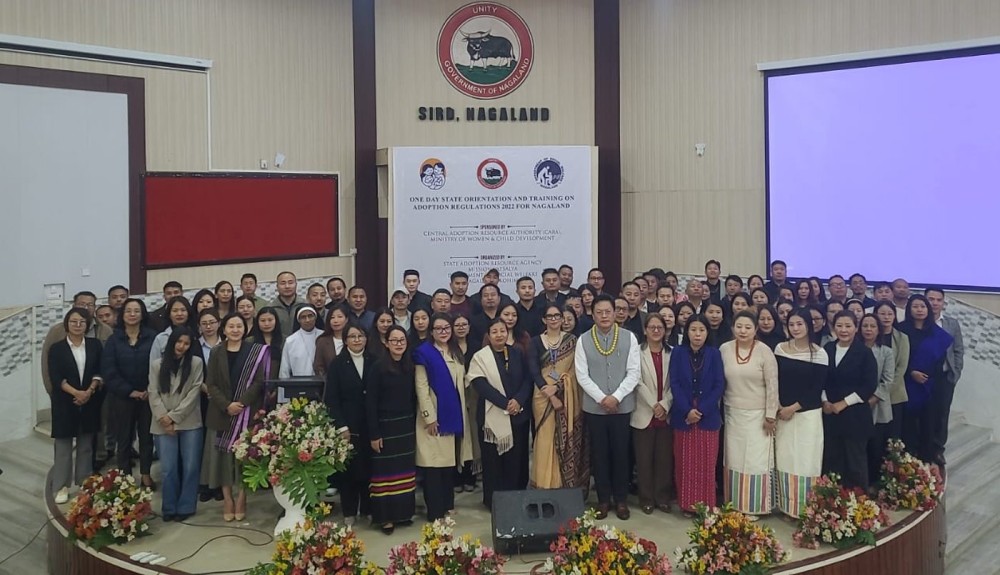
Ritu Rani Bhankur, Limawabang Jamir and Tosheli Zhimomi with participants of state orientation & training on Adoption Regulations 2022 in Kohima on April 9. (Morung Photo)
Our Correspondent
Kohima | April 9
The State Adoption Resource Agency (SARA) on Thursday categorically made the position clear that illegal adoption is a punishable offence and every child deserves a lawful beginning.
This was conveyed during one-day state orientation & training on Adoption Regulations 2022 for Nagaland, organised by SARA, Mission Vatsalya, Department of Social Welfare, Nagaland and sponsored by Central Adoption Resource Authority (CARA) at SIRD Auditorium Hall, Kohima on April 9.
Terming the direct adoption as illegal, SARA stated that taking a child directly from a hospital, nursing home, NGO and private person without a legal adoption order from the concerned authority is considered illegal. “Adoption is an act of love, but the process comes from law,” it stated.
Also stating, “Illegal adoption is considered child trafficking,” SARA stated that legitimate adoption requires registering on the Mission Vatsalya Portal, screening by Specialized Adoption Agency (SAA), and a final order from the Deputy Commissioner.
SARA is a state level monitoring agency under CARA, Ministry of Women & Child Development in order to promote and regulate adoption. Its mandate is to find a loving and caring home for children in need.
Highlighting the Adoption Regulations 2022 at the training programme, Ritu Rani Bhankur, Junior Professional CARA from New Delhi said, “It is important to ensure that every adoption process is done legally, ethically and in the best interest of the child.”
She said that all the stakeholders involved in the adoption process are extremely crucial in giving children a safe and loving family. Stating that the adoption process comes under the law only, Bhandur told the stakeholders to do the process as per the legal framework and guidelines.
‘Contribute to a more responsive adoption system’
Limawabang Jamir, Secretary to the Government of Nagaland, Department of Social Welfare & Mission Director Mission Vatsalya maintained the Adoption Regulations, 2022 as a significant step towards strengthening the child protection and adoption framework in India.
“Adoption is not merely a legal process; it is a compassionate act that transforms lives, giving children the warmth of a loving family and fulfilling the dreams of prospective parents,” Jamir said.
The Adoption Regulations, 2022, introduced under the Juvenile Justice framework, aim to make this process more transparent, efficient, and child-centric.
Stating that the best interest of the child is paramount in every adoption decision, he said “This ensures that every child is placed in a safe, secure, and nurturing environment where their overall development is protected.”
The regulations also emphasises; promoting in-country adoption, giving preference to placing children within their own socio-cultural environment, ensuring transparency and accountability through digital systems and centralized registration, strengthening the role of authorities like District Magistrates to speed up the adoption process and reduce delays and safeguarding children through strict procedures, monitoring, and post adoption follow ups.
These reforms reflect the Government’s commitment to ensuring that every child has the right to grow up in a loving and secure family environment, Jamir said.
Stating that the Government of India has been tirelessly working on accommodating those children in need under its safety net, Jamir encouraged all the stakeholders to gear up and activate themselves and do the needful so that every child gets a loving and stable home.
Asking the stakeholders to collectively contribute to a more responsive and compassionate adoption system, he said “Let us work together to uphold the spirit of care, protection, and hope that adoption represents.”
‘Every child deserves a family’
Tosheli Zhimomi, Director, Social Welfare Department, CEO & Member Secretary SARA pointed that the Adoption Regulations, 2022, framed under the Juvenile Justice Act, aim to simplify, streamline, and strengthen the adoption process in India while ensuring the best interests of the child remain paramount.
She described Adoption Regulations, 2022 as a progressive step towards ensuring the welfare, protection, and rights of children in need of care and a loving family. One of the primary objectives of these regulations is to ensure transparency and accountability in the adoption process, she said.
By digitizing procedures and strengthening monitoring systems, the regulations reduce delays and eliminate irregularities, making the system more trustworthy for prospective adoptive parents,
Zhimomi said. Furthermore, the regulations emphasise inclusivity and accessibility, she said adding that another significant objective is to strengthen the role of authorised agencies and institutions.
The regulations also focus on post-adoption care and monitoring, ensuring that children continue to receive proper care and protection even after they are placed in their new families.
She said that the implementation of Adoption Regulation in Nagaland is “being carried out judiciously.” Over the years, we have been able to find loving families for hundreds of Children in Need of Care and Protection (specifically the- orphans, abandoned, surrendered and destitute), she said.
In April 2025 to March 2026 itself, 11 Children in Need of Care and Protection have been adopted. The Adoption Regulations, 2022 promote awareness and encouragement of legal adoption, discouraging illegal practices and ensuring that every adoption is conducted lawfully and ethically. These regulations are a major step forward in building a child-centric adoption system in India, one that safeguards children’s rights, supports families, and strengthens collective commitment to giving every child the love and security they deserve, she said. “Let us all work together to spread awareness, support adoption, and contribute towards a society where no child grows up without a family,” Zhimomi said.
Earlier, Sekho Dawhuo DCPO Kohima and Kekuolhuno Nakhro, programme officer SARA chaired the programme while vote of thanks was proposed by Raitale Zeliang, Programme Manager SCPS.