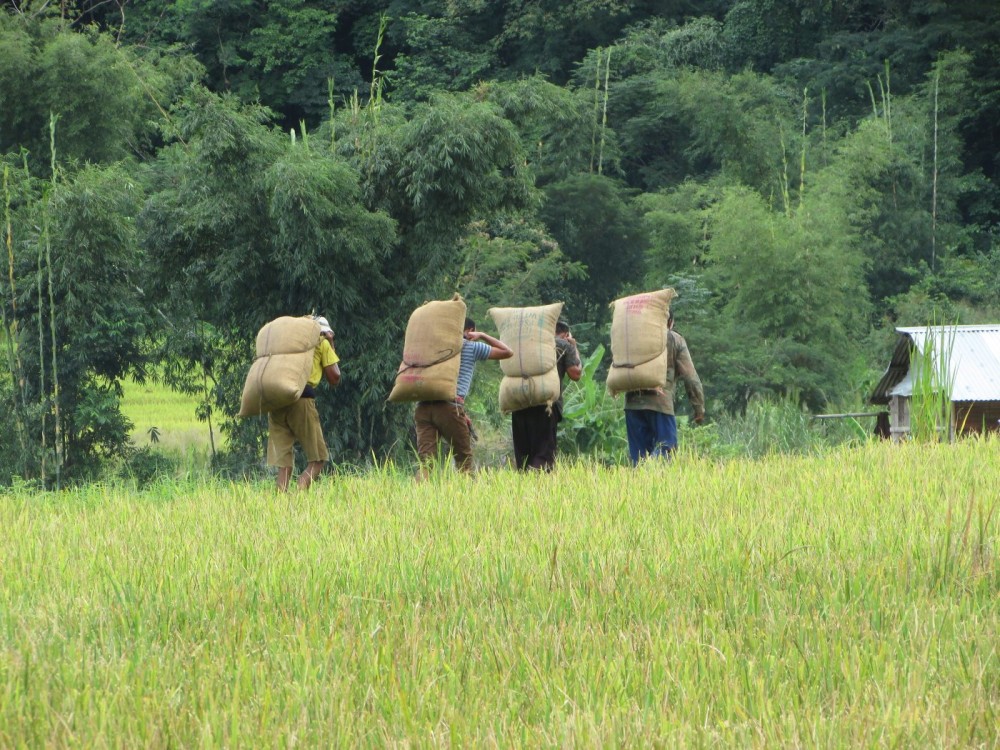
Farmers carry harvested produce in sacks across a field in Nagaland, where agriculture sustains nearly 70% of the population. The Nagaland Agriculture Policy 2025 flags climate change as a growing threat to rain-fed farming and underscores climate-smart, resilient practices to safeguard the sector. (Morung File Photo)
Our Correspondent
Kohima| April 19
Climate change, according to the Nagaland Agriculture Policy (NAP) 2025, ‘threatened’ the State’s rain-fed agriculture, adversely affecting food security and livelihoods.
Thus, “Climate-Smart Agriculture” was identified as Strategic Goal 4 of the NAP, aimed at building a climate-resilient agricultural sector through sustainable practices, climate-resilient technologies, and empowered farmers. This also involved prioritising the integration of traditional knowledge with innovation, interdepartmental collaboration, and the needs of vulnerable communities, it stated.
“This contributes to a sustainable and prosperous agricultural sector in Nagaland, safeguarding food security and enhancing environmental sustainability,” stated the NAP 2025, prepared by the Department of Agriculture and tabled during the 8th session of the 14th Nagaland Legislative Assembly (NLA) in Kohima
Agriculture is central to Nagaland's identity, culture, and economy, with approximately 70% of the population relying on it for their livelihoods and the sector contributing significantly to the Gross State Domestic Product, it added.
Enhancing climate-resilient crops
Among others, for enhancing climate-resilient crops, the NAP proposed integrating a disaster risk reduction strategy to address extreme weather events such as floods, droughts, and landslides through early warning systems, contingency planning, and climate-resilient infrastructure.
It sought to promote climate-resilient crops and practices by accelerating the adoption of drought-resistant, flood-tolerant, and pest-resistant varieties, while encouraging agroforestry, conservation agriculture, and integrated farming systems to enhance resilience and sustainability.
Through sustainable intensification and diversification, the policy emphasised improving productivity, optimising resource use, and reducing climate-related risks. This included promoting integrated farming systems, agroecological practices, and climate-smart livestock management.
Strengthening adaptation
Another goal of the policy was to enhance farmers’ resilience and adaptive capacities. This could be achieved through improved access to climate information and advisory services, the promotion of climate-resilient farming practices and technologies, strengthened climate risk management and contingency planning, and capacity-building through training and institutional support, it noted.
The policy stated that these measures would align with Nagaland’s State Action Plan on Climate Change (SAPCC).
District-specific approach
The policy further emphasised integrating disaster risk reduction strategies to address extreme weather events such as floods, droughts, and landslides, alongside promoting climate-resilient crops and practices, including drought-resistant varieties and agroforestry.
It also highlighted the efficient and sustainable use of agricultural inputs to minimise environmental impact. This included soil health-based nutrient management, integrated pest management, sustainable farm mechanisation, and ensuring access to quality inputs.
The NAP also envisaged introducing a district-specific Climate-Smart Agriculture (CSA) approach with localised early warning systems for extreme weather events. It also proposed developing micro-irrigation initiatives prioritised for jhum transition zones and integrating drought- and flood-resistant crop varieties into existing crop-zoning frameworks.
Other strategic goals and policy commitment
Apart from “Climate-Smart Agriculture,” the NAP 2025 outlined eight additional strategic goals, representing key priority areas for action and providing a framework for developing specific programmes, initiatives, and targets of the Government of Nagaland.
These included enhancing productivity, natural resource management, sustainable agriculture, sustainable input management, infrastructure and market development, knowledge, technology and innovation systems, digitalisation, and finance and crop insurance.
These goals were interconnected and mutually reinforcing, recognising that progress in one area would contribute to advancements in others, it noted.
As part of its policy commitment, the NAP stated that an “Implementation Plan Document” would be developed based on a phased implementation approach intended to provide a structured roadmap for translating the policy into action, ensuring timely and measurable outcomes.
Under the phased approach, Phase I (1–3 years) would prioritise institutional strengthening and pilot projects; Phase II (4–6 years) would focus on scaling up successful models; and Phase III (7+ years) would aim for the full-scale adoption of sustainable, market-driven, and climate-resilient agricultural practices.
The implementation strategy, the NAP held, would be aligned with the vision of Viksit Bharat 2047, focusing on resilient, market-oriented, and ecologically sound agricultural practices that empower farmers and promote inclusive growth.
The successful implementation of these strategic goals would require a concerted effort from all stakeholders to build a resilient and sustainable agricultural sector in Nagaland, it added.