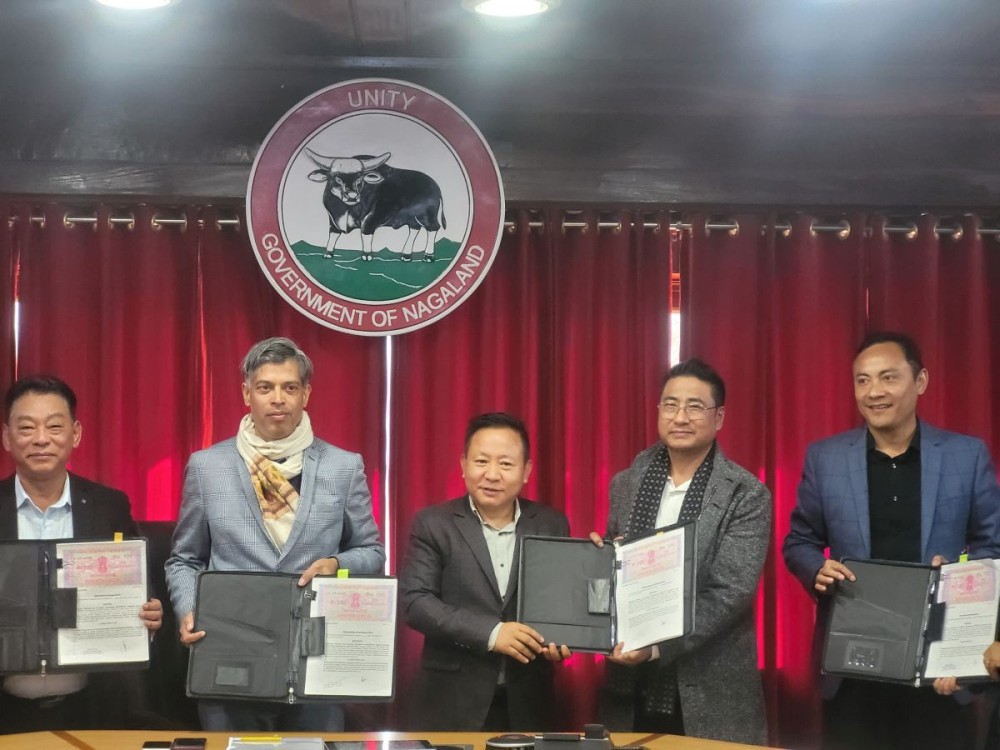
Dignitaries during the signing of MoA with Department of Land Resources and NEPED in Kohima on December 18. (Morung Photo)
Rs 575-crore World Bank-supported project to cover 225 villages across 16 districts of the state
Our Correspondent
Kohima | December 18
The Government of Nagaland has signed Memorandums of Agreement (MoAs) with two key state departments for a major World Bank-funded climate resilience project, marking a significant push for sustainable agriculture and water security in the state’s hill ecosystems.
The agreements, signed on December 18 with the Department of Land Resources (DoLR) and Nagaland Empowerment of People through Economic Development (NEPED) under the ELEMENT Project, implemented through the Society for Climate Resilient Agriculture in Nagaland (SoCRAN).
The total project cost stands at Rs 574.63 crore, which will cover 225 villages in 16 districts in Nagaland.
The MoAs was signed by Hekato N, Additional Director, DoLR, Kovi Meyase, Team Leader NePED and ELEMENT Project officials in the presence V Shashant Shekhar, Additional Chief Secretary & Agriculture Production Commissioner and Mission Director ELEMENT, Dr G Hukugha Sema, Commissioners & Secretary for land resources, Nagaland, agriculture department officials and others.
The ELEMENT Project aims to restore degraded landscapes, build climate resilience, and improve livelihoods across 225 villages in 16 districts of the State over a five-year period ending in 2030.
Under the MoA, DoLR has been designated as the State Technical Partner for Springshed Development and Coffee Development.
The initial engagement is for one year, with provision for annual renewal based on performance, which will be reviewed biannually by the State Project Management Unit (SPMU).
A part of this partnership, DoLR will provide comprehensive technical support, including resource mapping, spatial analysis, preparation of Detailed Technical Reports (DTRs), implementation planning, monitoring, and capacity building.
Key intervention will focus on spring rejuvenation, sustainable coffee plantation planning, and installation of Customized Automatic Weather Stations (CAWS).
Hydrological and climate data generated under the project will be integrated into the ELEMENT Decision Support System (DSS) and ERP platforms to support informed planning and decision-making.
At the village level, project activities will be implemented through Village Management Committees (VMCs) with support from Project Facilitating Agencies (PFAs) and Zonal Management Units (ZMUs), under the technical guidance of DoLR.
Community members and village animators will be trained to ensure local ownership, sustainability, and long-term impact.
The ELEMENT Project–SPMU will oversee coordination, approvals, procurement, monitoring, and compliance with World Bank fiduciary and environmental and social safeguard requirements. All data and outputs generated under this collaboration will remain the property of the Government of Nagaland and the ELEMENT Project.
This partnership marks a significant step toward sustainable water security, climate-resilient agriculture, and livelihood enhancement in Nagaland’s hill ecosystems.
Strengthens climate-resilient livelihoods
Another MoA was signed with NePED to strengthen climate-resilient livelihoods and sustainable development across 225 villages in 16 districts.
As part of this initiative, the NEPED through its Centre of Excellence for Renewable Energy Studies (CERES) has been engaged as a state technical partner for research, innovation, and technology development.
The partnership will run for 18 months, with scope for extension based on performance.
The collaboration focuses on designing, fabricating, and deploying low-energy, indigenous technologies tailored to Nagaland’s hill ecosystems. These include zero-energy cold storage systems, hybrid dryers, micro-hydro units, sustainable waste-management solutions, and low-energy agricultural machinery, aimed at reducing post-harvest losses, improving rural incomes, and enhancing climate resilience.
A key component of the initiative is the revival and strengthening of CERES as a state-owned hub for research and development, fabrication, skills training, and enterprise incubation. Local youth, Self-Help Groups (SHGs), and village institutions will be trained to adopt and manage these technologies, ensuring community ownership and long-term sustainability.
The technologies will be piloted, scientifically validated, and scaled up through community institutions and local entrepreneurs, contributing to livelihood diversification, value-chain strengthening, and environmentally sustainable practices.
All activities will follow World Bank environmental and social safeguards.
Through this initiative, the ELEMENT Project aims to build community confidence, promote innovation rooted in local knowledge, and position Nagaland as a leader in climate-smart, people-centred development.