

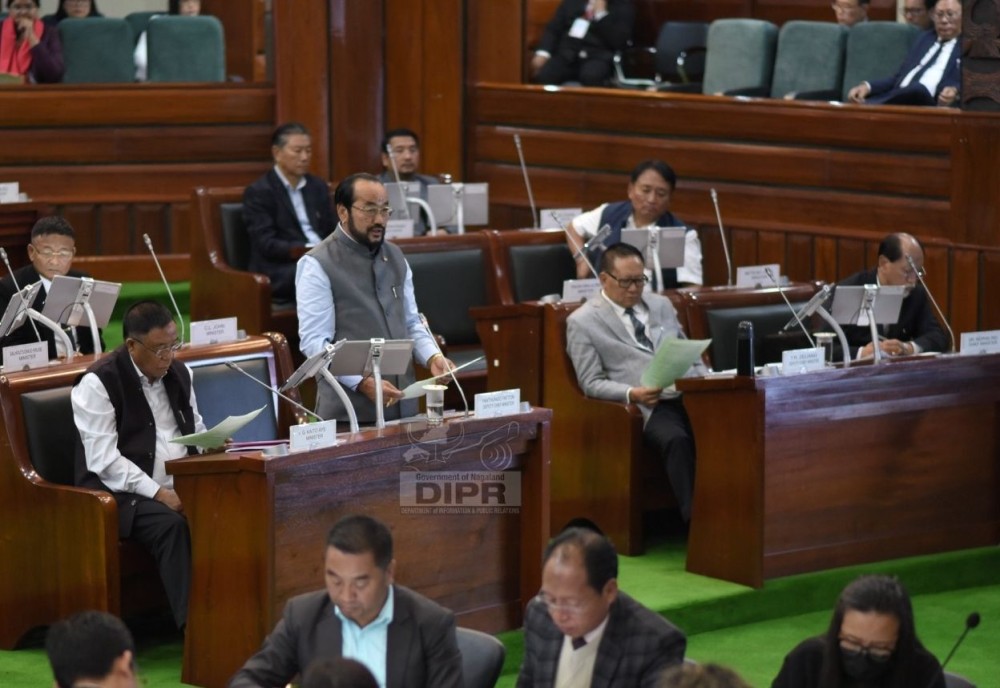
Deputy Chief Minister, Y Patton (DIPR Photo)
Our Correspondent
Kohima | March 27
Nagaland Jan Vishwas (Amendment of Provisions) Bill, 2026, which was introduced on March 26 by Deputy Chief Minister Y Patton, was also passed on the floor of the House on March 27.
This Bill aims to promote a culture of voluntary compliance based on trust rather than fear of prosecution, while retaining stringent penal provisions for serious offences affecting public order, health, safety, or revenue.
In a statement of objects and reasons, it stated that the Government of Nagaland is committed to fostering a governance ecosystem that is transparent, trust-based, citizen-centric, and facilitative of economic growth. In recent years, both at the Union and State levels, there has been a conscious shift from a regime of excessive criminalisation and procedural rigidity towards one that emphasizes compliance through trust, technology, and proportional accountability.
Several existing State enactments administered by various Departments contain provisions that criminalise minor, technical, or procedural lapses.
Such provisions, though originally intended to ensure compliance, often result in avoidable litigation, administrative burden, and hardship to citizens, entrepreneurs, small businesses, and community institutions, without necessarily improving regulatory outcomes.
The Nagaland Jan Vishwas Bill sought to review and rationalise such provisions across identified State laws by: decriminalising minor and technical offences that do not involve moral turpitude, public safety, environmental damage, or financial fraud, substituting criminal penalties with civil penalties, compounding mechanisms, and administrative adjudication, introducing graded and proportionate monetary penalties linked to the nature and gravity of the default, enabling digital compliance, transparent processes, and time-bound adjudication and reducing regulatory uncertainty and improving ease of doing business in the State.
“The Bill does not dilute regulatory oversight. Instead, it modernises enforcement architecture by introducing administrative adjudication mechanisms, appellate safeguards, and transparent penalty structures consistent with principles of natural justice,” the statement stated adding that the legislation is aligned with the broader objective of promoting good governance, responsive administration, and sustainable economic development in Nagaland.
