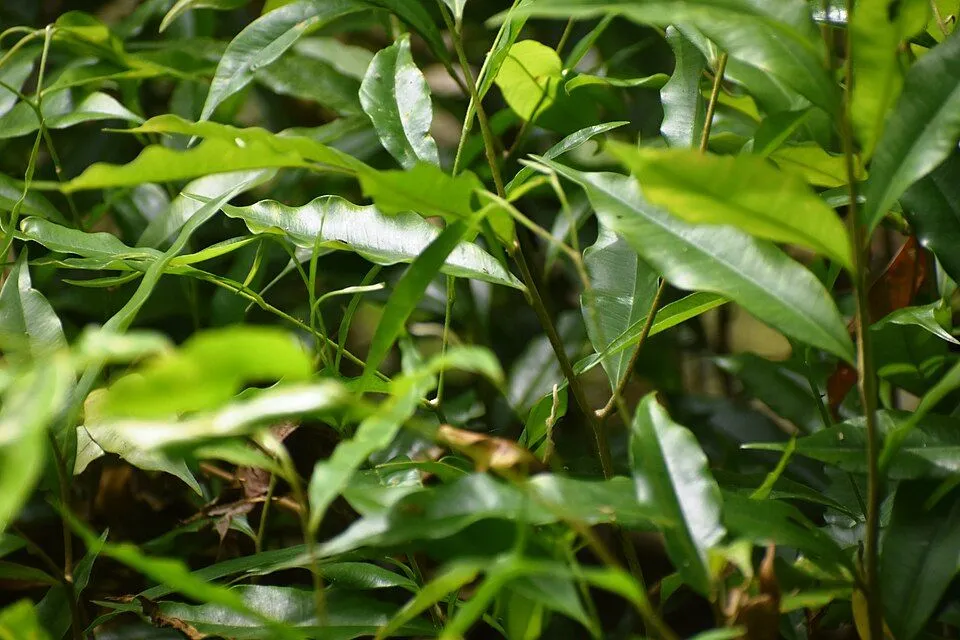
Agarwood (Aquilaria malaccensis) sapling in Jorhat Assam. (Photo Courtesy: Bhuyan Bhaskar via Wikimedia Commons)
• Banks on turning conservation into source of commercial opportunity
• Seeks to formalise trade, unlock market potential
Kohima, November 19 (MExN): The Department of Environment, Forests and Climate Change (DoEFCC) has notified the implementation of the Nagaland Agarwood (Conservation and Promotion) Policy, 2026, seeking to promote scientific cultivation, conservation, processing and trade of Agarwood as an alternative livelihood opportunity for farmers and a means to strengthen the State’s forest-based industries.
The policy envisaged the creation of around 500 hectares of Agarwood plantations annually over the next 10 years, alongside resource mapping, development of regional nurseries, plantation of saplings in degraded forest areas and promotion of cultivation on community and individual lands.
It also seeks to facilitate the registration of Agarwood plantations, regulate harvesting and transit, promote processing units and establish market linkages to improve returns for local growers and traders, according to the State DIPR.
Economic potential and conservation concerns
The policy identified Agarwood, scientifically known as Aquilaria malaccensis, as an opportunity to generate better economic returns, quality employment and boost forest-based industries in Nagaland.
In its preamble, the DoEFCC noted that, with over 70% of its population residing in rural areas, the State remains predominantly agrarian, with agriculture and allied sectors forming a major part of its economy.
The policy noted that over 75% of farmers practised jhum, which met around 60% of the State’s food demand.
However, climate change and shorter fallow periods had reduced the traditional jhum cycle from 12–14 years to 8–10 years, contributing to ecosystem degradation and soil nutrient loss.
The policy also cites an estimated loss of over 264 sq km of forest cover in Nagaland over the preceding four years, placing the State among the five States with the largest decrease in forest cover, according to the India State of Forest Report (ISFR), 2023.
Against this backdrop, the policy identified Agarwood as a potential agroforestry option, contending that its evergreen nature and relatively short rotation period of 10–15 years are considered suitable for jhum areas and compatible with organic farming systems.
It also highlighted Agarwood’s global demand for its medicinal, incense and perfumery properties, with the wood traded in raw form, as chips and as oil.
The policy estimated the value of the Agarwood market in India at over Rs 21,664 crore (approximately USD 2.4 billion), highlighting its potential for employment and livelihood generation. The North-East was identified as key region for tapping this potential through scientific cultivation and regulated trade.
However, it maintained that illegal harvesting and trade have resulted in the species being listed as critically endangered in the wild under the Convention on International Trade in Endangered Species of Wild Fauna and Flora (CITES), making its trade and products subject to strict regulation.
Broad objectives
The policy outlined eight broad objectives, including conservation and augmentation of Agarwood resources through suitable agroforestry models to improve farmers’ livelihoods.
It proposed comprehensive resource mapping to establish the status and quality of Agarwood in natural forests and plantations, while prescribing conservation measures to protect populations in their natural habitats.
Another key objective is to build awareness and technical capacity among farmers and other stakeholders in scientific cultivation, harvesting, post-harvest processing and marketing. The policy also seeks to facilitate the registration of Agarwood trees and plantations to maintain a comprehensive database, ensure legal compliance and support scientific harvesting and value addition.
It further envisaged testing and certification to ensure product quality, the development of national and international market linkages, and an appropriate royalty schedule to secure better returns for growers and traders while generating reasonable revenue for the State.
The objectives also include reviewing existing felling and transit rules to ensure compatibility with regulations in neighbouring States and at national and international levels, integrating Agarwood initiatives with existing departmental schemes, and establishing partnerships with government and non-government agencies, research institutions and neighbouring States such as Assam and Tripura.
Resource mapping and conservation strategy
The policy identifies natural Agarwood distribution in Nagaland's foothills and relatively warm areas, with concentrations in Tzurang Valley, Japfukong, Tuli, Sitap, Tamlu, Oting, Upper Tiru, Lower Tiru, Tizit, Athibung and Beisumpui.
These areas are also noted for superior-quality Agarwood with natural infection. However, unscientific extraction and habitat loss due to jhum cultivation have contributed to the decline of natural Agarwood stands, it noted.
To address this, the policy proposed a comprehensive assessment of Agarwood resources in natural forests and plantations, including their quality and availability.
The DoEFCC will undertake these studies in association with institutions such as the Rain Forest Research Institute (RFRI), Jorhat, the Botanical Survey of India and Nagaland University. Suitable areas for scientific cultivation will also be identified based on geo-climatic conditions and the requirements of the species.
The assessment will cover the availability of suitable land, quality planting material, technical expertise, processing facilities, market access and working capital. Findings are to be published and used to formulate conservation and promotion activities.
The policy also envisages protecting forests with abundant natural Agarwood stands, developing nurseries to supply quality planting material, planting saplings in degraded forest areas and encouraging cultivation on community and private lands.
It further proposes studying and adapting successful conservation and promotion models from other parts of the country, particularly neighbouring Northeastern States, and examining technological innovations in plantation management, post-harvest processing and marketing.
Key interventions
To translate these strategies into action, the policy identifies five major areas of intervention combining plantation development, regulatory measures, capacity building and institutional coordination.
Firstly, the Department will assess farmers’ requirements and facilitate access to quality Agarwood seedlings through the identification of suitable strains, mass multiplication and establishment of regional nurseries. Planting material may also be sourced from certified agencies where necessary.
It will also identify suitable cultivation areas and promote quality plantations, with a target of around 500 hectares annually over the next 10 years. Artificial inoculation of trees will be facilitated in areas where natural infection falls below expected levels.
The third intervention is framing rules and guidelines for plantation registration, harvesting, processing and transit of Agarwood and its products. Processing of marketable products, particularly Agarwood chips and oil, will be encouraged through technological and financial support, institutional linkages and market connections.
The Department will also design training and capacity-building programmes for farmers, extension workers and departmental personnel, focusing on scientific cultivation, plantation management, artificial inoculation and post-harvest processing, particularly for farmers cultivating Agarwood on private land.
The final intervention envisaged coordination with government and non-government agencies at the State, national and international levels to access technology, expertise, finance and markets, while adapting suitable practices in cultivation, harvesting, processing and marketing.
Expected outcomes
The policy envisages that conservation of natural Agarwood stands will help rejuvenate populations of the critically endangered species and contribute to ecological sustainability.
Promoting cultivation on degraded lands as well as community and individual holdings is expected to strengthen the rural economy, generate employment and provide better livelihood opportunities.
The DoEFCC, in coordination with other agencies and stakeholders, will prepare and implement the necessary schemes and interventions to achieve the policy objectives.
The policy thus seeks to link conservation with economic development by encouraging regulated and scientific cultivation and trade, while reducing pressure on natural forest resources.